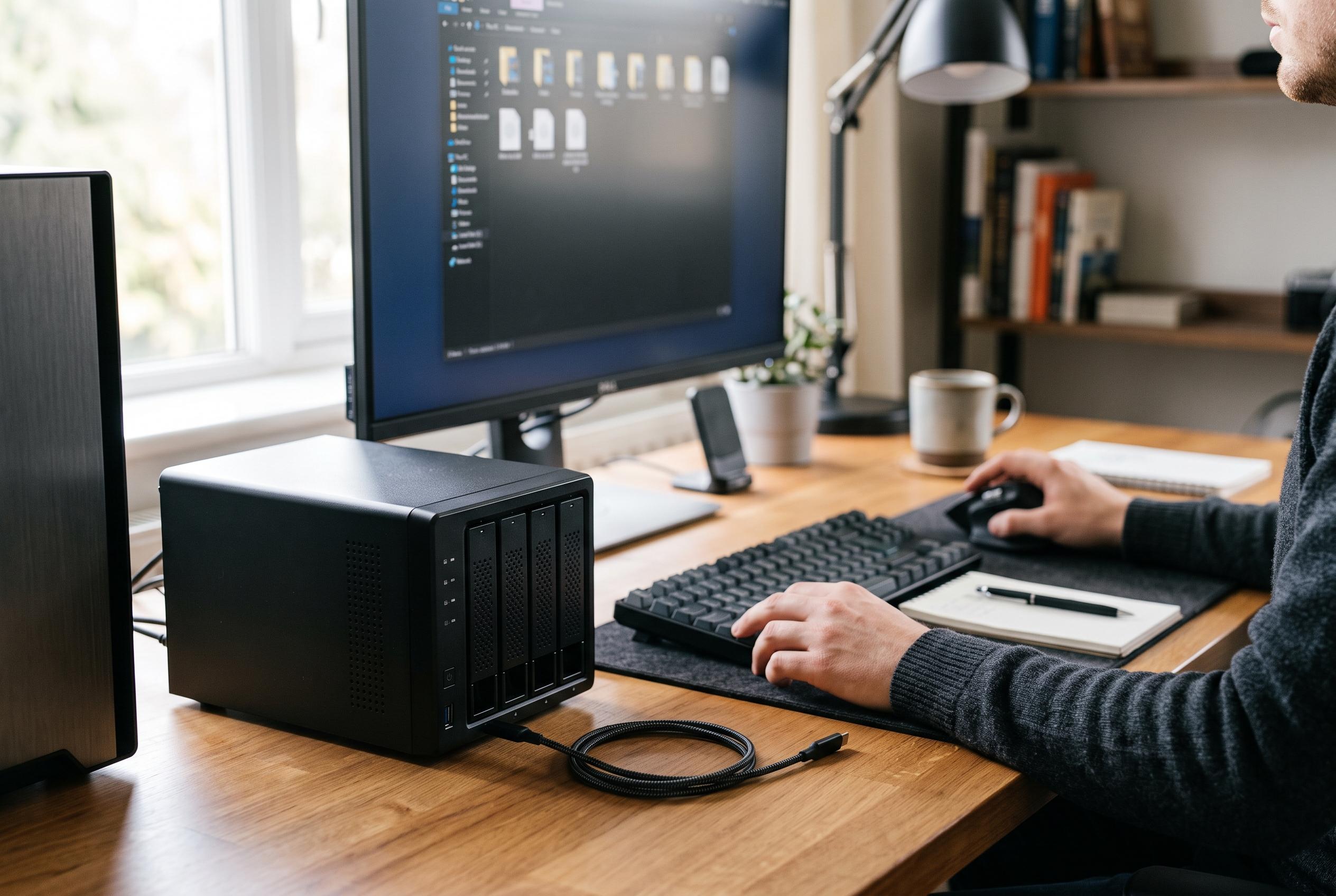

The four-bay USB-C enclosure targets users who already have an always-on computer and want to expand local storage without paying for a complete NAS.
TerraMaster has launched the D4-321, a four-bay direct-attached storage unit priced at 999 yuan, as the market for consumer hard drives continues to tighten. The timing matters. With drive prices still under pressure and many NAS buyers facing higher storage costs, a lower-cost enclosure gives owners of spare disks a practical alternative to buying a full network-attached system. According to the company’s announcement and coverage by Chinese tech sites, the D4-321 is aimed at users who already have a computer or small host that stays on for most of the day.
The hardware is straightforward. TerraMaster says the D4-321 provides four hot-swappable 3.5-inch SATA bays, Push-lock tool-free installation, a USB-C 10Gbps connection and an internal low-noise FDB bearing fan rated for more than 50,000 hours. The company also says the unit supports disk hibernation and includes power management intended to reduce the risk of damage during outages. Reported compatibility spans common desktop and server environments, including Windows, macOS, Linux, Proxmox, TrueNAS and Unraid, along with file systems such as NTFS, APFS, EXT4, FAT32 and exFAT.
The launch has also revived a familiar debate in storage communities: whether a DAS enclosure can stand in for a NAS. Discussion on Zhihu reflected a view common among many users that a network storage box makes sense for households that need always-on services, remote access, shared libraries, photo back-up and container workloads, while a direct-attached enclosure is more suitable when the main need is simply to keep large files close to one machine. That distinction is important because a DAS does not bring its own software stack. It depends on the host computer for file sharing, automation and remote access.
Some users are already building hybrid setups around that limitation. A Xiaohongshu post described a home configuration using a small N200-based mini PC with a TerraMaster enclosure, splitting solid-state and mechanical storage between the two devices to balance quiet operation, low power draw and expansion room. That kind of arrangement is attractive to people who already keep a host online and want inexpensive bays for older drives. It is also why the D4-321 is being read not as a replacement for a NAS, but as a cheaper storage layer for a system that already has the “brain” elsewhere.
There is, however, a clear trade-off. Community warnings about hardware RAID in disk enclosures remain relevant, with users citing weak fault tolerance, poor compatibility across mixed drives and opaque failure behaviour when things go wrong. For that reason, many experienced users prefer JBOD with software RAID, or no RAID at all when the disks are simply being used as separate volumes. In practical terms, the D4-321 looks best suited to local editing media, cold archives and backup targets. Anyone who wants household sharing, app hosting or remote access may still be better served by a full NAS, even at a higher starting cost.
TerraMaster’s own social media post positions the D4-321 as a compact four-bay enclosure for users who want higher-capacity local storage without moving into a full NAS product line. That is a narrower proposition than an all-in-one network box, but also a cheaper one. In a market where new hard drives are getting more expensive and old drives are often left unused, that may be enough to give direct-attached storage a fresh audience.
Disclaimer: This content is intended for informational purposes only. Readers are advised to exercise their own judgement, conduct due diligence, or consult a qualified expert before acting on any information provided.