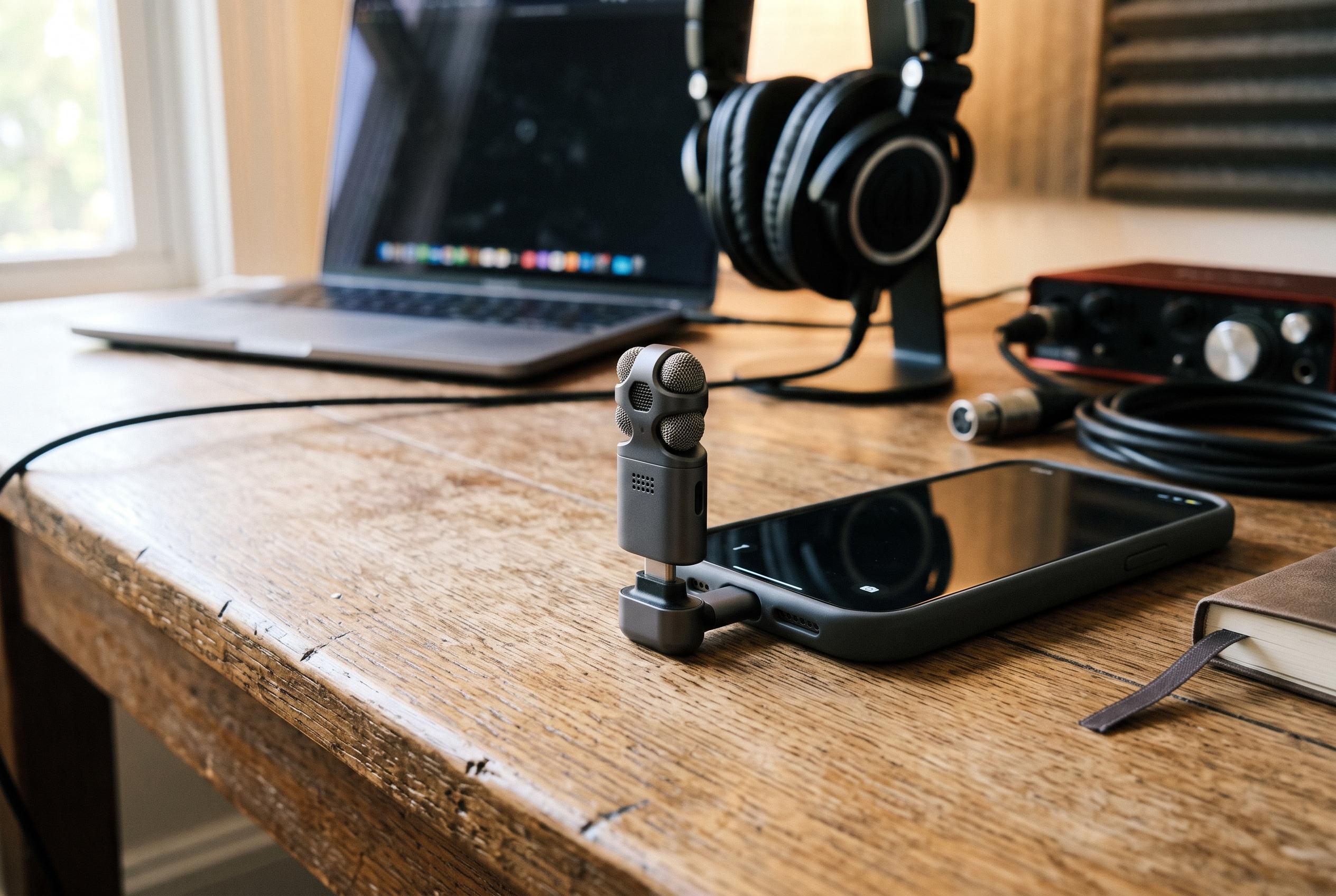

Sony’s 24g USB-C microphone uses four omnidirectional capsules to record ambisonic, binaural or stereo sound, offering creators a compact alternative to dedicated spatial-audio equipment.
Sony has introduced the ECM-AX10, a USB-C microphone that turns a smartphone into a compact spatial-audio capture rig and, according to the company, is the first microphone to receive Eclipsa Audio certification. The device is aimed at vloggers, mobile filmmakers and other creators who want to record and edit immersive sound without carrying a separate recorder or moving footage to a computer. Sony says it is available in Germany now for €199, with a US price of $249.99, and it is due to go on sale in Japan on 23 October 2026.
At the centre of the design is a spherical microphone module with four omnidirectional capsules. Sony says this arrangement is intended to capture not only the subject in front of the lens, but also the wider acoustic environment around it. The company offers three recording modes: Ambisonics for full spatial capture, binaural for headphone playback, and stereo for more conventional use. Sony’s own press material says the binaural and stereo modes work with standard camera and recording apps, while Ambisonics requires its dedicated workflow.
The Eclipsa Audio label matters because it ties the microphone to a new open spatial-audio format developed by Google and Samsung through the Alliance for Open Media, based on the royalty-free IAMF specification. YouTube has supported uploads in the format since 2025, and Samsung’s latest televisions and soundbars can decode it. In practical terms, the certification means the ECM-AX10’s output is designed to meet the format’s encoding and compatibility requirements, although playback support still depends on the destination platform. That is why Sony itself presents binaural mode as the more immediately useful option for many creators.
Sony says the microphone is meant to support a phone-only workflow through its Spatial Audio Video Tool app, which can handle recording, simple editing and export of finished clips with spatial sound. The company says the app will be available for both iOS and Android, but 4K recording will not arrive until December 2026. Until then, creators who need Ultra HD video will have to use another recording path or accept a lower resolution. The microphone is also compact, weighing about 24 grams, and Sony says it ships with a windscreen, a 40-centimetre USB-C extension cable and a hot-shoe mount for positioning away from the handset.
The hardware includes a selfie-mode switch that automatically adjusts the sound direction for front- or rear-facing shooting, a built-in accelerometer for portrait and landscape orientation, attenuation settings of 0, 10 and 20 dB, noise reduction and a 3.5mm output for live monitoring. Sony also says the ECM-AX10 was developed with its post-production arm, Sony PCL, which helped tune the sound character. Even so, the company’s claims remain largely self-assessed for now: independent listening tests are still needed, and the product is entering a small but potentially interesting niche between traditional lavalier microphones, which remain better for speech, and more ambitious spatial-audio tools aimed at ambience, travel and event recording.
Disclaimer: This content is intended for informational purposes only. Readers are advised to exercise their own judgement, conduct due diligence, or consult a qualified expert before acting on any information provided.