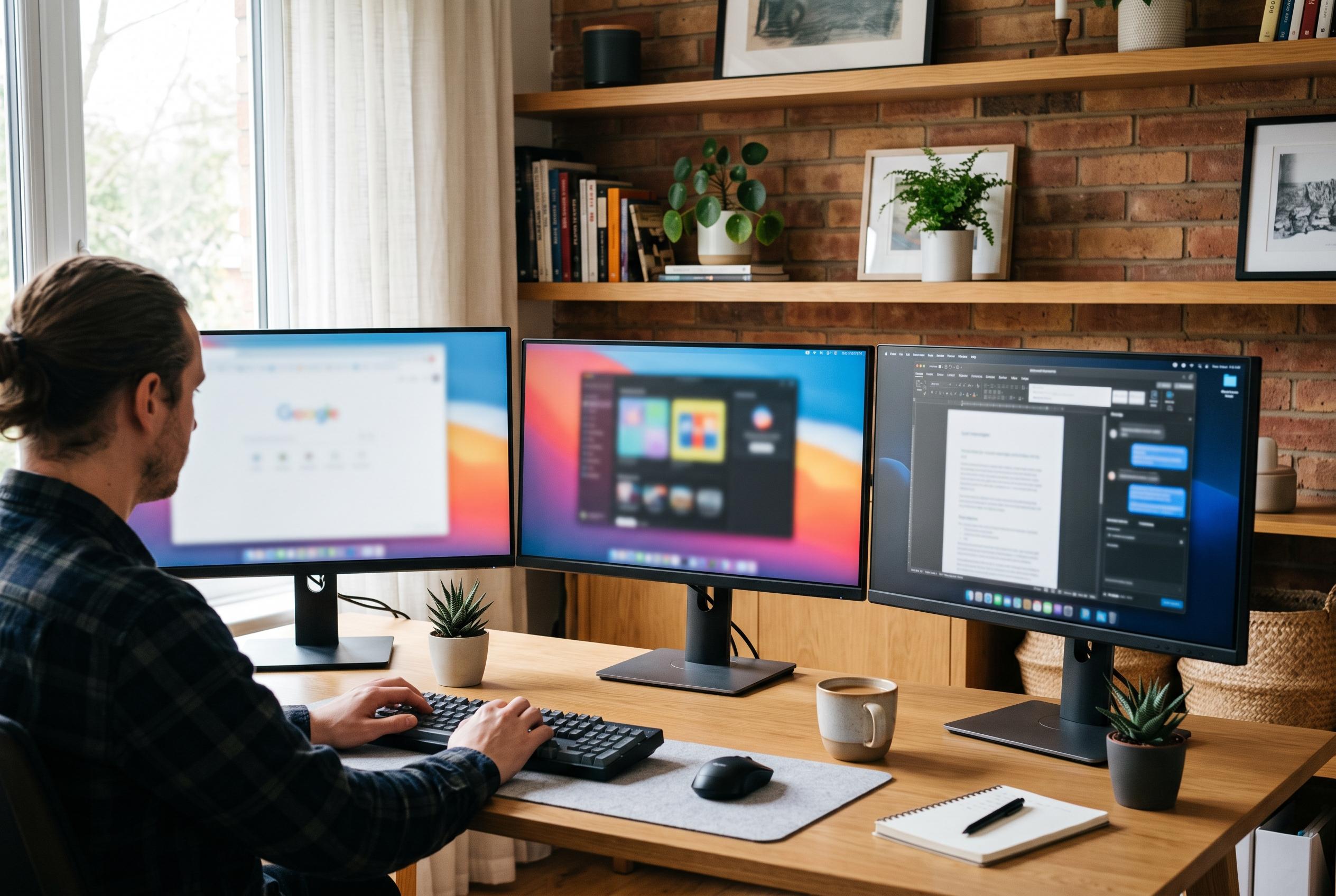

Sub-€400 monitor buyers can now choose between fast QHD IPS panels, high-contrast Mini-LED and ultrawide displays, with entry-level OLED models increasingly joining the competition.
Buying a PC monitor on a limited budget is less about finding a single best screen than matching the panel to the job. Frandroid’s guide on monitors under €400 reflects a market where decent 27-inch QHD models, ultrawide displays and even entry-level OLEDs now sit within reach. That is a meaningful shift: PC Gamer’s October 2026 deal coverage also shows how fast prices can move, with budget gaming monitors, 4K models and ultrawides appearing at sharply lower prices than was once common.
For a balanced all-round choice, Frandroid points to the Lenovo Legion 27Q-10 in its IPS version as a particularly strong value pick. The 27-inch 1440p panel is described as well suited to both work and play, with wide viewing angles, a 240 Hz refresh rate over DisplayPort, and support for AMD FreeSync Premium and Nvidia G-Sync. That makes it an easy recommendation for users who want smooth motion without paying OLED money, although Frandroid notes that contrast remains typical of IPS rather than exceptional. PC Gamer’s current budget-monitor coverage is consistent with that logic, treating high refresh rates and sensible panel technology as the main factors to watch in the affordable gaming segment.
At the top end of the under-€400 bracket, OLED is no longer entirely out of reach. Frandroid highlights Samsung’s Odyssey OLED G6, a 27-inch QD-OLED monitor with 1440p resolution, 240 Hz refresh, HDR10+ support and a rapid 0.03 ms response time. The trade-off is predictable: lower sustained brightness than LCD rivals, a restricted port selection and the usual need to think about burn-in management. PC Gamer’s separate coverage of low-cost OLED monitors, including an AOC model discounted to around $300 and an Acer Predator OLED priced just under $400, shows that this technology is becoming more accessible, even if the best-value offers can still fluctuate sharply by retailer and region.
For users who prefer contrast over speed, Frandroid makes a strong case for the TCL 27G64 and the Philips Evnia 34M2C3500L. The TCL uses Mini-LED backlighting with 180 local dimming zones, a 27-inch QHD VA panel and 180 Hz refresh, giving it higher brightness and stronger HDR potential than a conventional LCD at this price, even if black smearing and haloing remain visible in darker scenes. The Philips, by contrast, is aimed at people who want an ultrawide desktop: its 34-inch curved VA panel in 3440 x 1440 delivers deep blacks and good immersion, though the stand is basic and motion artefacts can still appear. PC Gamer’s October 2026 list similarly shows that ultrawide monitors and fast VA panels are now realistic budget options, with several models sitting well under the $300 mark.
Frandroid’s budget-buying advice is also clear on the basics. IPS remains the safest choice for general use because it balances colour accuracy and viewing angles; VA is preferable if deeper blacks matter more than perfect uniformity; TN is largely obsolete; and OLED offers the best image quality if the budget can stretch. For most 24-inch displays, Full HD is still sufficient, while 27-inch panels increasingly make more sense at 1440p. The publication also stresses that DisplayPort is the preferred connection for high refresh-rate PC use, with HDMI better suited to consoles, and that FreeSync and G-Sync now deliver broadly similar results on many affordable screens. In practice, the best choice under €400 is less about chasing the highest specification and more about choosing the right compromise for work, films or fast-paced games.
Disclaimer: This content is intended for informational purposes only. Readers are advised to exercise their own judgement, conduct due diligence, or consult a qualified expert before acting on any information provided.