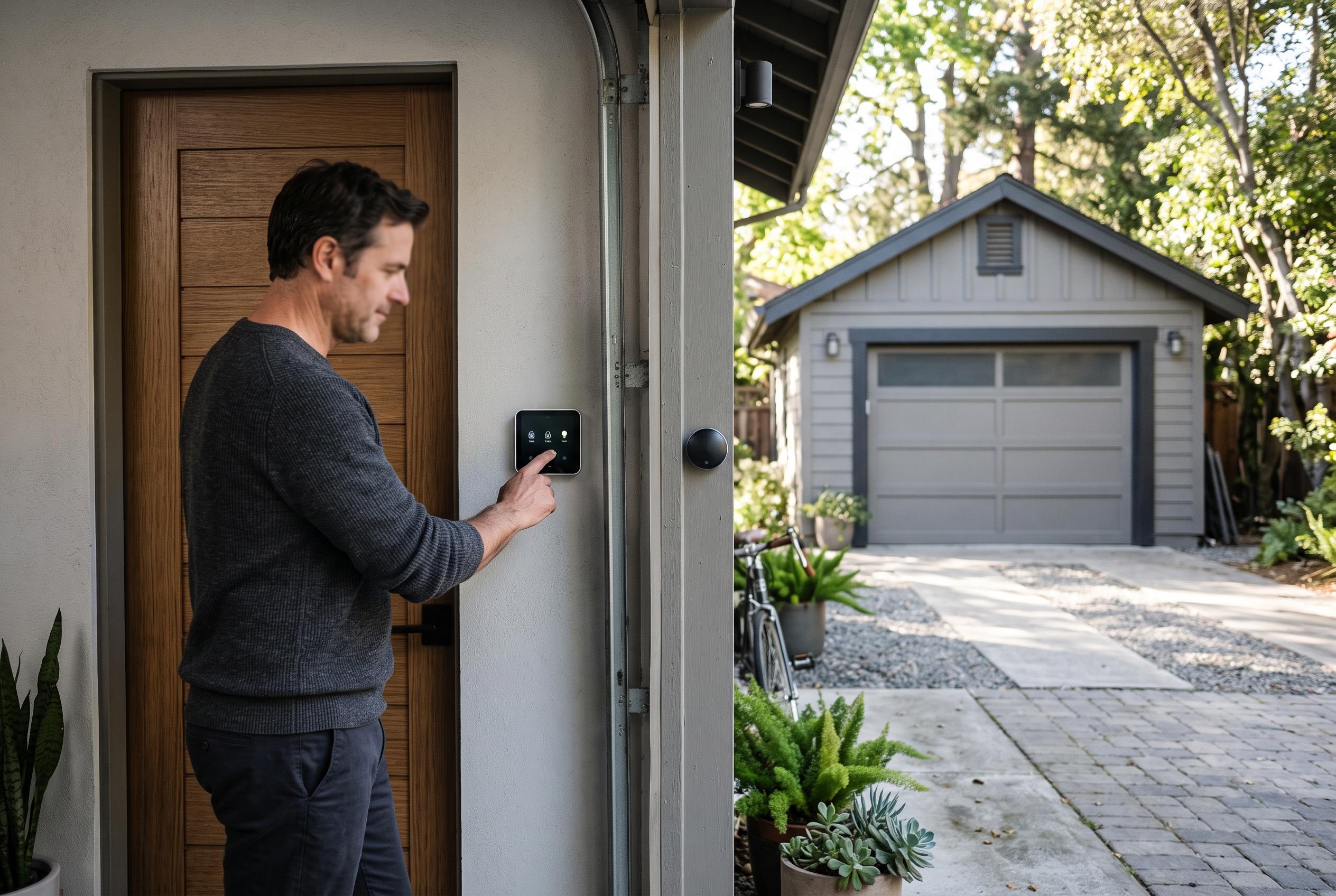

Dedicated controllers remain the simplest choice, but relay-and-sensor systems are becoming the more flexible option for multi-door homes, detached garages and open smart-home hubs.
Z-Wave garage door control has become a practical way to add remote access without replacing an otherwise working opener. The appeal is straightforward: local control, better reach to detached garages than 2.4 GHz Wi-Fi in many homes, and automation that keeps working if the internet drops. As the guide notes, the market is split between dedicated garage controllers and relay-based setups, and the distinction matters because most products sold for this job do not combine control and position sensing in one unit.
For readers who want the simplest path, the most complete option remains the GoControl GD00Z-8-GC. Product pages from GoControl resellers say it includes a tilt sensor, uses S2 security, works with most sectional door openers and provides both audible and visual warnings before the door moves. That warning is important because it is part of the safety approach expected for unattended closing. The guide also points out that this category is unusually narrow: purpose-built Z-Wave garage controllers are rare, and the GD00Z-8-GC is the main widely sold new model in that class.
For more flexible installations, relay-based products now dominate the discussion. The guide identifies the Zooz ZEN16 800LR as the strongest choice for multi-door homes, because it offers three relays in one module and can take wired inputs for door sensors. Its two-door sibling, the ZEN17 800LR, is better suited to smaller systems where independent inputs matter. Both are aimed at open ecosystems such as Home Assistant and Hubitat, rather than closed alarm-panel environments, and both rely on the installer to build the garage-door logic from a relay plus a separate sensor.
That sensor choice is where many installations succeed or fail. The guide argues that tilt sensors remain the most dependable approach for sectional doors, because they report position from the movement of the top panel rather than from a narrow magnet gap. Ecolink’s Garage Door Tilt Sensor Plus and the older TILT-ZWAVE2.5-ECO are both presented as proven options with long battery life and broad hub support. For users who want a wired reed switch, Aeotec’s Door/Window Sensor 7 Pro is notable because it accepts an external dry contact, while Aeotec’s Sensor 8 adds tilt, vibration and environmental readings for garages that also need temperature and humidity monitoring.
Long Range support is now another major buying factor. The guide highlights 800 Series devices such as the Zooz ZEN58, Shelly Wave 1 US LR and Zooz ZSE41, all of which are better suited to detached garages or gates that sit at the edge of a Z-Wave mesh. Shelly’s relay is presented as a strong long-distance option for a single opener, while the ZEN58 is positioned as a compact budget relay for one door. In commercial or workshop settings, the Shelly Wave Pro 2 US LR stands out because it mounts on DIN rail and can control two channels from a professional enclosure.
The practical conclusion is that the best Z-Wave garage door setup depends less on the badge on the box and more on the opener, the hub and the building layout. A security-panel user is still best served by a dedicated controller such as the GoControl unit, whereas an open-hub user with multiple doors is likely to prefer a Zooz relay and separate sensor hardware. For a detached garage, Long Range support may matter more than brand. And for any remote closing routine, the core safety rule remains the same: confirm the door’s true position before automation, and do not rely on a relay alone to know whether the door is open or shut.
Disclaimer: This content is intended for informational purposes only. Readers are advised to exercise their own judgement, conduct due diligence, or consult a qualified expert before acting on any information provided.