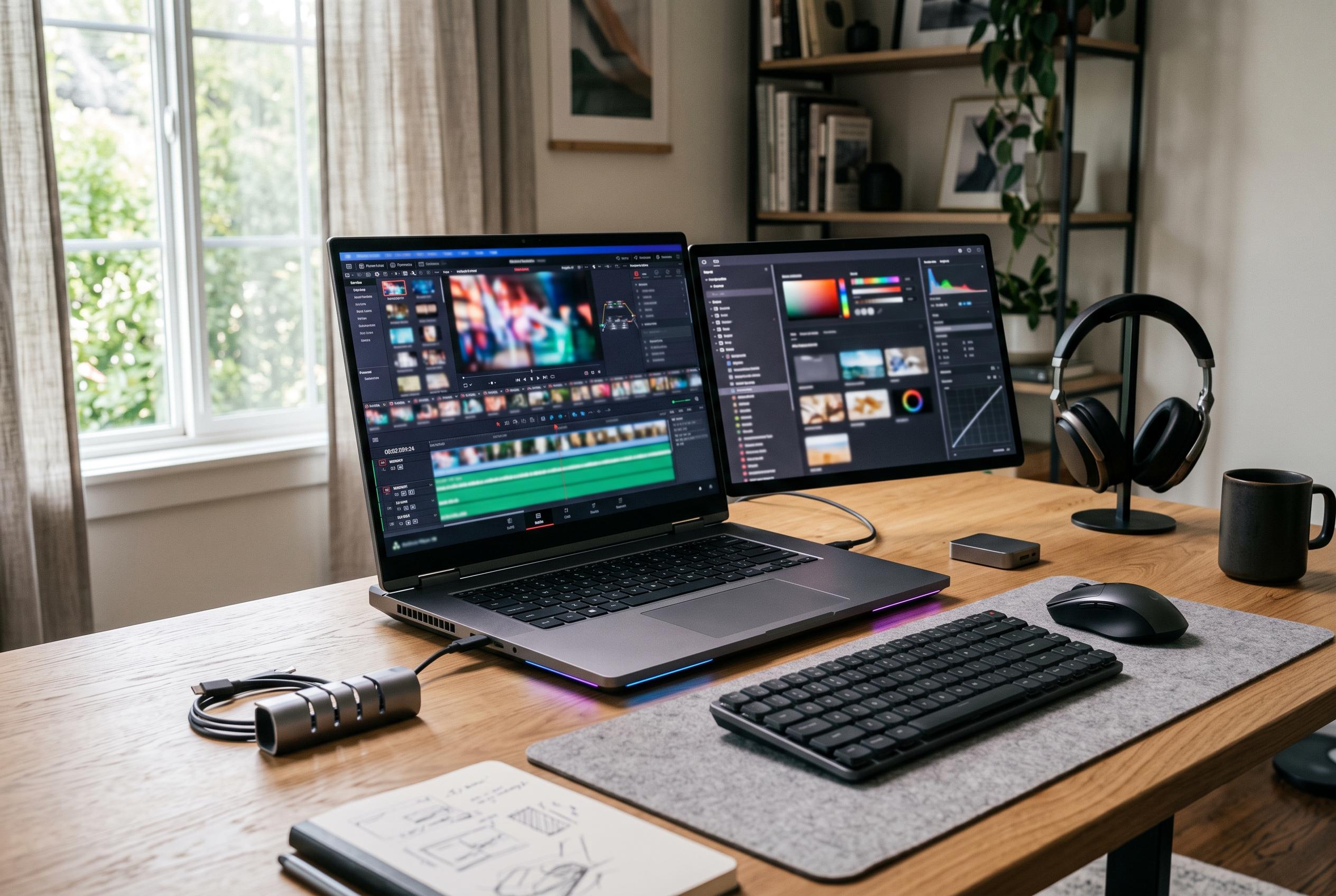

With two 16-inch OLED displays, flagship hardware and a price aimed at wealthy enthusiasts, ASUS’s ROG Zephyrus Duo GX651 is a powerful but highly specialised portable workstation.
ASUS has built one of the most unusual premium laptops on the market with the ROG Zephyrus Duo GX651, a dual-screen machine that is as much a portable workstation as it is a gaming system. The concept is easy to admire and harder to justify. At a price that mobile-review estimates at more than 600,000 roubles for the reviewed configuration, it is aimed at a very narrow audience: wealthy enthusiasts, creators, streamers and professionals who will actually exploit the second display rather than simply be impressed by it.
That positioning matters because ASUS is not presenting the Duo as an indulgence. In the company’s own framing, this is a hybrid device for gaming, coding, editing and content production, and it arrives as ROG marks its 20th anniversary. The marketing line is blunt: “DUO IT ALL”. The product is also part of ASUS’s broader Zephyrus philosophy, which has long tried to combine slim chassis design with high-end performance. Here, that idea is pushed further than ever, with two 16-inch OLED panels, a 1.99cm chassis and a weight of 2.82kg.
The industrial design is restrained rather than flashy. The chassis is milled from aluminium and finished in a single colour, Stellar Grey. ASUS has added Slash Lighting across the lid, but the effect remains measured. The more important work is structural. A dual-stage hinge with a torsion spring keeps the machine steady whether it is opened normally or tilted into one of its five working positions. Those modes are the real reason the Duo exists: a standard laptop layout, a dual-screen desktop arrangement, a mirrored sharing mode for meetings, a portrait-style book mode and a tent mode for two-person use.
The keyboard has had to change completely to make that possible. It is a detachable Bluetooth unit, only 5.1mm thick, yet it still offers 1.7mm of travel and a 140Hz polling rate. Mobile-review says the deck is finished in a premium fabric-like material that resists skin oils, while the keys use an excimer coating intended to improve durability and reduce visible wear. The touchpad is far larger than before, which is necessary when the machine is being used to control two 16-inch displays. ASUS has also placed the power button on the right edge, which makes sense for users running the notebook closed with an external monitor, or stood upright on its rear support.
The display system is the centrepiece. Both panels are 16-inch OLED screens with a 3K resolution of 2,880 x 1,800, a 120Hz refresh rate and 16:10 aspect ratio. ASUS says they are part of its ROG Nebula HDR range, with 100% DCI-P3 coverage, Pantone validation, G-SYNC support and a peak HDR brightness of 1,100 nits. Mobile-review also highlights the anti-reflective coating and stylus support. More unusually, ASUS and Samsung have pushed the refresh behaviour of the OLED panels to reduce flicker, while the company’s Nebula HDR engine and OLED care software are meant to handle brightness, tone mapping and burn-in protection across both screens.
Under the bonnet, the reviewed model uses Intel’s Core Ultra 9 386H processor with an integrated NPU rated at up to 50 TOPS, which places the machine in the Copilot+ PC category. It is paired with an NVIDIA GeForce RTX 5090 Laptop GPU with 24GB of GDDR7 memory and a quoted graphics power ceiling of 150W, plus 64GB of LPDDR5X-8533 memory and a 1TB PCIe 5.0 SSD. ASUS says the machine also supports Wi-Fi 7, Bluetooth 6.0, Thunderbolt 4, HDMI 2.1 FRL and a microSD UHS-II reader. The battery is rated at 90Wh, while the bundled power adapter is listed at 300W.
In practice, the machine behaves like a mobile workstation that is being held in check by physics. Mobile-review’s stress testing suggests the processor can briefly surge well above its long-term limits, but sustained heavy load pulls it back to much lower power levels to protect the thin chassis. The same pattern appears on the graphics side: the RTX 5090 Laptop is extremely fast, but it is still a mobile part. That distinction matters. In raw gaming tests, the Duo can push modern titles hard, yet the numbers are not those of a full desktop replacement. The strongest results come when the machine is allowed to lean on upscaling and frame-generation technologies rather than running everything natively at maximum settings.
Cooling is therefore central to the design. ASUS uses liquid metal and a vapour chamber, and the review says the system can keep temperatures under control even when the fans have to spin aggressively. In everyday use, however, the Duo is meant to be quiet and efficient. ASUS says the lower screen can be switched off, the discrete GPU can be disabled and the laptop can rely on integrated graphics for lighter work, which is how the machine is expected to stretch battery life to around seven to nine hours in modest productivity use. With both displays active, that figure drops sharply.
The conclusion is straightforward. The Zephyrus Duo GX651 is technically impressive and unusually well considered for a product this ambitious. It is also unapologetically niche. For most buyers, it will be too expensive and too specialised to make sense. For a much smaller group of users, though, it offers something genuinely distinctive: a portable dual-screen platform that can be used for gaming, coding, editing and heavy multitasking without feeling like a novelty object. That is its real achievement.
Disclaimer: This content is intended for informational purposes only. Readers are advised to exercise their own judgement, conduct due diligence, or consult a qualified expert before acting on any information provided.