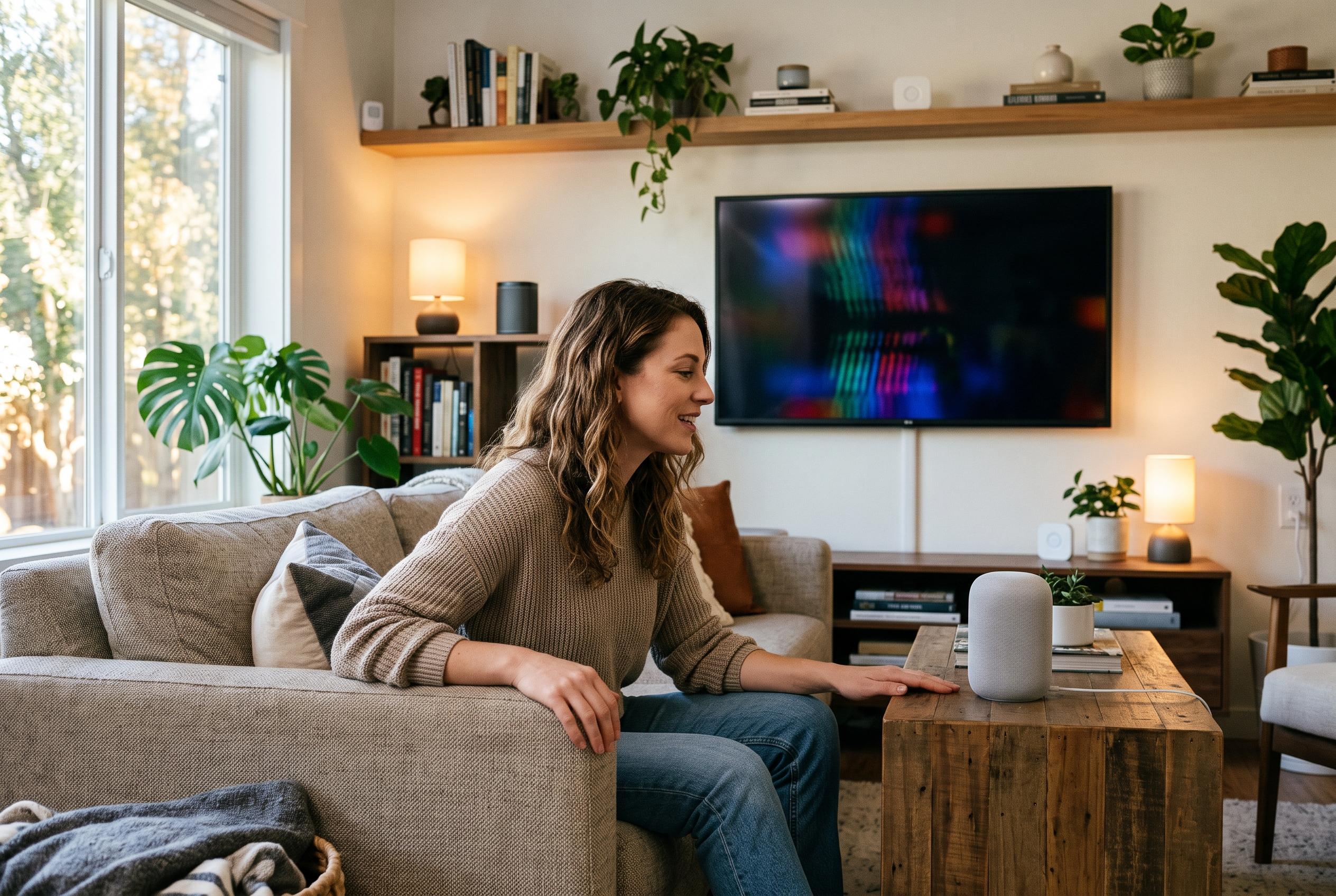

Apple has launched HomeView, updated HomePod mini and Apple TV 4K devices, plus a new range of connected-home accessories, as it seeks to make Siri the control centre of its hardware ecosystem.
Apple has moved sharply deeper into the connected-home market with a broad set of product launches that centre on a rebuilt version of Siri. The company has unveiled a new smart display called HomeView, a second-generation HomePod mini, a fourth-generation Apple TV 4K and a new Apple Home Collection of accessories made with LG Electronics and Schneider Electric. Taken together, the releases suggest Apple is trying to turn the home into a more integrated extension of its device ecosystem, while also catching up with rivals that have been stronger in smart-home hardware for years.
HomeView is the clearest sign of that strategy. Apple says the 7-inch display is designed as a shared household device that can still serve personalised content to individual users. It recognises up to six people by face, then presents each one with their own apps, widgets and relevant information. Apple says private material such as messages and calendar entries only appears when the recognised user’s paired iPhone or iPad is nearby and recently unlocked, while shared photo albums and music remain visible to everyone in the home. The device starts at $299 and comes in silver, starlight, rose pink and space grey, with a wall-mounted version also priced at $299 but requiring a separate Schneider Home mount. Pre-orders began in the US, Canada, the UK, Australia, India and New Zealand, with availability from 13 November. Apple says it will not sell HomeView in the EU for now because Siri AI is not yet available there.
The smart display also reflects how central Apple now considers its updated assistant. Across the new home products, Siri AI is the common thread. Apple describes it as a rebuilt Siri based on its latest Foundation Models, with broader knowledge, more natural conversation and the ability to use personal context when paired with an Apple Intelligence-capable iPhone or iPad. Users without such a device can still access general knowledge and conversational features, but personal requests depend on a linked device. That distinction matters, because it means some of the most useful functions remain tied to Apple’s wider hardware stack.
The new HomePod mini keeps the familiar small spherical shape, but Apple says it now uses an S10 chip and improved computational audio. The company is positioning it not just as a speaker, but as part of a more capable home system. Four units can be paired with the new Apple TV 4K for a surround-sound setup, provided they are arranged in matching front-and-rear pairs. The speaker can also act as a Mac speaker, serve as a home hub and support features such as Sound Recognition for smoke and carbon monoxide alarms, as well as visitor announcements from compatible doorbells. It costs $149 and is available in pink, green, blue, white and midnight. Pre-orders opened in the US and more than 23 other markets, with shipping beginning on 30 October.
Apple’s updated Apple TV 4K is being presented less as a streaming box than as another voice-controlled home hub. The new model adds Siri AI to the television interface, allowing users to search for content, ask follow-up questions during playback and, with a paired iPhone, make requests that draw on personal context. Apple says responses to in-viewer questions appear in a small overlay instead of taking over the whole screen. The box is powered by an A19 chip, which Apple says delivers up to 50 per cent faster CPU performance and up to twice the GPU performance of the previous version, and it adds a dedicated AV1 decoder. A new Siri Remote includes Find My with Precision Finding, while the box itself now has three built-in far-field microphones so users can speak to Siri without reaching for the remote. Apple says the device will cost $299 and be available from 13 November.
The most commercially ambitious part of the announcement is the Apple Home Collection, a line of smart-home hardware developed with LG and Schneider Electric. Apple says each product can be set up with an iPhone tap, controlled entirely through the Home app and used without a separate account or companion app. The range includes four cameras, all of which record up to 2.5K video, identify people, pets, vehicles and packages, and store 10 days of history through iCloud+ without a separate camera subscription. The Video Doorbell Wired costs $249.95, the Floodlight Cam $399.95, the Outdoor Cam Plug-In $299.95 and the Indoor Cam Plug-In $199.95. Apple also plans a smart deadbolt lock for the US and Canada, priced at $349.95, which uses Ultra Wideband to unlock automatically as a user approaches with a home key on iPhone or Apple Watch. The collection also includes thermostats and temperature and humidity sensors, though Apple has not yet disclosed prices for those products. The line will arrive in December, with some accessories shipping only in early 2027, and Apple Retail will offer paid professional installation in the US through ADT.
Disclaimer: This content is intended for informational purposes only. Readers are advised to exercise their own judgement, conduct due diligence, or consult a qualified expert before acting on any information provided.