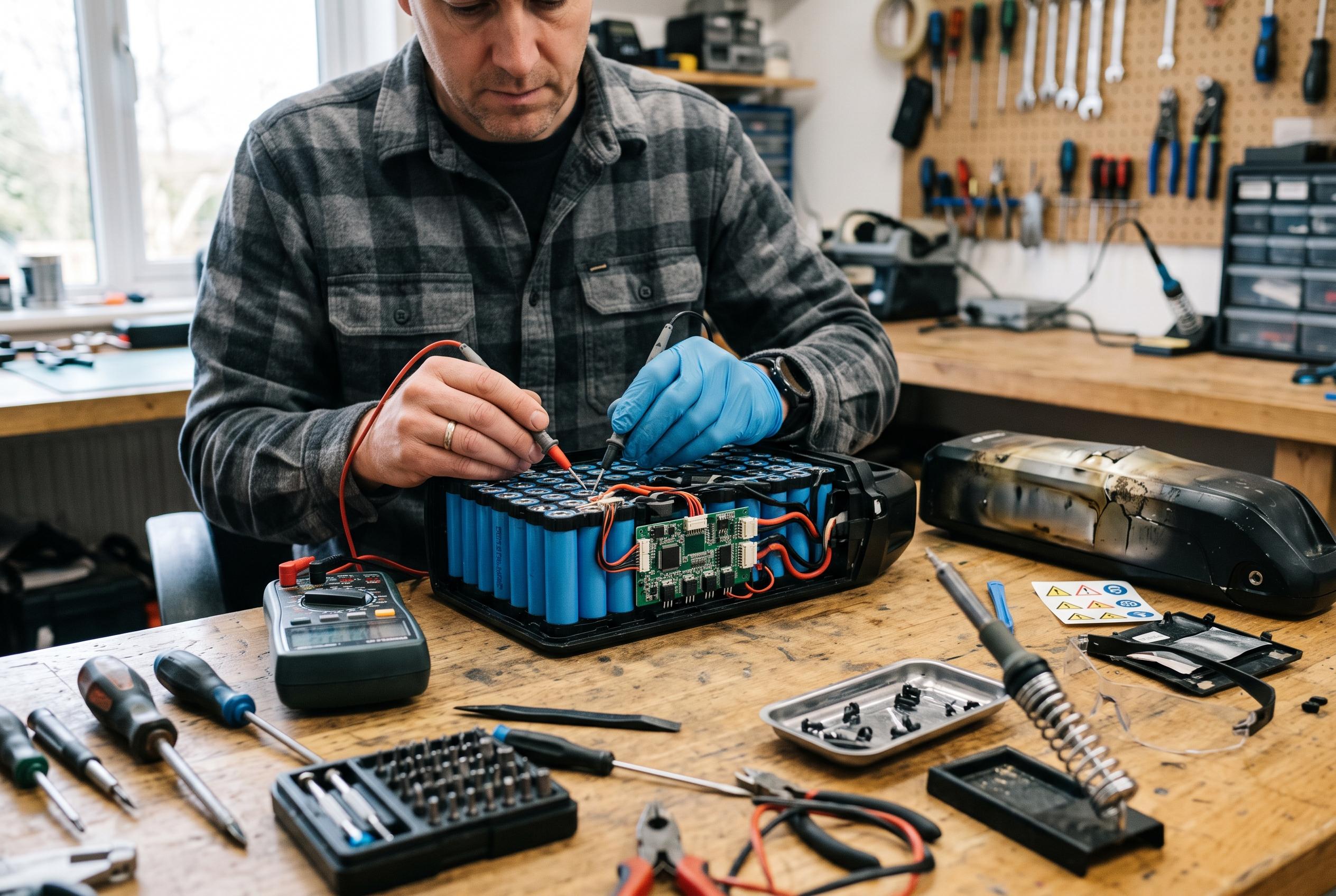

Faults in chargers, fuses and battery management systems can mimic cell failure, but swollen, crushed or overheated packs should be replaced rather than rebuilt.
E-bike battery faults are not always terminal, but they do require careful diagnosis. In many cases, the problem lies in a charger, fuse, connector, or battery management system rather than the cell pack itself. Where the cells have simply aged, professional rebuilding can sometimes restore performance at lower cost than a full replacement. Where the pack has swollen, been crushed, flooded, or overheated, replacement is the safer option.
Lithium-ion batteries do not fail in one uniform way. A pack may appear dead because its cells have degraded with age, because the management electronics have cut output, or because the charger is not delivering the correct voltage. A broken charge port, corroded pins or a blown internal fuse can also mimic a much more serious failure. That is why the first step is usually external testing rather than opening the casing.
The battery management system, or BMS, is the control unit that protects the pack from overcharging, deep discharge, excess current and overheating. When a battery will not charge or deliver power, a failed BMS can look very similar to worn-out cells. In some cases, a specialist can replace the BMS or recell the pack by fitting new matched lithium-ion cells inside the original housing. This is most practical on standard, non-proprietary batteries. It is far less straightforward on tightly integrated systems from major brands, where encrypted firmware and custom housings can make a rebuild impractical.
Cost is one of the main reasons riders consider repair. A minor fix such as a connector, fuse or port may be relatively inexpensive. A full recell is still often cheaper than a brand-new OEM battery, particularly for older or discontinued models. The trade-off is safety and warranty. A replacement from the manufacturer normally offers the cleanest compatibility and the least risk, while an independent rebuild depends heavily on the technician’s equipment, testing and cell quality.
DIY repair is strongly discouraged except for the simplest external checks. Lithium-ion packs store enough energy to cause severe burns, fire or toxic smoke if they are short-circuited. Spot-welding cells, soldering directly to battery terminals or trying to defeat BMS protections at home introduces a serious hazard. Even when a battery is not visibly damaged, an amateur repair can create faults that only emerge later under load.
For that reason, the safest practical routine is straightforward: test the charger first, inspect the fuse and connector contacts, and then consult a reputable battery specialist if the fault appears to be inside the pack. Warning signs such as sudden range loss, rapid voltage drop, long charging times, swelling, unusual heat or a chemical smell usually mean the battery needs professional attention. If the pack shows crushing, fire damage or severe water intrusion, it should be retired rather than repaired.
The wider lesson is that battery care matters as much as motor power or frame design. Riders can extend service life by avoiding deep discharges, keeping the pack within a moderate charge range, storing it in a cool dry place and using the correct charger. Good habits will not prevent every fault, but they can delay costly work and reduce the chance of a premature failure.
Disclaimer: This content is intended for informational purposes only. Readers are advised to exercise their own judgement, conduct due diligence, or consult a qualified expert before acting on any information provided.