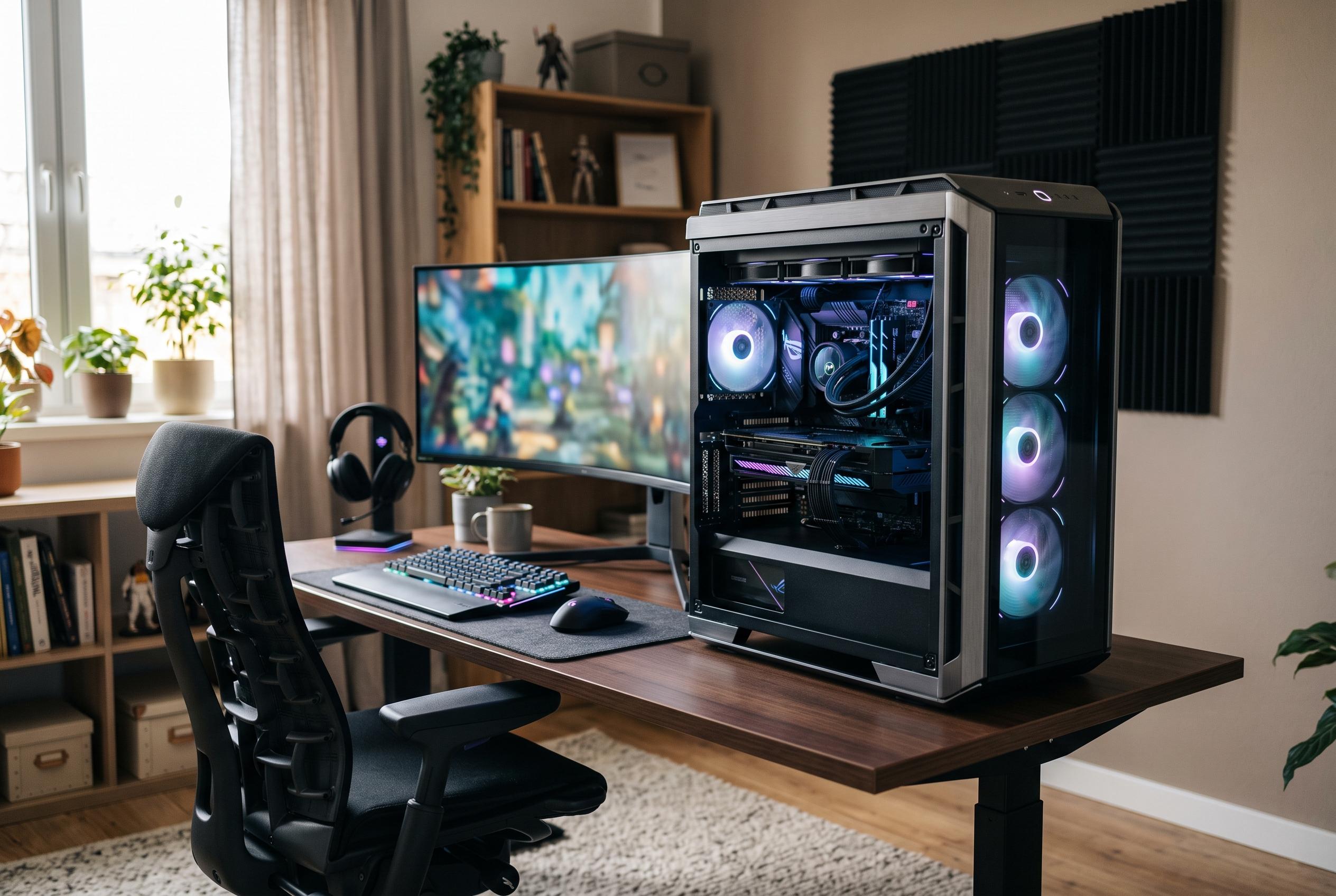

ASUS’s enormous ROG G1000 combines a Ryzen 9 9950X3D, RTX 5080 and zone-based cooling with holographic fans, but its AED 31,999 price raises questions over value.
ASUS’s ROG G1000 is not designed to blend in. It is a vast, 40kg gaming tower built around a Ryzen 9 9950X3D and an RTX 5080, with 64GB of DDR5 memory, a 420mm liquid cooler and holographic AniMe Holo fans that turn the chassis into part gaming machine, part display piece. The combination places it among the most extravagant prebuilt desktops currently sold, but it also sets a high bar for value, particularly at AED 31,999.
That price is easier to understand when the system is viewed as a complete package rather than a simple parts list. ASUS has wrapped the hardware in a 104-litre enclosure and split the interior into separate thermal zones for the CPU, GPU and power supply. The company says that design improves airflow and helps the machine sustain high output over long gaming sessions. In practice, it is a clear attempt to solve one of the basic problems of high-end desktops: keeping very hot components from limiting one another.
The processor choice is a strong one. The Ryzen 9 9950X3D combines 16 cores with AMD’s 3D V-Cache technology, which is especially useful in games that are sensitive to latency, simulation load and asset streaming. It also gives the machine the kind of headroom that matters beyond gaming, including streaming, video work, software builds and other heavy multitasking. In a system this expensive, that balance is important. It means the CPU is unlikely to become the first part that feels dated.
The graphics card, by contrast, is where the specification becomes more divisive. The RTX 5080 is a high-end Blackwell card and is more than capable of delivering excellent 1440p performance and playable 4K results when DLSS is used. That makes it a very fast option for most current games. Even so, the absence of an RTX 5090 in this configuration will matter to buyers who expect the absolute top tier at this price point, especially when path-traced titles and memory-heavy workloads can push the 16GB frame buffer harder than simpler games.
In normal use, the G1000 appears best suited to 1440p displays, where its hardware has room to breathe and the CPU can help drive very high refresh rates. That is the resolution where the system makes the most sense for competitive players and for single-player users who want high image quality without leaning too heavily on frame generation. It can handle 4K as well, but the machine’s most convincing argument is that it should feel exceptionally smooth at 1440p with settings pushed high.
The supporting hardware is broadly sensible, though not without compromise. ASUS includes 64GB of memory and a 2TB PCIe 4.0 SSD, both of which are useful but not especially generous for a machine in this price bracket. The storage capacity in particular feels modest once modern AAA games routinely occupy more than 100GB each. The platform does offer room to expand, with support for more memory and additional drives, and the 1000W power supply leaves scope for future upgrades.
What distinguishes the G1000 most clearly is its cooling and presentation. ASUS’s Thermal Atrium layout is intended to separate heat sources and feed the CPU and GPU with cooler air from independent zones. That should help performance remain stable during long sessions and may also keep fan noise under control. The AniMe Holo system is the more theatrical element: fans that can project animated patterns and images through persistence of vision, controlled through ASUS software and switched off with a physical button when the effect is not wanted. It is an unusual feature, but it is also one that fits the machine’s purpose.
ASUS has now taken the G1000 into more than one market. According to reports from Malaysia and Canada, the desktop has been launched there as well, with the same core formula of a Ryzen 9 9950X3D, RTX 5080, 64GB of DDR5 memory and a 2TB SSD, alongside the Thermal Atrium cooling chamber and holographic fan system. That wider rollout suggests ASUS sees the machine as more than a concept build. It is trying to create a premium prebuilt that competes on engineering as much as on performance.
The central question remains whether that is enough to justify the asking price. For buyers who want a turnkey desktop with unusual cooling, striking industrial design and top-end gaming performance, the G1000 has a clear identity. For buyers who care primarily about value per frame, the compromises are harder to ignore. The RTX 5080 is fast, but the chassis is enormous, the storage is not generous, and the cost puts the machine in territory where some users will reasonably expect the very highest GPU option.
Disclaimer: This content is intended for informational purposes only. Readers are advised to exercise their own judgement, conduct due diligence, or consult a qualified expert before acting on any information provided.