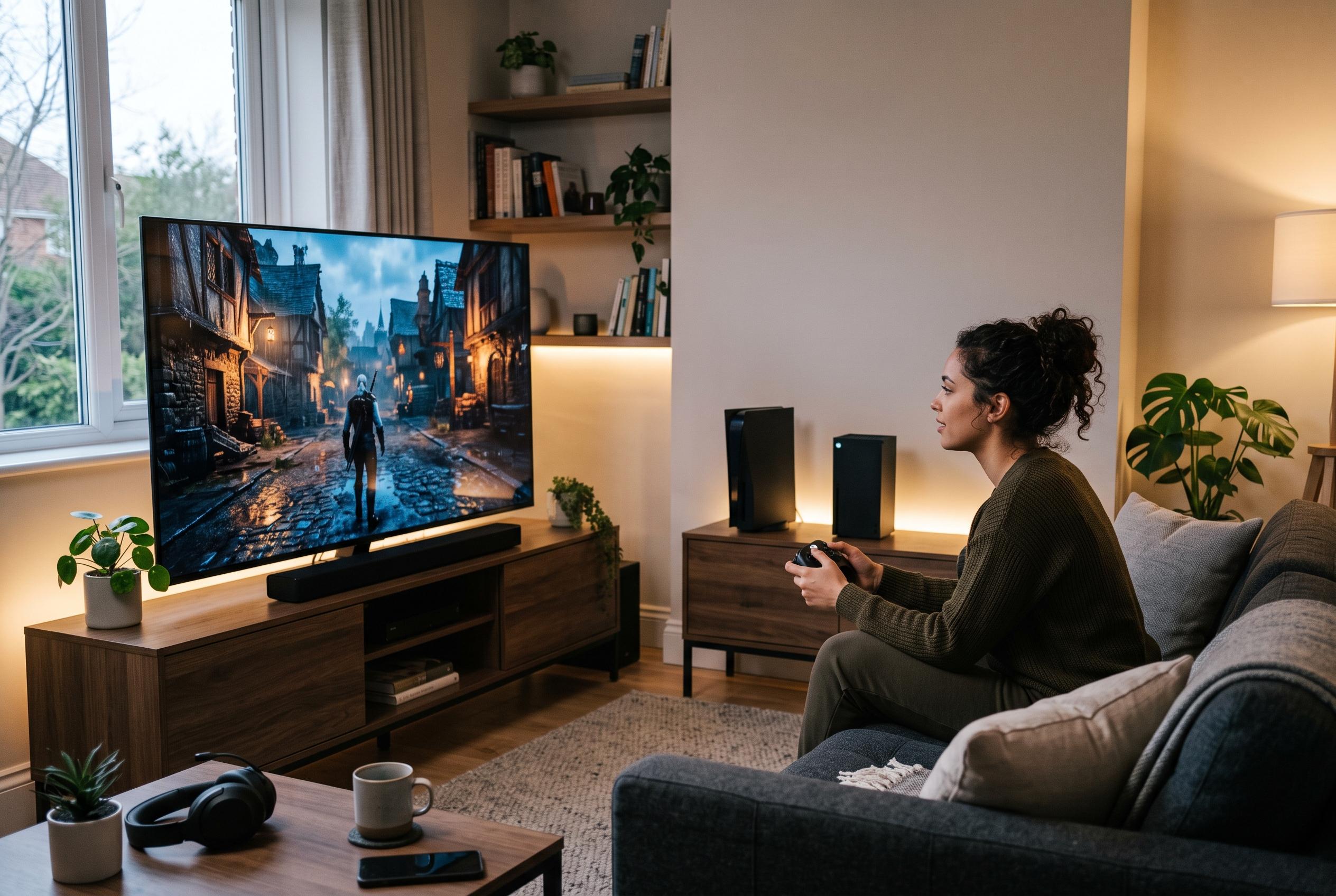

Sony’s PS5 Pro delivers sharper visuals, stronger ray tracing and twice the storage, while Microsoft’s Xbox Series X counters with a lower price, a disc drive and broader backward compatibility.
The PS5 Pro and Xbox Series X now represent two very different ideas of what a current-generation console should be. Sony’s machine is the newer, more ambitious piece of hardware, built to push image quality, ray tracing and storage capacity beyond the original 2020 standard. Microsoft’s console remains the more conservative design, but it still offers a full disc drive, broad backward compatibility and a lower entry price in most 2026 pricing trackers. For buyers in October 2026, the choice is less about absolute power than about which trade-offs matter most.
On paper, the PS5 Pro holds the clear advantage. Independent comparison sites including TechRadar and makemecharts continue to list its 16.7 TFLOPS GPU, 60 compute units and 2TB SSD against the Xbox Series X’s 12 TFLOPS graphics processor, 52 compute units and 1TB storage drive. The CPU story is far less dramatic, with both consoles using AMD Zen 2 cores, so the real divide is in graphics throughput, storage size and the way each platform handles image reconstruction. Sony’s PSSR upscaling is a central part of that advantage, giving the PS5 Pro a more consistent platform-level approach to reconstruction than the title-by-title implementations used on Xbox Series X.
That hardware gap is visible in current game testing. ElectronNexus reports that across 20 cross-platform titles, the PS5 Pro averaged 58 frames per second in Performance mode, compared with 52fps on Xbox Series X. The same report says the Sony console also produced cleaner image quality in Quality mode, with less shimmering on thin details such as fences and foliage. A second ElectronNexus analysis adds that the PS5 Pro’s stronger GPU allows more detailed ray tracing in supported games, while the Xbox Series X can still feel steadier in some cases, with fewer micro-stutters even when its average frame rate is lower. In other words, Sony’s console is often the more impressive machine when the game is built to use it properly, but Microsoft’s box can still deliver a smoother-feeling experience in some titles.
Storage is another area where the PS5 Pro has the more aggressive specification, but not necessarily the more convenient ownership experience. Its 2TB internal SSD gives players more room before expansion becomes necessary, and its M.2 slot allows standard NVMe upgrades if the drive meets Sony’s speed requirements. The Xbox Series X starts with 1TB, but its proprietary expansion card is simple to install and matches the console’s internal architecture without performance compromise. For buyers with large libraries, the Sony route is cheaper in the short term because it begins with twice the internal space. For buyers who value simplicity, Microsoft’s expansion system remains the easier one to live with.
Price still matters, and here the Xbox Series X keeps its strongest argument. The PS5 Pro launched at $699.99 without a disc drive, while the Xbox Series X entered the market at $499.99 with a 4K Blu-ray drive included. As several 2026 comparison trackers note, the Sony machine is usually the pricier choice in current retail listings as well, even before the cost of a separate optical drive is added. That makes the Xbox Series X the clearer value proposition for shoppers who want physical media support and do not need the extra graphical headroom Sony now offers.
The library question cuts in the other direction. Xbox Series X has the deeper backward-compatibility programme, covering Xbox One, Xbox 360 and select original Xbox titles as well as current-generation games. PS5 Pro plays the full PS5 library and most of the PS4 catalogue, but it does not match Microsoft’s multi-generation reach. Sony, however, continues to benefit from a stronger first-party software strategy in the genres most likely to profit from the Pro’s extra performance, especially visually dense single-player games that can take advantage of higher-fidelity rendering and improved ray tracing. The result is a familiar split: Xbox offers continuity and breadth, while PlayStation offers the more technically advanced showcase.
For most buyers, the right answer depends on what they want the console to do. The PS5 Pro is the better machine for players who care about enhanced image quality, stronger ray tracing, larger built-in storage and the most capable version of cross-platform games. The Xbox Series X remains the better choice for those who want lower cost, a disc drive included by default, easier storage expansion and the widest legacy library. In 2026, neither console is obsolete. They simply serve different priorities, and that is why the comparison still matters.
Disclaimer: This content is intended for informational purposes only. Readers are advised to exercise their own judgement, conduct due diligence, or consult a qualified expert before acting on any information provided.