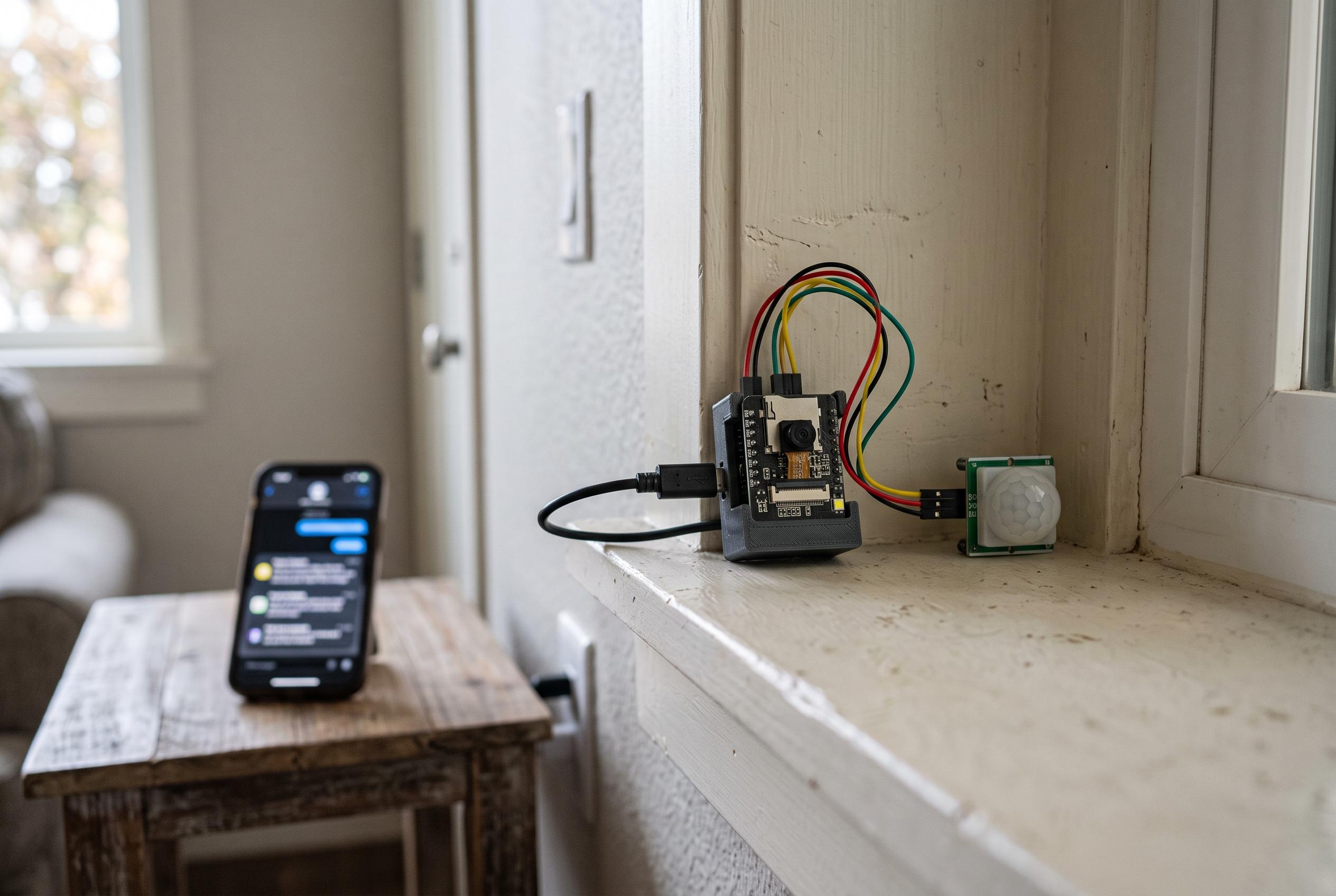

Pairing an ESP32-CAM with a PIR sensor lets makers capture images, send instant Telegram alerts and remotely arm or disarm a compact home-monitoring system.
The ESP32-CAM remains one of the most striking examples of how far low-cost electronics have moved into the security space. In a board scarcely larger than a matchbox, AI-Thinker combined a programmable microcontroller, WiFi, Bluetooth, camera support and expandable storage, creating a compact platform that can be adapted to simple surveillance tasks at very low cost. The original project describes it as a practical tool for makers who want motion-triggered image capture and smartphone notifications without the expense or complexity of a conventional camera system.
At the centre of the design is a straightforward idea: pair the ESP32-CAM with a passive infrared sensor and let the board react when movement is detected. In practice, the PIR unit senses changes in infrared radiation from a moving body, wakes the camera and triggers a capture routine. Several tutorials on the same theme show the same basic architecture, with the ESP32-CAM taking a photo when motion occurs and then relaying it to Telegram, where the image and alert can be viewed immediately on a phone.
The project is notable for how little hardware it needs. The board includes a camera connector for modules such as the OV2640, an SD card slot and a built-in LED that can serve as a flash or scene light. The original article notes that the module can be programmed through Arduino IDE, while the supporting tutorials show the same workflow: install the ESP32 board package, choose the correct board profile, wire the PIR sensor, and upload the sketch. One tutorial even frames the build as suitable for beginners, which underlines how accessible the platform has become for small IoT security projects.
Telegram is used as the alert path because it offers a simple messaging API and a familiar interface for users. The camera board can post an image directly to a Telegram bot by sending the picture through HTTP, while the bot token and chat ID identify the destination account. Related projects expand that idea further, using Telegram not only for motion alerts but also for remote control, including commands to switch devices on and off or request sensor data. In that sense, the messaging app becomes a lightweight control layer as well as a notification channel.
The original project also goes one step further by adding remote arming and disarming through a simple web server. A text file on the server acts as a basic state store, and the ESP32-CAM checks that file before sending an alert. That makes the system more useful in daily use, because it can be enabled only when needed. Similar community projects follow the same pattern, combining the ESP32-CAM with PIR motion detection and Telegram messaging to build compact security systems for rooms, garages or other small monitored spaces. The result is not a professional surveillance installation, but it is a capable and inexpensive one, built from readily available parts and easy-to-understand code.
Disclaimer: This content is intended for informational purposes only. Readers are advised to exercise their own judgement, conduct due diligence, or consult a qualified expert before acting on any information provided.