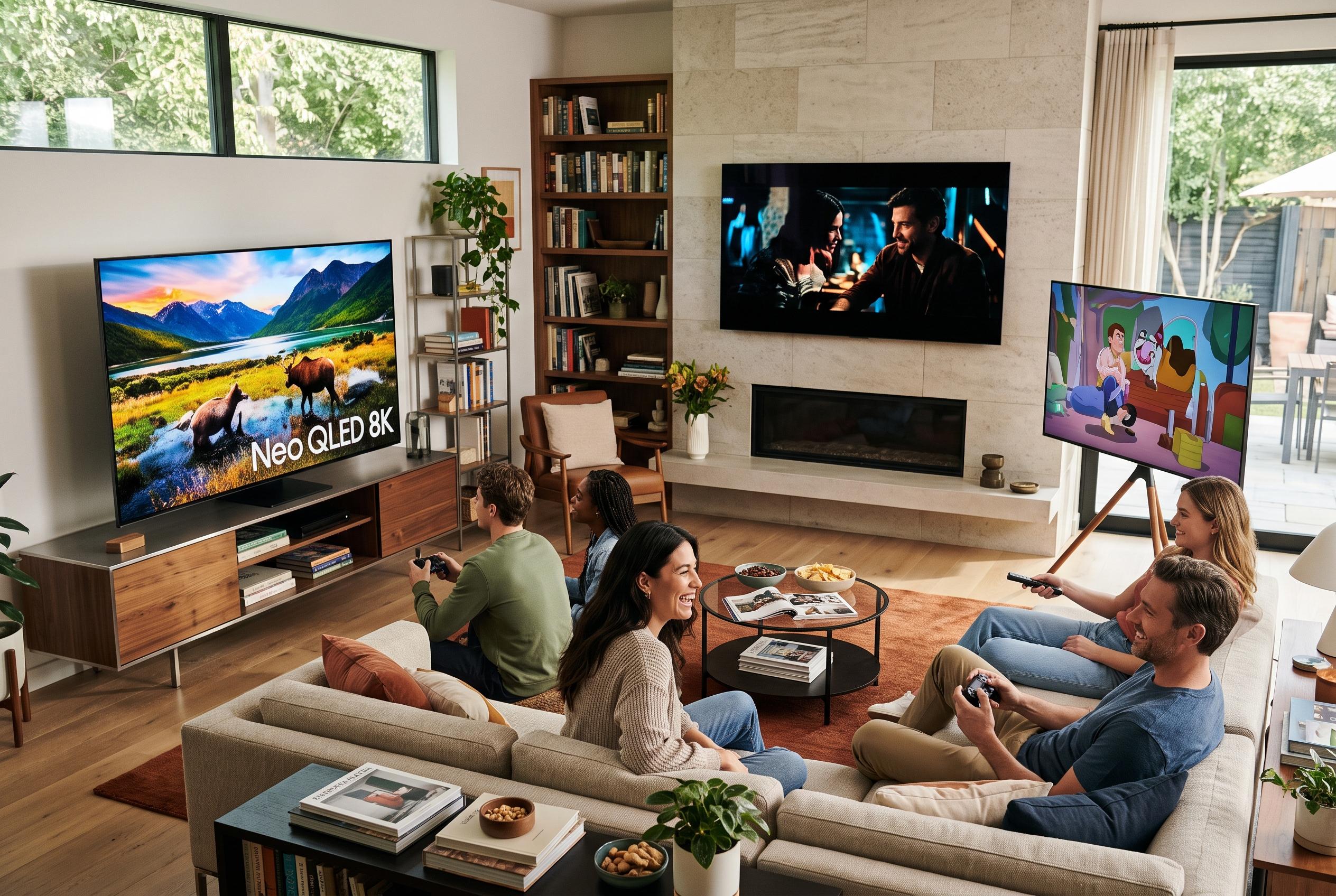

From flagship OLEDs and Mini LED sets to The Frame and entry-level Crystal UHD models, Samsung’s 2026 range is increasingly defined by room conditions, gaming needs and viewing habits rather than screen size alone.
Choosing a Samsung television in 2026 means weighing far more than screen size alone. The brand’s range now spans Crystal UHD, QLED, Neo QLED, OLED and Micro RGB, with each tier aimed at a different mix of picture quality, gaming performance, room brightness and price. Tecnoblog’s latest guide collects ten current models in retail and frames the choice around how the set will actually be used, rather than on specifications alone.
At the top of the range, the Samsung S95H is positioned as the company’s premium OLED option, with self-emitting pixels that deliver deep blacks and strong contrast. TechRadar said its bright-room performance is particularly impressive, helped by high peak brightness and an effective anti-glare layer. The set also brings a 165 Hz panel on some sizes, VRR support and compatibility with FreeSync Premium Pro and G-Sync, making it one of Samsung’s most complete gaming TVs. Its limitations are familiar: Dolby Vision is still absent, and the built-in audio, while improved, does not fully match the panel’s visual ability. The same general performance profile also underpins Samsung’s 2026 flagship QD-OLED, the S99H, which What Hi-Fi? describes as the brand’s most advanced OLED yet.
For buyers who prefer Mini LED, Samsung’s QN90F and QN85F sit in the Neo QLED camp, combining LCD panels with quantum dots and dense backlighting for better local control of brightness. That architecture is designed to improve contrast in bright rooms while limiting light spill, although the effect is not as absolute as OLED and blooming can still appear around high-contrast highlights. The QN90F can reach 165 Hz depending on size, while the QN85F offers up to 144 Hz, four HDMI 2.1 ports, VRR and FreeSync Premium Pro. The guide also notes that Samsung is promising up to seven years of software support on selected recent lines, which is a meaningful factor for a premium television expected to stay in service for years.
Samsung’s other OLED entry, the S85H, is aimed at viewers who want the core strengths of the technology without stepping up to the flagship. It keeps the same basic advantage of pixel-level light control, which gives films and series richer shadow detail and stronger black levels than LCD-based sets. The NQ4 AI Gen 2 processor handles upscaling and picture enhancement, and the 120 Hz panel with VRR makes it suitable for console and PC gaming. Its sound system is simpler than the S95H’s, so buyers may still want to budget for a soundbar if dialogue clarity and scale matter.
Below those premium ranges, the Q7F and U8600F are the more conventional choices for everyday television. The Q7F uses QLED technology to widen colour volume and includes HDR10+ support, but its 60 Hz panel makes it better suited to streaming, broadcast TV and films than fast-paced gaming. The U8600F, by contrast, is a Crystal UHD model with standard LED backlighting, Wi-Fi 5 and Bluetooth 5.2, again at 60 Hz. That places it firmly in the entry-level part of Samsung’s line-up, where value and simplicity matter more than advanced motion handling or deep contrast.
Samsung’s more design-led The Frame remains a distinct proposition. It is built for buyers who want a television that can disappear into a room’s decor when not in use, with a matte finish that cuts reflections and an Art Mode intended to display images and paintings. The guide stresses that the refresh rate varies by size, so the 55-inch version is the more capable option for gaming, while the 50-inch model is limited to 60 Hz. That variability is important, because The Frame is often chosen as much for appearance as for specifications, and the wrong size can quietly undermine the experience.
Among the newer options, the M75H stands out as a practical middle ground. Tecnoblog treats it as one of the stronger value propositions because it combines a 4K Mini LED panel with AI-assisted processing, HDR10+ support and the local dimming advantages associated with more expensive sets. It is not the obvious pick for serious gaming in the way Samsung’s fastest OLED and Neo QLED models are, but for mixed viewing in films, sports and series it offers a strong balance of picture control and price. In a market where many buyers now compare Samsung not only with its own higher-end ranges but also with rival Mini LED and OLED sets, that balance may matter more than any single headline feature.
Disclaimer: This content is intended for informational purposes only. Readers are advised to exercise their own judgement, conduct due diligence, or consult a qualified expert before acting on any information provided.