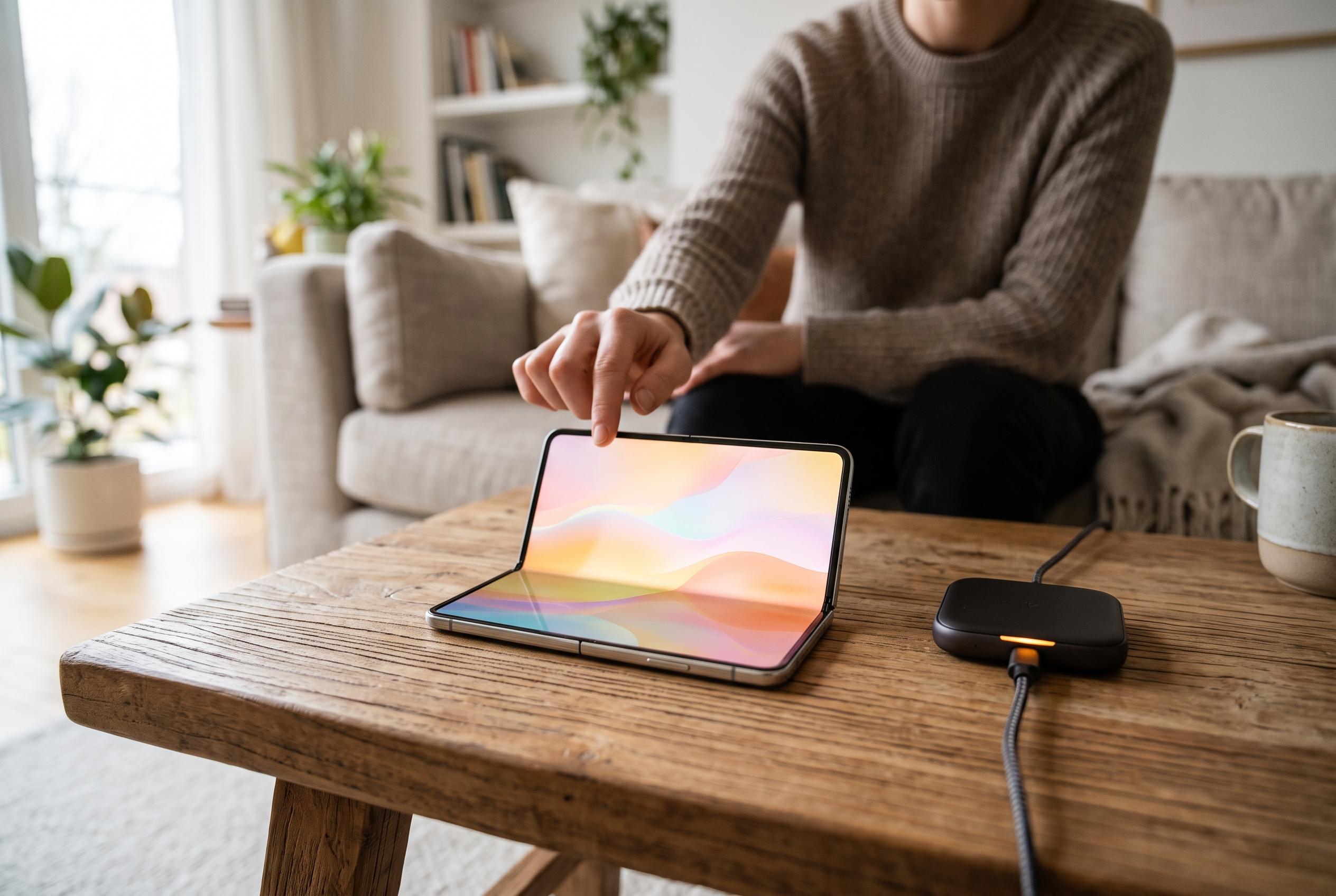

Motorola’s ambitious Razr Fold pairs dual high-refresh displays, a 6,000mAh battery, fast charging and strong cameras with broad US carrier support, despite trailing rivals in processor performance.
Motorola’s Razr Fold is emerging as one of the more interesting entries in the US foldable market, not because it is the fastest phone in its class, but because it combines a large inner display, a substantial battery, fast charging and unusual connectivity features in a form factor that has already reached major carriers. The device was first teased at CES, unveiled at MWC 2026 and later added to T-Mobile and Verizon’s line-ups, giving it a broader route to buyers than many early foldables get. That wider availability matters, because it gives Motorola a better chance of turning a technically ambitious handset into a mainstream option rather than a niche showcase.
In design terms, the Razr Fold sits close to the top of the category. It uses a single premium configuration with 16GB of RAM and 512GB of storage, and the hardware package is built around an 8.1-inch inner display and a 6.6-inch outer panel. According to the review material, both screens are among the brightest and fastest-refreshing in the segment, with the cover display reaching 165Hz and peaking at 6,000 nits. Other reviewers have also praised the panels and the overall industrial design, although Tech Advisor noted that the device is comparatively bulky and that the stylus experience still leaves room for improvement.
Where Motorola takes a different path from some rivals is in battery and charging. The Razr Fold’s 6,000mAh silicon-carbon battery is unusually large for a foldable, and multiple reviews singled out its endurance as a major strength. Motorola pairs that cell with 80W wired charging and 50W wireless charging, a combination that is faster than what many competitors offer in the US market. The company also says the phone supports up to 30% charge in about 10 minutes and can reach a full charge in under an hour, which makes the device more practical for heavy daily use than many foldables that still need careful charging habits.
Performance is the clearest compromise. The Razr Fold uses a Snapdragon 8 Gen 5 chip rather than the more powerful platform found in some rival premium foldables, and benchmark results put it well behind the fastest devices in single-core and multi-core CPU tests. Even so, real-world use appears to be less dramatic than the numbers suggest. GPU performance is more competitive, and reviewers from Android Central and Trusted Reviews said the phone remains responsive enough for everyday tasks. That gap between benchmark weakness and ordinary usability is important: for many buyers, the question is not whether the handset can top charts, but whether it feels quick, and by several accounts it does.
Motorola appears to be leaning on camera quality and network engineering to differentiate the Razr Fold further. The company has promoted the phone as the first commercially sold smartphone in the US with a 6Rx antenna configuration, which it says improves throughput, coverage and battery efficiency. The camera system has also drawn unusually strong praise for a foldable, with the device ranking highly in DXOMark and reviewers highlighting its triple-50MP setup as a rare strength in a category that has often lagged behind traditional flagships. That combination of battery life, display quality, camera competence and carrier support helps explain why the Razr Fold is increasingly being viewed as a serious contender, even if its processor choice keeps it from being an outright benchmark leader.
Disclaimer: This content is intended for informational purposes only. Readers are advised to exercise their own judgement, conduct due diligence, or consult a qualified expert before acting on any information provided.