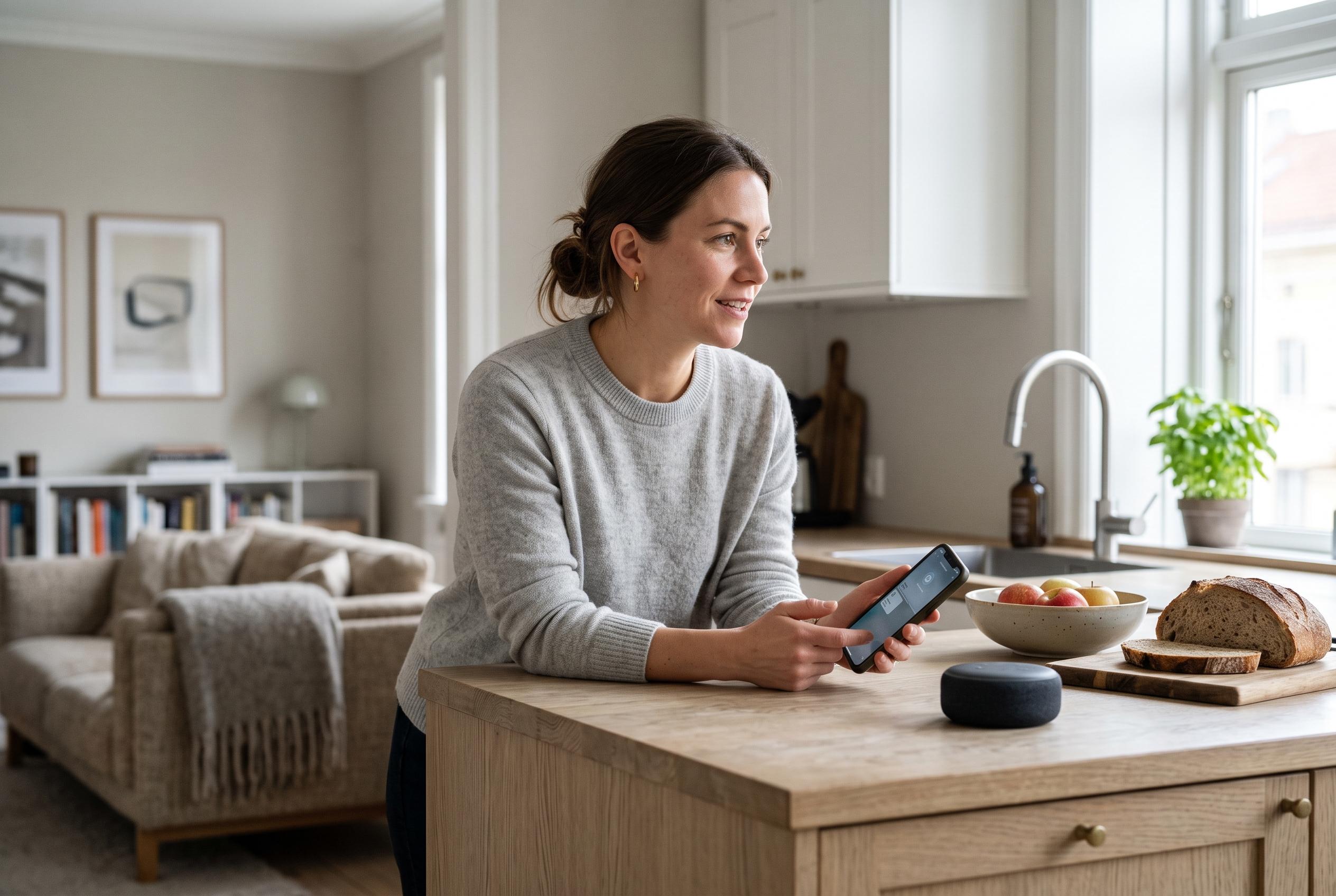

Running a local language model through Home Assistant makes voice control more natural and private, but unreliable interpretations mean access must be tightly limited and complex actions locked into tested routines.
Using a local large language model to control Home Assistant can make a smart home feel far more natural to use, but it also introduces a new layer of risk. The appeal is obvious: instead of memorising rigid voice commands, the system can interpret ordinary speech, map it to an existing routine and carry out the right action. Yet once the model is allowed to decide what happens in the home, every misinterpretation becomes a practical problem rather than a minor software error.
The setup itself is not especially complicated. The article describes running Qwen3 1.7B on a Mac while Home Assistant operates on a separate machine, with the model served over the local network through Ollama and connected via Home Assistant’s conversation integration. Home Assistant can then expose selected devices, such as lights, fans and thermostats, as well as scripts that stand in for multi-step routines. That approach is attractive because it keeps processing local, avoids cloud dependency and lets the model handle open-ended requests more flexibly than traditional rule-based voice control. Other guides on local Home Assistant integrations make the same case, noting the privacy and latency advantages of on-device processing.
The difficulty is reliability. The writer says the model repeatedly confuses similar commands, acts on the wrong rooms, answers with actions when only a status check was requested, and occasionally reads out function-call syntax instead of executing anything. Those errors are not merely inconvenient; they can trigger the wrong routine, affect the wrong devices or leave the home in an unexpected state. The more entities the model can see, the wider the scope of a bad interpretation becomes, which is why other coverage of local Home Assistant LLMs stresses that they are useful, but only within tight limits.
That is where guardrails matter. Home Assistant itself recommends exposing fewer than 25 entities when experimenting with local models, and the article treats that as a sensible baseline. Rather than rely on prompt instructions alone, the safer approach is to restrict access at the tool level. The writer has narrowed the model’s reach to a small set of frequently used devices and routines, and uses predefined scripts for complex sequences such as a bedtime routine. That way, the model only has to identify the user’s intent; the sequence of device actions is fixed in advance and can be tested before it is exposed.
The same logic applies to sensitive controls. If a thermostat should only accept a narrow temperature band, or a lighting tool should only affect one room, those limits need to be enforced by the script or automation itself, not by the model’s judgement. That distinction is important because a language model can misread instructions even when the prompt is clear. For anything safety-critical, the article argues, the better option is either a trusted confirmation step or no exposure at all. The result is a useful but deliberately constrained setup: natural language for convenience, deterministic automation for anything that matters.
Disclaimer: This content is intended for informational purposes only. Readers are advised to exercise their own judgement, conduct due diligence, or consult a qualified expert before acting on any information provided.