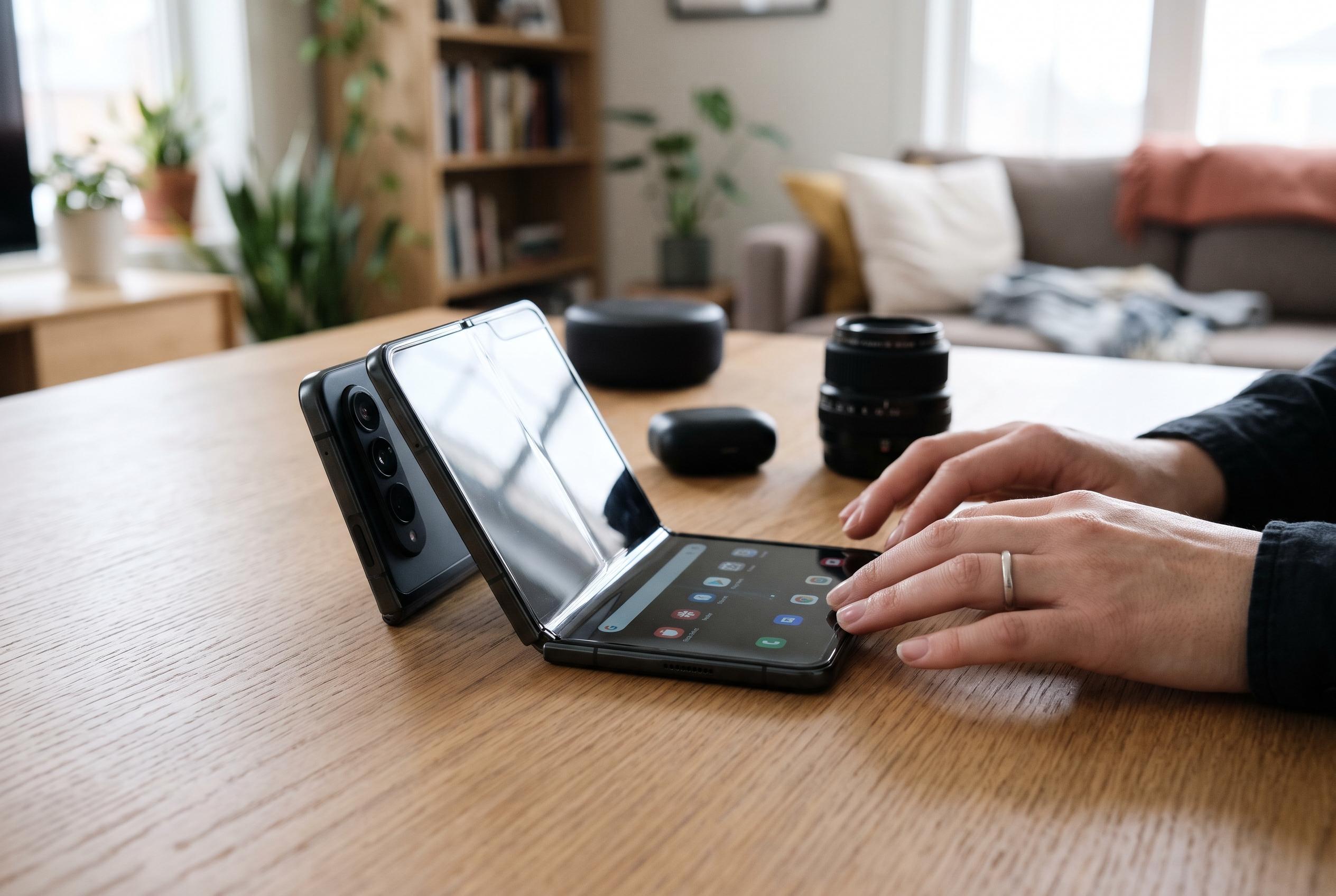

Samsung’s latest clamshell remains slim, pocketable and cleverly suited to photography, but middling battery life, 25W charging and the absence of a telephoto camera make its $1,199 price harder to justify.
Samsung’s Galaxy Z Flip8 refines the foldable formula without changing its limits. Reviewers across Wired, Tom’s Guide and other publications describe a handset that remains slim, pocketable and well suited to one-handed use, but one that still asks buyers to accept compromises in endurance, charging and camera versatility. Tom’s Guide also notes that the starting price is $1,199, making the phone a difficult upgrade for owners of the previous generation.
Battery life is one of the clearest trade-offs. Wired says the Flip8 uses a 4,300mAh silicon-carbon battery that is adequate for lighter use, but not especially reassuring for heavy users, while Tom’s Guide reports that Samsung has kept the same battery capacity and 25W wired charging as before. Wired also criticises the lack of Qi2 magnetic support, which leaves the phone behind some rivals in convenience and accessory compatibility. In practice, the device is capable, but it is still not the sort of phone that can comfortably power through a demanding day without some discipline.
The camera system is similarly competent rather than class-leading. The main 50-megapixel sensor produces pleasing results in good light, according to Wired, SamMobile and Notebookcheck, but image quality falls away as light levels drop and fine detail softens. The 12-megapixel ultrawide is useful for wider scenes and group shots, yet remains a clear step down in quality. Multiple reviews also point out that Samsung has still not added a telephoto camera, which limits zoom flexibility and leaves the phone relying on crop-based 2x framing for modestly useful results.
Where the Flip8 does stand out is in how it uses its folding design for photography and video. Reviewers note that the cover display lets users take selfies with the rear cameras, giving far better quality than the 10-megapixel front camera is likely to deliver on its own. SamMobile adds that the form factor also makes group shots easier, since the handset can be partially folded and positioned as a makeshift stand. Wired highlights Samsung’s Horizon Lock, which keeps video level even as the phone is rotated or moved, and points to newer AI tools such as My FanCam, Now Brief and Now Nudge as small software additions intended to make the handset more useful day to day.
Software polish is not the same as software simplicity, however. Wired says Samsung has widened what can run on the cover screen, including several first-party apps and services such as YouTube, Netflix, Google Maps and Messages. But third-party app support still requires Good Lock and the MultiStar plug-in, a detour that reviewers consider unnecessarily clumsy. Wired also complains that Samsung preloads a mix of its own apps and some third-party services that many buyers may not want on such an expensive phone. The result is a handset that feels thoughtfully engineered in hardware, yet still uneven in some of the everyday details that matter most.
Disclaimer: This content is intended for informational purposes only. Readers are advised to exercise their own judgement, conduct due diligence, or consult a qualified expert before acting on any information provided.