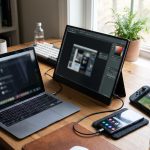

ASUS’s dual-screen ROG Zephyrus Duo finally delivers the graphics power creative professionals have been waiting for, but its near-£6,100 price makes it a spectacular niche machine rather than a sensible all-rounder.
ASUS’s latest ROG Zephyrus Duo is one of the most ambitious portable computers currently on sale, but its appeal is narrower than its specification sheet suggests. Creative Bloq’s review argues that the machine finally solves the graphics weakness that held back the Zenbook Duo line by pairing the dual-screen idea with a discrete Nvidia GPU. In practice, that makes far more sense for creative work and multitasking than for the gaming audience the ROG badge targets. The trade-off is price: the top configuration sits firmly in luxury territory, while cheaper, conventional laptops can still match or exceed its creative performance.
The concept is immediately familiar, but the execution is larger and more substantial than ASUS’s thinner dual-screen machines. Instead of a single 14in panel and integrated graphics, the Zephyrus Duo uses two 16in OLED touchscreens, a thicker chassis to manage the cooling system and a detachable keyboard that can be positioned in several ways. Creative Bloq notes that the notebook is closer to 3kg than to a typical portable workstation, so it is clearly intended for desk use rather than lap use. The design is restrained by gaming standards, with an all-black finish and only modest branding, although the keyboard’s soft-touch surface and 1.7mm key travel make it feel less compromised than the earlier Zenbook Duo layout.
For productivity users, the two displays are the machine’s strongest argument. PCWorld and TechRadar both say the dual-screen format is paired with two 16in OLED panels running at 120Hz, while GamesRadar describes the secondary display as a genuinely useful workspace for games and creative applications. That is the more convincing use case here: separate panels can be assigned to timelines, palettes, reference material or browser windows, and the screens can be rotated into portrait orientation for code or document work. Creative Bloq also points to the broad port selection, including Thunderbolt 4, USB-A, HDMI 2.1 and an SD card slot, though the omission of Ethernet remains a notable gap at this price.
Battery life is better than the format might suggest, at least when the graphics hardware is not being pushed hard. Creative Bloq reports close to 13 hours in a single-screen video loop and around 11 hours with both displays active, which broadly matches the favourable battery comments from PCWorld and TechRadar. The picture changes once the RTX 5090 is involved, however, as heavy gaming or other GPU-intensive work quickly drains the pack. That is consistent with GamesRadar’s view that the machine is highly capable but not especially efficient, and that its performance, while strong, does not fully capitalise on the class-leading GPU inside the most expensive model.
That value problem dominates the verdict. Creative Bloq reviewed a configuration costing £6,099.99, or $5,499.99, while even the entry model begins at £3,999.99, or $4,499.99, according to ASUS’s pricing as reflected across the reviews. Windows Central and GamesRadar both suggest that the RTX 5090 version is best understood as a statement piece for buyers with deep pockets, while a lower-tier model makes more financial sense. The consensus is clear: this is an unusually polished dual-screen laptop with real utility for power users, but it is too costly, and too specialised, to recommend on performance alone. For most buyers, a traditional high-end laptop still offers better value, and in some cases better results as well.
Disclaimer: This content is intended for informational purposes only. Readers are advised to exercise their own judgement, conduct due diligence, or consult a qualified expert before acting on any information provided.