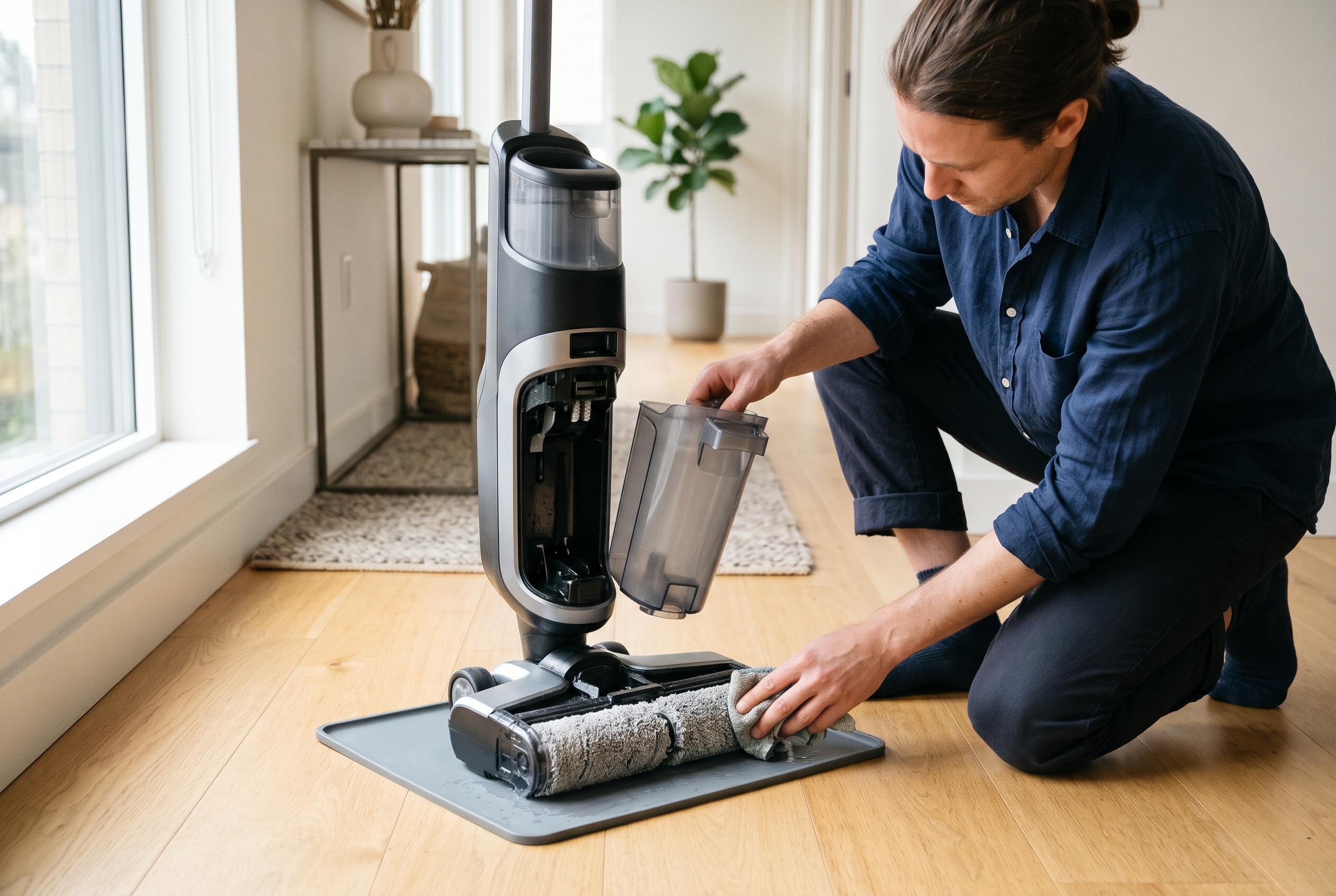

Self-cleaning cycles do not make wet-cleaning machines maintenance-free: emptying tanks, washing rollers and drying filters are still essential to prevent odours and protect performance.
A self-cleaning cycle does not make a floor washer maintenance-free. The usual failure after months of use is not a broken motor or a defective pump, but a smell that builds up because dirty-water tanks, rollers and filters have not been emptied, rinsed or dried properly. In practice, the odour problem is usually a maintenance problem, not a warranty problem.
The most important habit is also the simplest: empty the dirty-water tank after every use and rinse it straight away. Dyson says its Clean+Wash machine uses a self-cleaning cycle to flush the system and rinse the rollers after each run, but it still advises users to clear the dirty-water tank and debris tray regularly to avoid odours. That matches the basic logic of any wet-cleaning appliance: if waste water sits in a sealed container overnight, bacteria and residue will start to build up.
Rollers need more attention than many owners expect. Tineco’s manuals for its FLOOR ONE series recommend regular cleaning of the dirty-water tank, brush roller and filter, both to preserve suction and to prevent smells. The practical point is that a self-cleaning button usually cleans only part of the system. Hair, grease and fine debris can remain trapped near the roller core, in the filter housing or in internal channels, which is why weekly or fortnightly manual cleaning still matters even on machines with heated drying.
Filters are another common weak point. If a filter can be washed, it should be rinsed and allowed to dry completely before being refitted; if it is not washable, it should not be soaked at all. Manuals for Tineco’s wet-cleaning machines also stress that the dirty-water tank should be rinsed after each use, and that the filter and floater need routine attention to keep airflow clear. Once a filter is blocked or left damp, the first sign is often weaker performance, followed by a sour smell.
The same maintenance logic applies to other floor-cleaning gear in the home. Dust cups should be emptied before they reach the maximum line. Brush heads should be checked weekly for tangled hair. Any parts that have been washed must be fully dry before reassembly, otherwise moisture becomes the source of the next odour. In homes with children or pets, these intervals usually need to be shorter, not longer, because the machine is handling more debris and more moisture.
Disclaimer: This content is intended for informational purposes only. Readers are advised to exercise their own judgement, conduct due diligence, or consult a qualified expert before acting on any information provided.