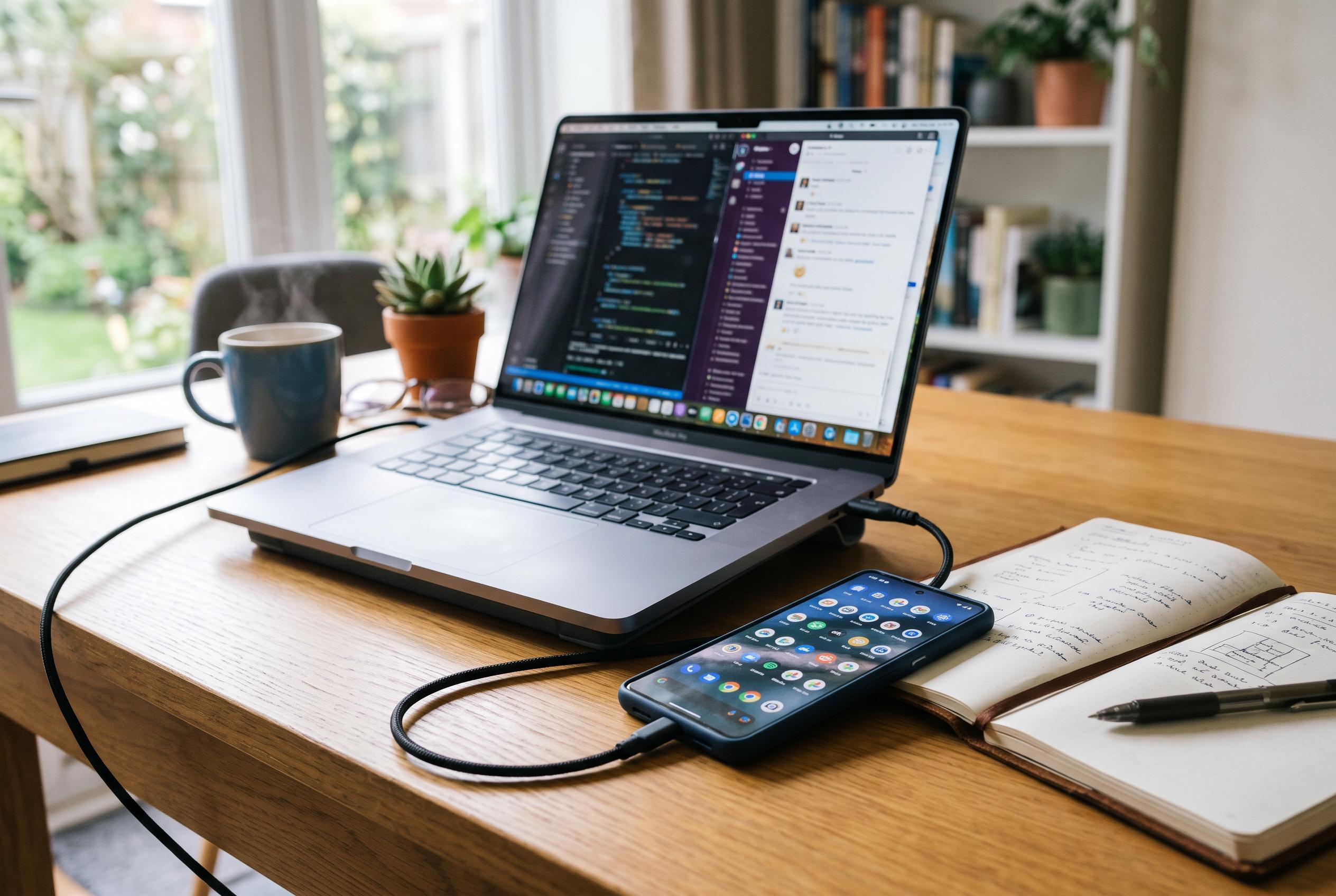

A seven-layer readiness model is challenging the industry’s online/offline view of phone fleets, urging operators to track device state, audit execution and pause when account or app conditions become uncertain.
In phone-based social media automation, the most useful status indicator is often not whether a handset is connected, but whether it is genuinely ready to do work. A device may appear online while still being unusable because the screen is locked, a verification prompt is blocking the app, the wrong account is active, or the network path has changed. The argument made in the lead article is that reliability depends on observing the full execution context, not just the bridge to the phone.
That distinction matters because Android Debug Bridge can confirm communication without proving readiness. In practice, a device may respond to commands while still being trapped in an unexpected state: logged out of the target app, frozen on a dialog box, short of storage, or attached to the wrong user profile. The article argues that device health should therefore be treated as a stack of conditions, spanning connection quality, battery and storage, operating-system state, network stability, application health, account status and the workflow’s starting point.
The article proposes seven readiness layers, beginning with connection and ending with workflow context. That model is notable because it moves operators away from a binary online/offline view and towards explicit states such as READY, BUSY, DEGRADED, RECOVERING and REVIEW_REQUIRED. A state label alone is not enough, however; the article also insists on recording the reason for the state and the time of the last verified transition, so that operators can distinguish a transient slowdown from a real fault.
That emphasis on state-aware control is echoed by several commercial platforms in the same market. Phonorbit says it runs automation on real Android devices and includes per-account safety governors, gradual warm-up phases and a full audit trail. Rovaflow markets physical-phone automation with per-device proxy assignment and no-code scripts. SurfCloudPhone promotes cloud-hosted Android devices with live control and fingerprint isolation. IgMatrix also positions real-device execution as a way to reduce ban risk, while Matrix Mobile describes device streaming, touch control, screenshots and orchestration across real Android hardware. Together, these services reflect the same operational premise: the closer automation is to a live phone, the more important it becomes to know the exact condition of that phone before a task begins.
The lead article also argues for better observability at the boundaries of a job rather than constant indiscriminate capture. It recommends taking evidence before and after key steps, including screenshots or structured screen signatures, command latency, app version and recovery attempts. That approach is consistent with the design of PhoneHarness, a research paper that evaluates phone-use agents through observable side effects and auditable execution traces rather than through plausible answers alone. The practical lesson is that automation should prove what happened, not merely infer success from internal signals.
Recovery, the article suggests, should also depend on the failed layer. A connection failure may justify a reconnect and a harmless health check, while an application crash may require a restart and a return to a known checkpoint. But account uncertainty is different: if a verification flow appears unexpectedly, the system should stop and escalate rather than trying to guess its way through. In that sense, the best automation platform is not the one that retries most aggressively, but the one that knows when to pause.
The broader operational gain is clarity. A fleet view built around device state can show how many phones are ready, which accounts are blocked, which devices are repeatedly recovering and whether capacity is sufficient for the next publishing window. That reduces the need for manual watching and blind retries. The central point of the article is simple: in phone-based automation, a connected device is not necessarily a usable one, and treating readiness as a measurable state is what separates dependable operations from constant guesswork.
Disclaimer: This content is intended for informational purposes only. Readers are advised to exercise their own judgement, conduct due diligence, or consult a qualified expert before acting on any information provided.