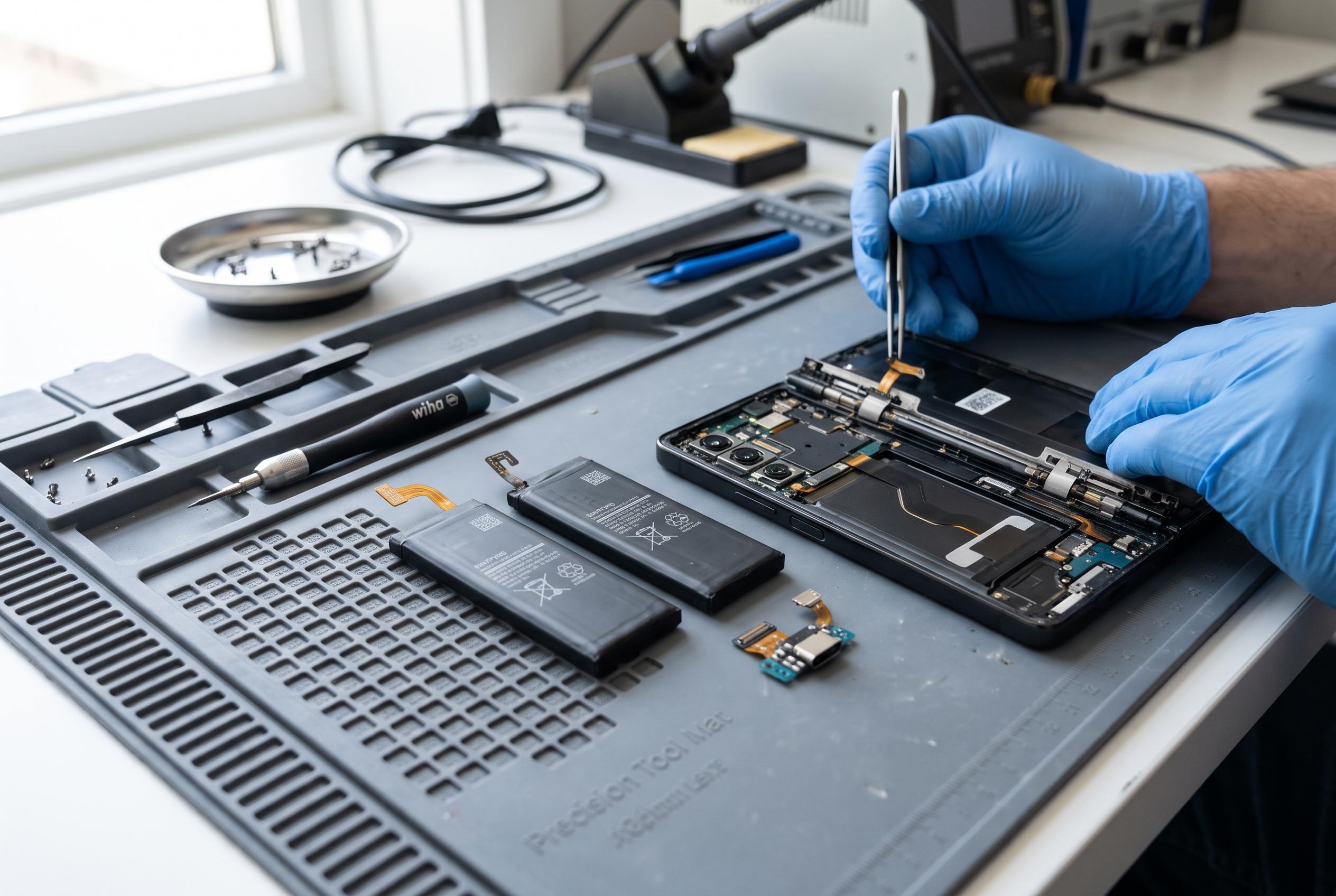

Early teardowns reveal a dual-battery design and modular USB-C port, but costly displays, a complex hinge and hard-to-reach components keep Apple’s first foldable difficult to repair.
Early teardown videos of Apple’s iPhone Duo suggest that the company’s first foldable is not impossible to service, but its most important vulnerable parts are still costly and awkward to reach. Phone Repair Guru’s disassembly, reported by MacRumors and iSpazio, shows a handset built around two battery cells, a modular USB-C port and a layout that is less layered than recent iPhones, yet still densely packed where it matters most. Apple has also published its own technical specifications for the device, underlining how much of the model’s appeal rests on a tightly integrated design rather than on easy field repair.
One of the clearest findings is the dual-battery arrangement. The phone uses two cells with capacities of 2,962mAh and 1,921mAh, for a combined 4,883mAh, and both are held with Apple’s electrically released adhesive, which appears to work cleanly in this case. According to the teardown, the device can continue running even if one battery remains connected, which could reduce the chance of a total shutdown after a single-cell failure. Apple is charging €269 for a battery replacement in Italy, a figure that is materially lower than display-related repairs, but still significant for a component expected to wear over time.
The charging hardware is another notable change. Phone Repair Guru found that the USB-C port is a separate module fixed with two T4 screws, a design that should make a damaged charging connector more straightforward to replace than on many earlier iPhones. By contrast, the internal layout still creates repair pressure in other areas. The front camera assembly on the outer screen is wired directly into the main board, and several flex cables are layered over one another, which makes access slower and increases the risk of collateral damage during a repair.
The most difficult parts remain the ones buyers will care about most. The Touch ID sensor in the side button can be removed, but the teardown describes the job as extremely difficult and not practical for most repair shops. The inner display is even more problematic: removing it reportedly took around an hour, and although the panel survived, the surrounding frame did not return to its original condition. MacRumors and Gadgets360 both note that Apple in Italy charges €1,149 for the internal screen, compared with €489 for the outer display, while the company also lists €1,719 for “other damage” and €55 for the nano-texture layer.
There is also evidence that Apple has prioritised structural complexity over serviceability in the hinge and display stack. REWA Technology’s separate teardown, highlighted by MacRumors, focuses on the hinge and the internal structure that links the two halves of the phone. The Mac Observer has reported that the hinge contains more than 100 components, which helps explain why Apple has not presented it as a user-repairable part. Taken together, the early teardowns point to a foldable that is more repairable than some observers feared in a few specific areas, but still difficult and expensive to open where it counts.
Disclaimer: This content is intended for informational purposes only. Readers are advised to exercise their own judgement, conduct due diligence, or consult a qualified expert before acting on any information provided.