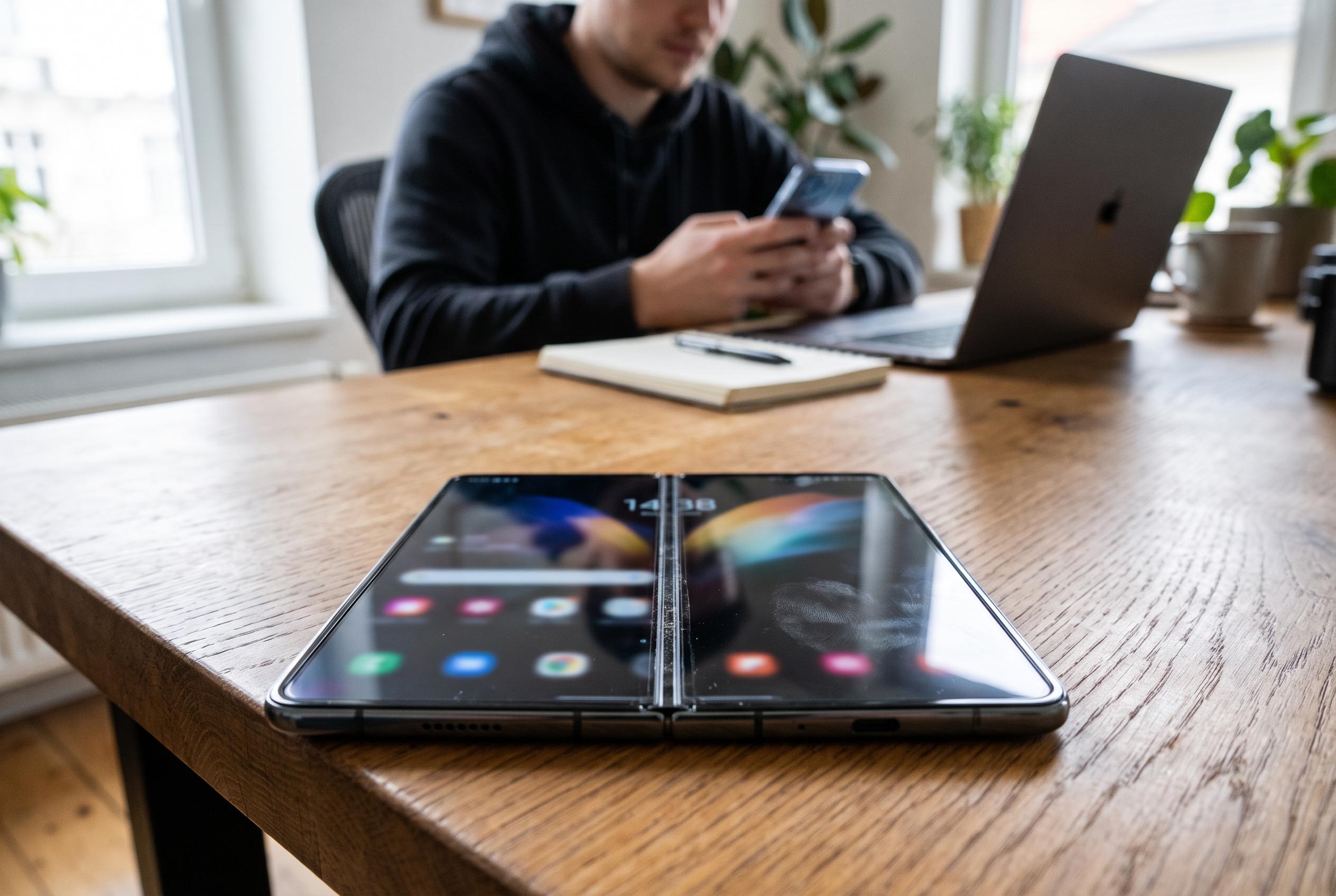

Early owners and durability tests point to cracked hinge displays, limited app support and costly repairs, leaving Apple’s first foldable better suited to enthusiasts than everyday buyers.
Apple’s first foldable phone has entered the market with a familiar problem: innovation comes with trade-offs. Priced from about $2,000, the iPhone Duo has drawn early attention not only for its design but for the practical compromises that first buyers have already encountered. Early reports from users and reviewers point to a device that is impressive in concept, but still far from fully mature in execution.
One of the most immediate concerns is the internal flexible display. Within a day of launch, some owners began posting images of panels that had cracked along the hinge line, often with a band of dead pixels or a clean fracture running through the centre. In one case described by an Australian buyer, the screen failed after fewer than 20 openings in six hours of use, although the handset was replaced under warranty. The official out-of-warranty repair price for the inner display is said to be $999, which underlines how expensive a failure could be for anyone outside coverage.
Durability testing has also exposed structural weaknesses. In a stress test by JerryRigEverything’s Zack Nelson, fine dirt entered the titanium hinge and prevented the two halves from closing cleanly, even with magnetic assistance. When the device was bent back on itself, the frame remained intact, but the flexible panel developed green lines and stopped responding to touch. That compares unfavourably with Samsung’s Galaxy Z Fold 8, which reportedly survived the same treatment without catastrophic screen failure. The result suggests Apple still has work to do on sealing and internal protection.
The display itself has some advantages. Apple has used a matte nanocoating, which helps to cut glare and hide minor scratches that are common on plastic-covered foldable panels. The trade-off is a slight reduction in colour richness, but for everyday use the finish appears to make the screen easier to live with. The crease down the middle is also subtle at first. Yet, as testing by Mediastorm showed, it becomes more visible after repeated folding, and review observations suggest it can deepen within about a week of regular use. That is not unusual for this class of phone, but it is still a reminder that the panel changes over time.
Software remains another weak point. According to reviewers MrWhosetheboss and Channel Ramble, Apple’s own apps, including Safari and the Books app, are already adapted to the larger foldable format. Many third-party titles are not. Google Docs and Sheets, for example, reportedly revert to a mobile-style layout rather than expanding properly across the wider screen, while apps such as Discord and Clash Royale can open in a phone-like view that fails to use the full display effectively. Multitasking is also limited: split screen appears to be locked to a fixed 50:50 arrangement, without the adjustable divider found on iPad.
Buyers also give up several features that are standard on the iPhone 18 Pro line. There is no Face ID on either display, with unlocking handled instead by Touch ID built into the side button. The sensor reportedly requires a firm press rather than a quick tap and can be awkward to reach one-handed. There is no telephoto lens, so zooming is limited to a modest 6x digital crop, which is less useful for portraits and distant subjects. The under-display selfie camera is only 4 megapixels and is described as soft in detail, although the folding design does allow self-portraits with the main 48-megapixel camera by using the outer screen as a viewfinder.
There are also thermal and optical compromises. The main camera module is said to be smaller than the one in the iPhone 18 Pro and lacks a variable aperture. Performance remains strong, but not quite at the level of Apple’s top slab-style phones. Meanwhile, the folded chassis is reportedly around 30 per cent thicker than a conventional handset, and the reduced vapour chamber is less efficient at drawing heat away from the A20 Pro chip during sustained load. Taken together, these limits explain why the iPhone Duo feels more like a first-generation statement product than a fully rounded flagship.
Even so, the device is not being written off by early observers. The consensus is that it is best suited to enthusiasts who want to be among the first to own Apple’s foldable rather than buyers looking for the most practical premium phone. For most people, the iPhone 18 Pro or Pro Max still looks like the safer and more polished choice. Those tempted by the Duo may be better advised to wait for later revisions, which are likely to benefit from feedback on the current model. For now, the most sensible precaution may be AppleCare+, given the cost of repair and the fragility that comes with a foldable design.
Disclaimer: This content is intended for informational purposes only. Readers are advised to exercise their own judgement, conduct due diligence, or consult a qualified expert before acting on any information provided.