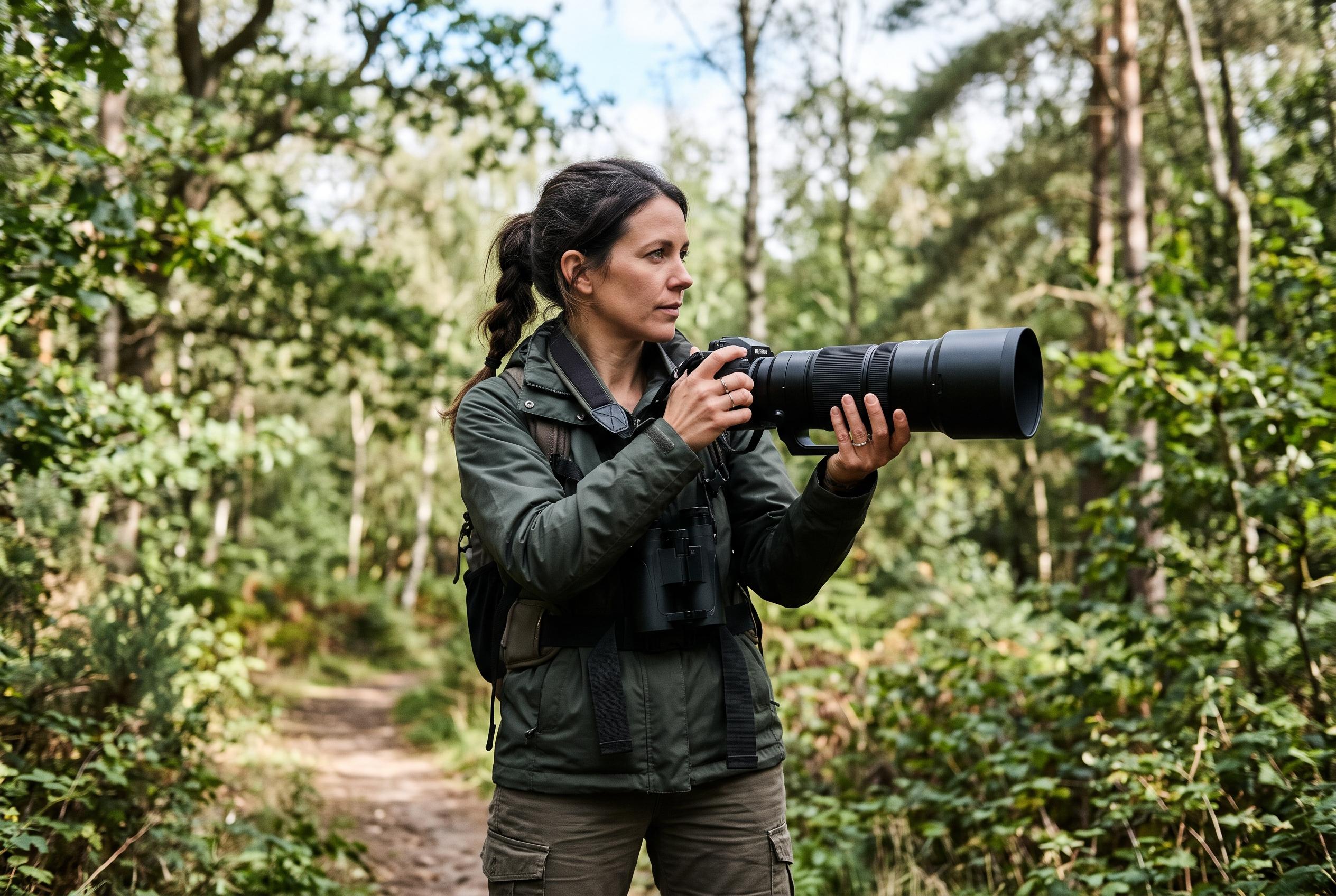

Sony’s 400mm and 600mm primes closely match Nikon’s rival Z-mount lenses while weighing less and costing less, forcing wildlife photographers to prioritise portability, price, speed and autofocus.
Sony’s new 400mm f/4.5 and 600mm f/6.3 primes are forcing bird and wildlife photographers to weigh portability against price in a way that feels unusually stark. In a recent comparison, bird photographer Jan Wegener argued that Sony has taken aim at Nikon’s closely matched Z-mount super-telephotos with lighter bodies and lower sticker prices, creating a direct choice for anyone building a long-lens kit for field work. For photographers who spend hours hand-holding glass in poor light or on the move, the difference is not merely academic: a few hundred grams and a substantial price gap can decide which system is practical over the long term.
The 400mm pairing is especially close. Sony’s FE 400mm f/4.5 GM OSS is about 170 grams lighter than Nikon’s NIKKOR Z 400mm f/4.5 VR S and, at list price, roughly $800 cheaper, according to Wegener’s comparison. Nikon’s lens weighs about 1,160 grams and has a minimum focus distance of 2.5 metres, while Nikon says its optics are designed to suppress chromatic aberration and that built-in optical VR provides the equivalent of 5.5 stops of stabilisation. Wegener’s verdict is that the two lenses are so similar in use and image quality that the decision may come down to the wider system rather than the optics alone.
The 600mm class opens up a bigger split. Sony’s FE 600mm f/6.3 GM OSS is around 400 grams lighter than Nikon’s NIKKOR Z 600mm f/6.3 VR S and about $1,500 cheaper, according to Wegener. Nikon says its lens weighs approximately 1,390 grams and is designed with a centre of gravity shifted towards the camera body to aid handheld use, while its optical VR system is rated at up to 6.0 stops. Sony’s lens, meanwhile, has been reviewed as a compact professional super-telephoto at 995 grams, with testers praising its sharpness and portability. The practical difference matters in the field: Wegener says Sony’s lens is more settled than a larger zoom, but Nikon’s 600mm prime gives a particularly stable handheld viewfinder image that makes tracking small birds easier.
The bigger surprise is how much these lenses have changed what 600mm means in practice. A decade ago, a prime of that reach usually meant an f/4 optic weighing more than 3kg, with a price tag that put it out of reach for most photographers and a tripod almost mandatory. Since then, lighter designs from Canon, Nikon and now Sony have made long reach easier to carry and more realistic for travelling shooters. Better high-ISO sensors and software denoising have also softened the penalty of slower apertures, so an f/6.3 lens at ISO 3,200 is far more usable now than it would have been only a few years ago. For bird photographers, that shift can mean working from a creek bank, a kayak or a fast-moving trail rather than being tied to a monopod or gimbal.
Wegener also argues that the body ecosystem may matter as much as the lens choice. Sony still has an edge in burst speed and some tracking functions, with models such as the a1 II offering pre-capture and 30 frames per second, while Nikon’s Z9 delivers 20 fps raw. Nikon’s subject detection, however, has become notably strong at finding birds in cluttered scenes and can rival Sony in that area. Pricing is less straightforward than the lens numbers suggest, because body discounts can narrow or reverse the gap depending on the dealer and the time of purchase. Wegener’s overall point is that both systems now offer genuinely portable super-telephotos, but the better buy depends on whether the photographer values Sony’s broader speed advantage or Nikon’s steadier handheld handling and detection performance.
Disclaimer: This content is intended for informational purposes only. Readers are advised to exercise their own judgement, conduct due diligence, or consult a qualified expert before acting on any information provided.