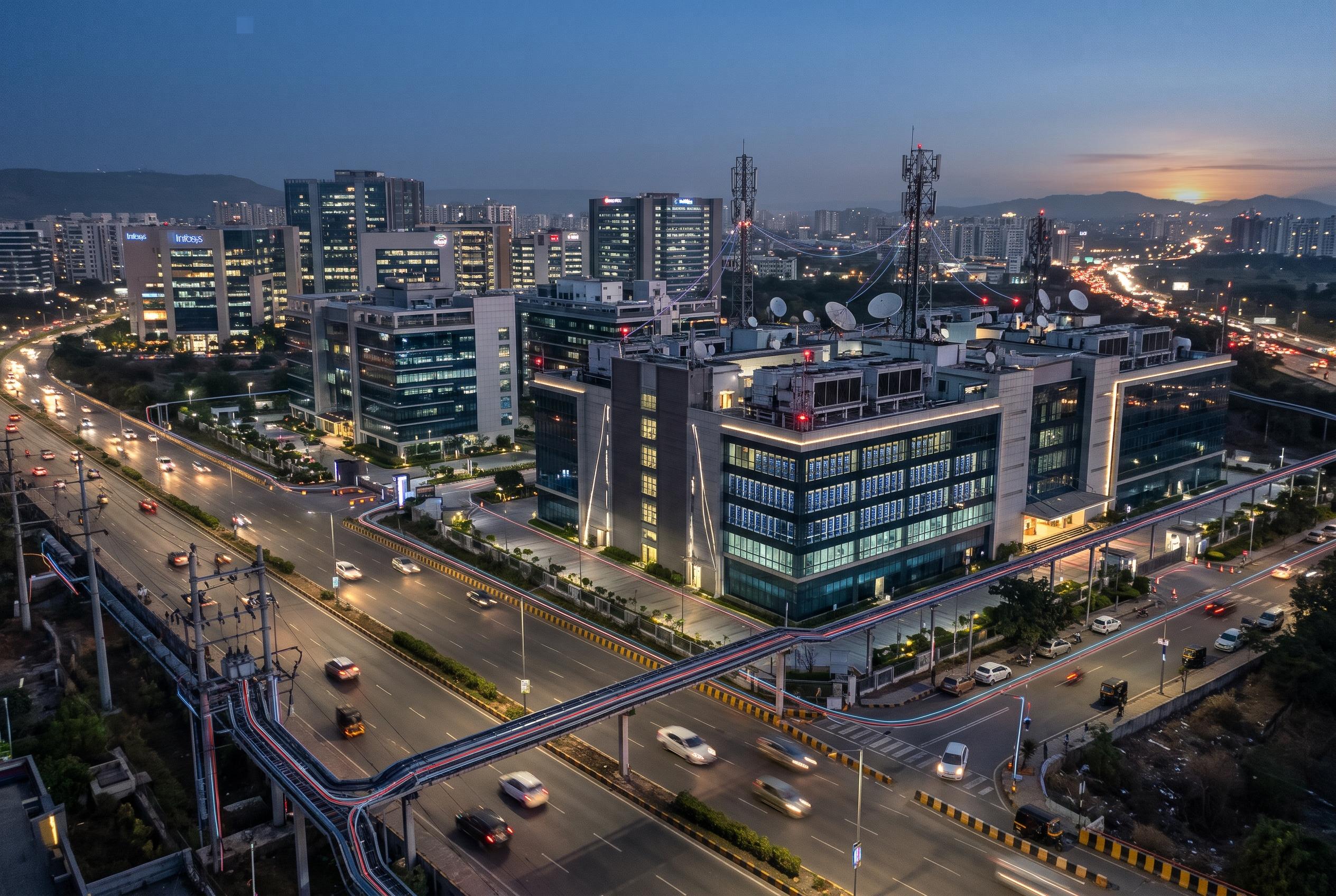

Tata Communications plans to invest about ₹4,350 crore in an AI-focused network linking India’s main data centre hubs with international cable landing stations.
Tata Communications has unveiled plans to spend about ₹4,350 crore, or roughly $400 million to $450 million, on a new AI-focused connectivity build-out that will stretch across around 10,000 km of network infrastructure in India. The company said the project is designed to tie together major data centre and artificial intelligence hubs as demand rises for faster, lower-latency digital links to support cloud platforms, hyperscalers and enterprise customers.
In a stock exchange filing, Tata Communications said the outlay will be funded from operating cash flow and delivered over a long implementation window between FY2030 and FY2036. The company also said the first phase will run through the Mumbai–Pune–Hyderabad–Chennai corridor, a route it sees as central to India’s expanding AI and hyperscale ecosystem.
Later phases are expected to extend the network to emerging data centre clusters in western and eastern India, including Vizag, Bhubaneswar, Jamnagar and GIFT City. Tata Communications said the wider plan is intended to link domestic AI and data centre locations with international cable landing stations, creating a route between Indian infrastructure and global AI hubs.
The company expects the investment to add about 6 petabits per second of capacity to its existing 1.25 Pbps network, while current utilisation is running at roughly 70% to 80%, according to the filing. Tata Communications said the increase is meant to prepare for heavier AI and cloud traffic, where operators need not only compute and power capacity but also resilient network architecture at scale.
Ganesh Lakshminarayanan, the company’s managing director and chief executive officer, said the data centre-to-data centre connectivity market could become worth more than $1 billion in the medium term. Rupesh Chokshi, executive vice-president and global business head of network services, said AI workloads require networks built for speed, scale and resilience. The company added that it will continue to expand its national long-distance and metro infrastructure to meet enterprise and data centre demand.
According to a government press information bureau release cited by the company, India holds nearly 20% of the world’s data but only around 3% of global data centre capacity. The release said Mumbai and Navi Mumbai account for more than a quarter of live capacity in India, while Bengaluru and Hyderabad each hold about 22%, followed by Delhi-NCR, Chennai, Pune and Kolkata. That imbalance helps explain why network operators are now racing to build the transport layer that will sit beneath the country’s next wave of AI infrastructure.
Disclaimer: This content is intended for informational purposes only. Readers are advised to exercise their own judgement, conduct due diligence, or consult a qualified expert before acting on any information provided.