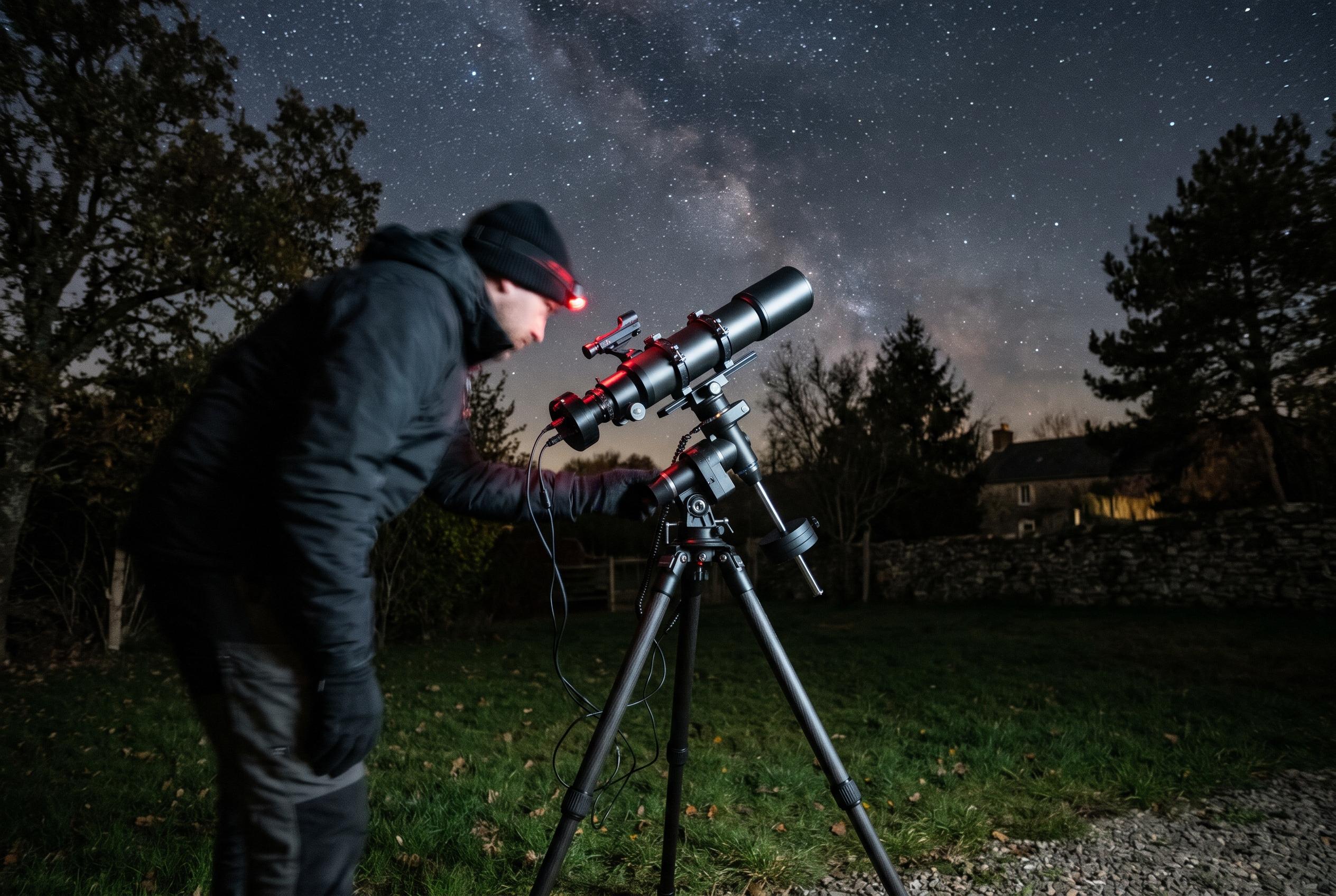

ZWO’s compact Seestar S50 automates alignment, focusing, tracking and image stacking, bringing surprisingly detailed colour views of nebulae and star clusters within reach of beginners.
ZWO’s Seestar S50 is a rare kind of astronomy device: small enough to carry in one hand, yet capable of producing colour images of nebulae, clusters and other deep-sky targets with very little user intervention. Sky & Telescope’s test report describes a unit measuring roughly 13 cm square and 25 cm tall, with a carbon-fibre tabletop tripod lifting the total height to about 48 cm and the full package weighing under 3 kg. That compact form is a key part of its appeal, but the broader story is that ZWO has packaged a complete imaging system into a single consumer product, rather than a telescope that still depends on a long list of accessories and technical skill.
The Seestar is built around a 50-mm f/5 apochromatic triplet, a Sony IMX462 colour sensor, a motorised alt-azimuth mount, electronic focusing, a dew heater and a dual-band filter for emission nebulae. The Sky & Telescope review notes that the telescope is intended to work straight out of the box with only a smartphone or tablet, while Live Science and BBC Sky at Night Magazine both highlight how straightforward the app-driven setup is for newcomers. ZWO’s own positioning of the product, as reflected in independent reviews, is that of an integrated smart telescope rather than a traditional scope with add-ons.
In use, that simplicity is the Seestar’s strongest quality. Sky & Telescope found that the telescope can level, calibrate and plate-solve itself, then centre a target with minimal input from the user. The app offers object lists, search and sky-map views, while the telescope automatically stacks 10-second exposures and updates the image in real time. Live Science says that frequent app updates can mean occasional relearning, but the basic workflow remains easy enough for beginners, and BBC Sky at Night Magazine similarly praises the accessible software interface.
Image quality is the reason the Seestar has attracted so much attention. Sky & Telescope reported that even short stacks can produce surprisingly rich views of bright Messier objects, while longer integrations show far more detail and colour. The same review also makes clear that the telescope’s strengths are tied to deep-sky work rather than high-magnification planetary observing, a limitation shared by the small aperture and short focal length. Space.com likewise notes that the 2-megapixel output and modest optics set a ceiling on what the telescope can do, even if the results are strong for an entry-level device.
Practical constraints are part of the trade-off. Sky & Telescope found battery life to be respectable but variable, with the dew heater reducing runtime, and reported that the Wi-Fi link is not especially robust over distance. The review also warned that the digital compass can be sensitive to nearby metal, which matters most when locating the Sun or Moon before plate solving has a chance to correct the pointing. These are not fatal flaws, but they show that the Seestar still depends on careful placement and a clear understanding of what kind of observing it is best suited to.
The wider consensus across reviews is that the Seestar S50 has changed expectations for what an affordable smart telescope can do. At launch, Sky & Telescope noted a price of $499, far below the cost of earlier smart-telescope rivals from Vaonis and Unistellar, while other reviews describe it as an unusually strong value proposition for beginners and technically curious observers alike. That value is not just in cost, but in how much of the imaging process ZWO has automated: alignment, tracking, focusing, stacking and saving. More recent coverage of the Seestar S50 Pro suggests ZWO is already trying to push the concept further, with upgraded optics, a higher-resolution sensor and an equatorial mode aimed at longer exposures.
Disclaimer: This content is intended for informational purposes only. Readers are advised to exercise their own judgement, conduct due diligence, or consult a qualified expert before acting on any information provided.