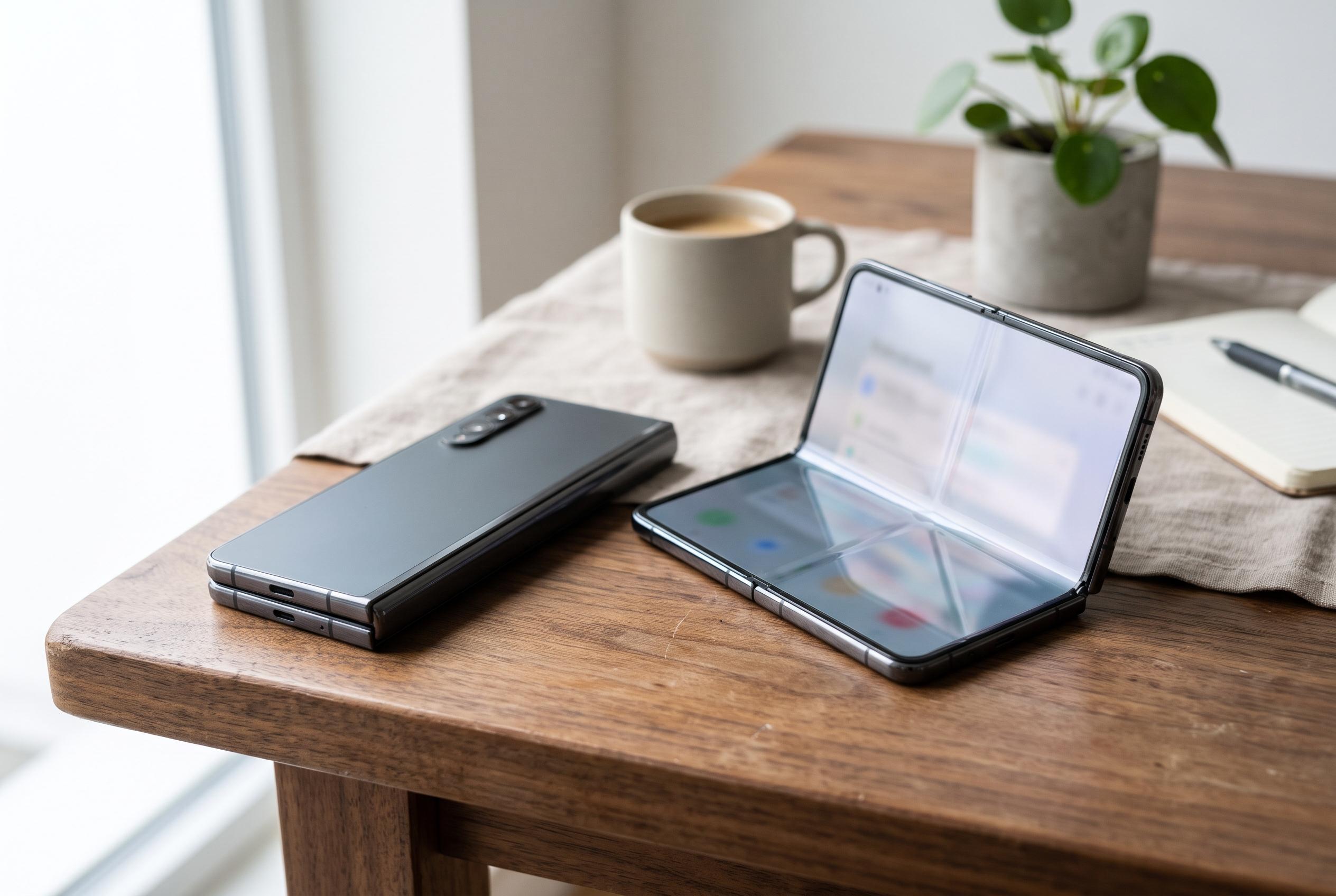

A 20-minute graphics stress test found Apple’s foldable reached higher surface temperatures but delivered significantly more stable performance than Samsung’s Galaxy Z Fold 8.
Tom’s Guide has put Apple’s iPhone Duo and Samsung’s Galaxy Z Fold 8 through a thermal stress test, and the result points to a familiar trade-off in foldables: the cooler handset is not always the one that performs best over time. In a 20-minute run of 3DMark Wild Life Extreme, the iPhone Duo recorded higher surface temperatures than its rival, yet it maintained stronger sustained graphics performance throughout the test.
Using a FLIR One thermal camera, the publication found that Samsung’s foldable concentrated heat near the processor area at the top of the device before spreading it across the rear panel and the right-hand display. By contrast, the iPhone Duo dispersed warmth more evenly over a wider area of the chassis and screen. At the same measured point, Tom’s Guide reported a surface temperature of about 103F, or 39.4C, on the iPhone Duo, versus roughly 96F, or 35.6C, on the Galaxy Z Fold 8.
The more important difference emerged in performance stability. Tom’s Guide said the iPhone Duo achieved a stress-test stability score of 67.9%, compared with 51.4% for Samsung’s device. The best and worst loop scores also favoured Apple’s foldable, at 7,639 and 5,184 respectively, against 7,047 and 3,626 for the Galaxy Z Fold 8. During the test, Samsung’s internal core temperature reportedly rose from 95F to 113F, underlining how quickly heat built up under a heavy and continuous load.
The outlet linked the gap to cooling design. The iPhone Duo uses a vapour chamber system that helps move heat away from the processor and spread it through the body of the phone, while the Galaxy Z Fold 8 relies on a more basic thermal setup that appears to allow heat to collect around the chip. For users who play demanding mobile games or run sustained workloads, the finding matters because better thermal control can help preserve frame rates and reduce stutter over longer sessions. Tom’s Guide also noted that the benchmark remains synthetic, so real-world results will still depend on the app, ambient temperature and each phone’s power-management software.
Disclaimer: This content is intended for informational purposes only. Readers are advised to exercise their own judgement, conduct due diligence, or consult a qualified expert before acting on any information provided.