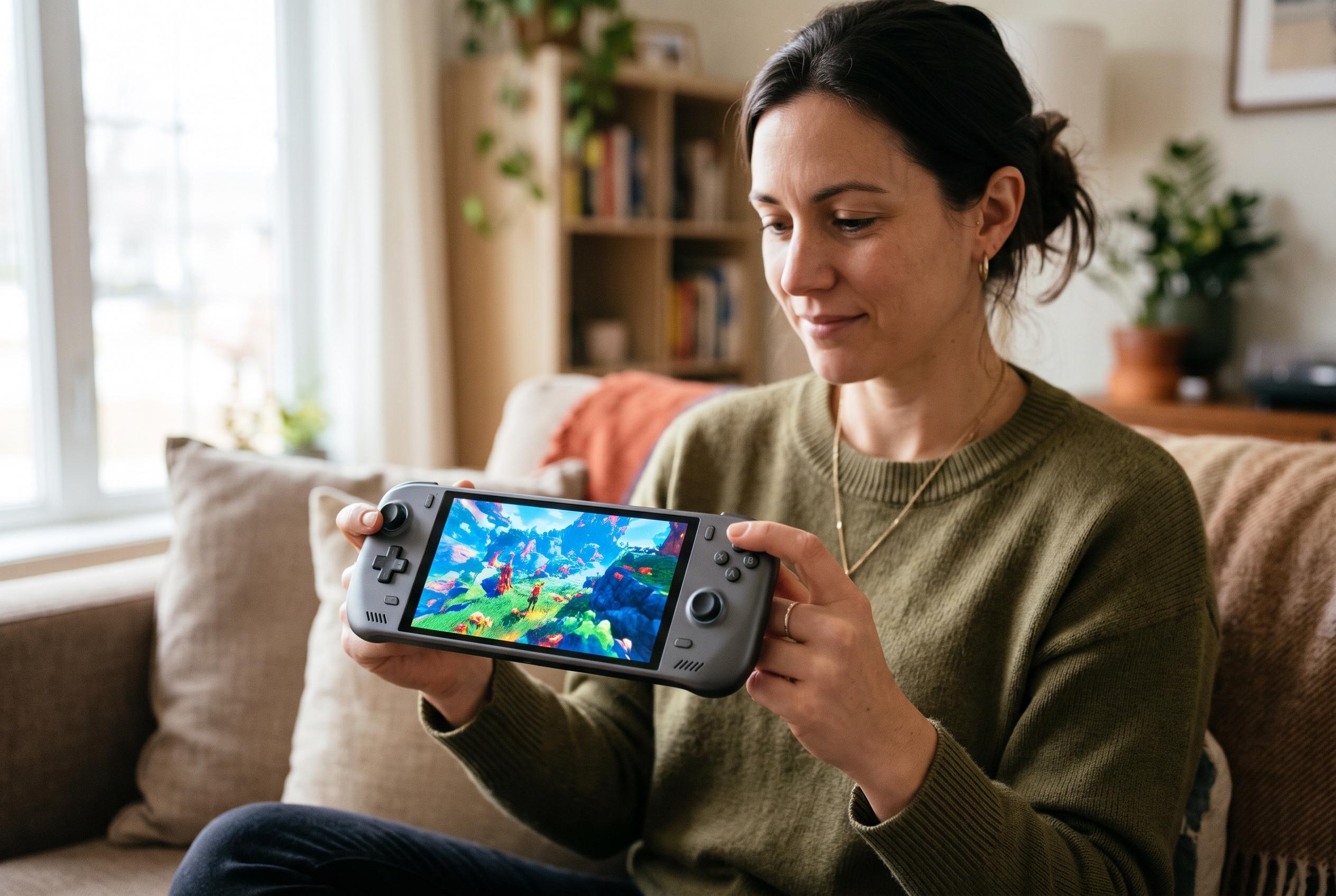

ASUS’s anniversary handheld brings a sharper OLED display, revised controls and subtle performance tuning to the Ally X formula, though Windows software remains its biggest weakness.
The new ROG Xbox Ally X20 arrives as more than a simple cosmetic refresh, even if ASUS is clearly leaning into the model’s 20th-anniversary branding. The smoked grey chassis is punctuated by gold accents, a commemorative badge and subtle design tweaks that give the handheld a more premium look than the original Ally X. But the changes go well beyond finish and styling: the company has reworked the controls, altered the grip texture and upgraded the panel, making the X20 feel like a genuine mid-cycle revision rather than a minor variant.
The most obvious functional changes are around the controls. ASUS has redesigned the D-pad so it can switch between a four-way and an eight-way layout, a feature that should be especially useful for fighting games and other titles that depend on precise directional inputs. The face buttons are also slimmer and more rounded, which makes rolling between inputs easier. Tom’s Hardware and PC Gamer both highlighted the more comfortable feel of the controls, while ASUS says the device also ships with TMR joysticks as standard, a welcome move for users concerned about stick drift. The rear buttons, triggers and shoulder buttons remain broadly familiar, although the squeaky trigger behaviour noted by some reviewers appears to persist.
The screen is the centrepiece of the upgrade. The X20 replaces the older panel with a 7.4-inch OLED display running at 1,920×1,080 and up to 120Hz, with VRR support and Gorilla Glass DXC treatment to reduce glare. In practice, that gives the handheld a much richer image than the earlier model, with stronger contrast, deeper blacks and more vivid colour reproduction. Independent testing cited by reviewers found excellent brightness for an SDR handheld display and strong gamut coverage, while Notebookcheck, TechSpot and Tom’s Hardware all singled out the panel as the device’s most impressive feature. The trade-off is the usual one for OLED: brightness and battery behaviour become more sensitive at higher settings.
There are also changes that are not immediately visible but still matter. According to hands-on testing, the X20 can outperform the Ally X despite sharing the same headline platform, including the AMD Ryzen AI Z2 Extreme, Radeon 890M graphics, 24GB of LPDDR5X memory and 1TB of storage. That suggests ASUS has adjusted firmware or thermal tuning rather than changing the silicon itself. The fan profile also appears to have been revised, with lower reported RPM and similar noise levels, although that may again be down to BIOS-level tuning. Battery capacity remains at 80Wh, and real-world endurance is broadly similar between the two machines at lower brightness levels, though the OLED panel naturally raises power draw once the brightness climbs.
On the software side, the picture is less settled. The Xbox full-screen experience has been criticised by the reviewer as unstable and cluttered, with delays, unresponsive controls and at least one game failing to launch before later updates restored compatibility. That kind of inconsistency matters because the X20 is being marketed as a more console-like Windows handheld, yet the operating system remains the most obvious weakness. Even so, the device does improve on the original in areas that affect daily use. Its louder speakers, rubberised rear grips and better thermals all contribute to a more polished feel, while the bundled charger has been increased to 68W. ASUS also supports 100W USB-C charging, which can get the battery to 50% much faster, even if the final stretch is slowed by thermal limits.
For buyers already using the original Ally X or the first-generation Ally, the X20 looks like a meaningful upgrade rather than a superficial refresh. According to multiple reviews, it is more comfortable, more refined and noticeably more pleasant to look at, even if the core performance class is unchanged. The catch is price: at around $1,300, this is a premium handheld aimed at enthusiasts who value the OLED screen and the revised controls enough to justify the jump. ASUS may present it as an anniversary edition, but in practical terms it reads as a carefully tuned second act for one of the most capable Windows gaming handhelds on the market.
Disclaimer: This content is intended for informational purposes only. Readers are advised to exercise their own judgement, conduct due diligence, or consult a qualified expert before acting on any information provided.