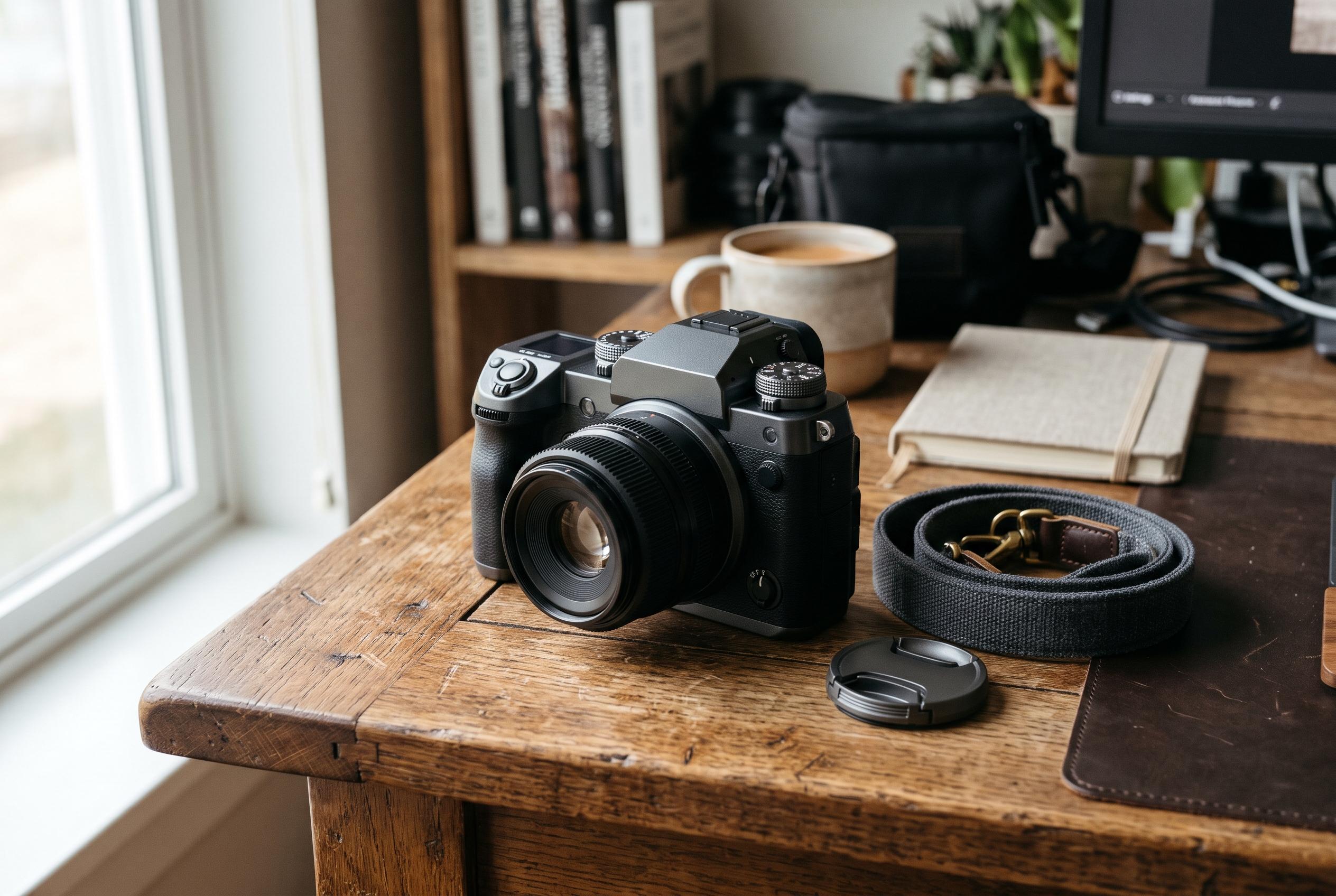

Fujifilm’s X-E5 adds in-body stabilisation, a 40.2-megapixel sensor and faster controls, but its greater weight and shorter battery life make the upgrade less straightforward for X-E4 owners.
Fujifilm’s X-E5 is best understood not as a simple refresh, but as a shift in priorities. Compared with the X-E4, it brings a 40.2-megapixel APS-C sensor, the X-Processor 5 and five-axis in-body image stabilisation, while also adding a dedicated Film Simulation dial that is aimed squarely at photographers who want quicker access to Fujifilm’s colour profiles. The company’s own positioning suggests a more hands-on camera for enthusiasts, rather than a thinner body at any cost.
The most important practical change is stabilisation. According to Fujifilm, the X-E5’s IBIS system is rated at up to seven stops in the centre and six at the edges under specified CIPA 2024 testing with the XF35mmF1.4 R. The X-E4 has no in-body stabilisation at all. That makes the newer model far more useful for handheld shooting in lower light, especially when photographing static subjects, although it does not remove the need for a fast shutter speed when the subject itself is moving.
Resolution is the other major step forward. The X-E5’s 40.2-megapixel sensor gives far more latitude for cropping than the X-E4’s 26.1-megapixel chip, and several reviews note that this makes the newer body more versatile for travel, street and general everyday use. That said, higher resolution also places greater demands on storage, editing hardware and workflow. If an existing X-E4 already delivers enough detail for the intended output, the extra pixels will matter less than the stabilisation.
The penalty is size and weight. Fujifilm lists the X-E4 at about 364g with battery and card, against 445g for the X-E5, a difference of 81g. The newer body is also slightly larger, and the change is enough to be felt once a lens is mounted. PhotographyBlog and other reviewers note that both cameras keep the same compact rangefinder-style character, but the X-E5’s added grip, thumb rest and top-plate controls make it less minimal than its predecessor. For some users, that is an improvement; for others, it weakens the appeal of the X-E line.
The control layout also marks a more deliberate move towards enthusiast shooting. The X-E5 adds the Film Simulation dial and dual command dials, while retaining a 2.36-million-dot electronic viewfinder. Its video specification is also stronger, with up to 6.2K/30p and 4K/60p, plus support for subject-detection autofocus on animals, birds and vehicles. TechRadar and Tom’s Guide both praise those additions, but also note that the model is not perfect for video, with concerns including heat build-up in longer takes and the absence of some convenience features found on larger cameras.
Battery life and storage follow the same pattern of trade-offs. Fujifilm uses the same NP-W126S battery in both bodies, but its published CIPA-based figures are lower for the X-E5, at about 310 frames in Normal mode or 400 in Economy mode, compared with about 460 frames for the X-E4. The newer model does, however, support faster UHS-II SD cards, while the X-E4 is listed with UHS-I support. In practice, that means the X-E5 is better suited to heavier bursts and higher-bitrate recording, provided the rest of the system keeps pace.
For an X-E4 owner, the upgrade case is clearest if handheld low-light work, more flexible cropping or richer video options are genuine needs. If those are not problems in day-to-day use, the older body still offers the lighter, more compact package that originally defined the series. Fujifilm announced the X-E5 on 12 June 2025, and its UK e-shop currently lists the body at £1,399. The X-E4 is now marked discontinued on the manufacturer’s site, so any second-hand purchase should be judged carefully on condition and included accessories.
Disclaimer: This content is intended for informational purposes only. Readers are advised to exercise their own judgement, conduct due diligence, or consult a qualified expert before acting on any information provided.