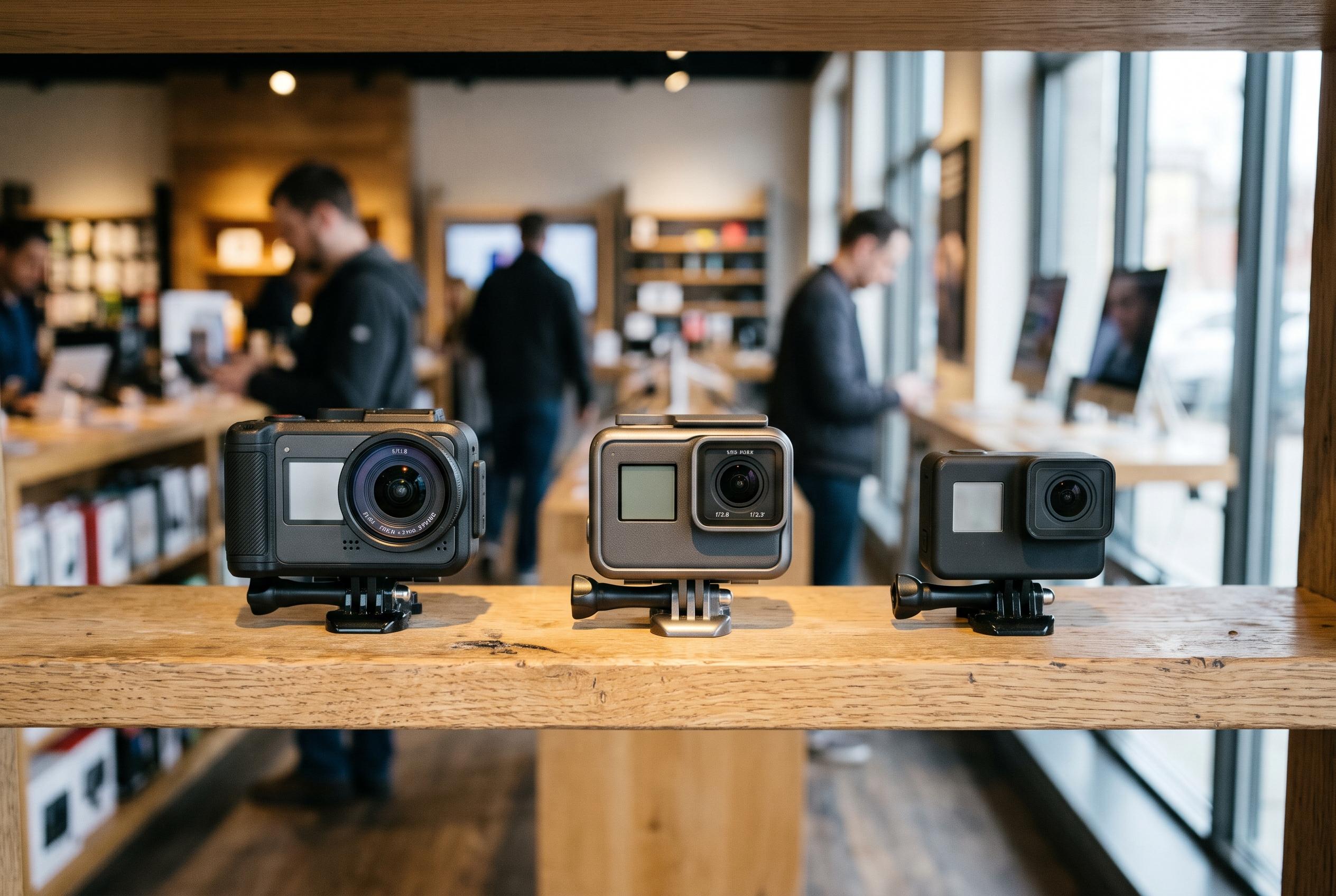

With GoPro’s market share and finances in retreat, DJI and Insta360 are widening the gap in action cameras , leaving buyers to choose between value, 8K detail and low-light flexibility.
The gap between the three leading action cameras on sale this autumn is now wide enough to force buyers to think beyond raw specifications. On recent screenshots shared on Chinese social platforms, DJI’s Action 5 Pro was shown selling for a little over 1,400 yuan, Insta360’s Ace Pro 2 for about 1,616 yuan, and DJI’s Action 6 at just over 2,100 yuan. In other words, the spread between the cheapest and most expensive of the three can reach roughly 700 yuan, a difference that would have looked unlikely in this category only a year ago.
That pricing matters because the market itself has changed. GoPro, the company that once defined the action-camera segment, entered into a definitive merger agreement with Starman Optical on 1 September 2026. Under the deal, GoPro shareholders are to receive 285 million dollars in cash, or 1.14 dollars a share, and will retain about 10% of the combined company. GoPro has said the transaction is intended to recapitalise the business and give it a broader platform, while still supporting its consumer products, subscription service and cloud offering. Reuters-style coverage elsewhere has framed the move as a response to years of weak sales and mounting pressure on the company’s core camera business.
The shift is stark when measured against GoPro’s earlier peak. The company listed on Nasdaq in 2014 at 24 dollars a share and, within months, traded above 90 dollars, valuing it at nearly 12 billion dollars. Today, according to the figures cited in the source material, the brand that once set the standard for the category has become the third option on the shelf. Global shipment data for 2025 underline that change: DJI shipped 10.4 million hand-held smart cameras, or 62.4% of the market, while Insta360 shipped 3.4 million and GoPro 1.8 million, a year-on-year decline of 25.9%.
The competitive picture is just as clear in Japan. BCN data for 2025 showed DJI with 40.1% of the action-camera market there, Insta360 with 37.9%, and GoPro on 18.9%. GoPro’s own financial performance has also weakened, with 2025 revenue reported at 652 million dollars, down 19%, and a net loss of 93 million dollars. The proposed merger with Starman, which remains subject to completion, is widely seen as an attempt to stabilise a business that has lost ground in both volume and relevance.
For buyers, the lesson is that an action camera is no longer a matter of chasing the longest feature list. The real decision now involves stabilisation, accessory support, app quality, battery behaviour, firmware updates and after-sales service. On that basis, the DJI Action 5 Pro remains the value pick for most people who mainly shoot video while commuting, cycling or diving. Its 1/1.3-inch sensor and 4K at 120fps specification are still strong, even if stills and zoom are less convincing. The savings, compared with the higher-priced models, are enough to buy a memory card and a spare battery.
Insta360’s Ace Pro 2 is the clearer choice for users who want the headline benefit of 8K capture, particularly in daylight. The model pairs a 1/1.3-inch sensor with an imaging chip and Leica-branded optics, but that extra resolution comes with trade-offs: cropped field of view in some recording modes, greater storage demands and heavier requirements on a computer for editing. By contrast, DJI’s Action 6 is the more ambitious tool for users who care about low light and flexibility. Its 1/1.1-inch square sensor, variable aperture from f/2.0 to f/4.0 and true 2x zoom give it advantages on paper, especially for those who want to frame both horizontal and vertical video in one take. The cost, however, is higher, and the body is larger than before.
Practical limits still shape the buying decision. Reports from social media users suggest the Action 6 can run into thermal limits after around half an hour of 4K60 recording in some conditions, while battery life at higher frame rates can vary sharply depending on temperature and bitrate. In other words, the most important question is not which camera has the best spec sheet, but which one you are likely to carry and use regularly. For many buyers, that means the cheapest of the three; for others, the better choice is the one that matches their shooting style, whether that is daylight detail, low-light performance or a more complete all-round package.
Disclaimer: This content is intended for informational purposes only. Readers are advised to exercise their own judgement, conduct due diligence, or consult a qualified expert before acting on any information provided.