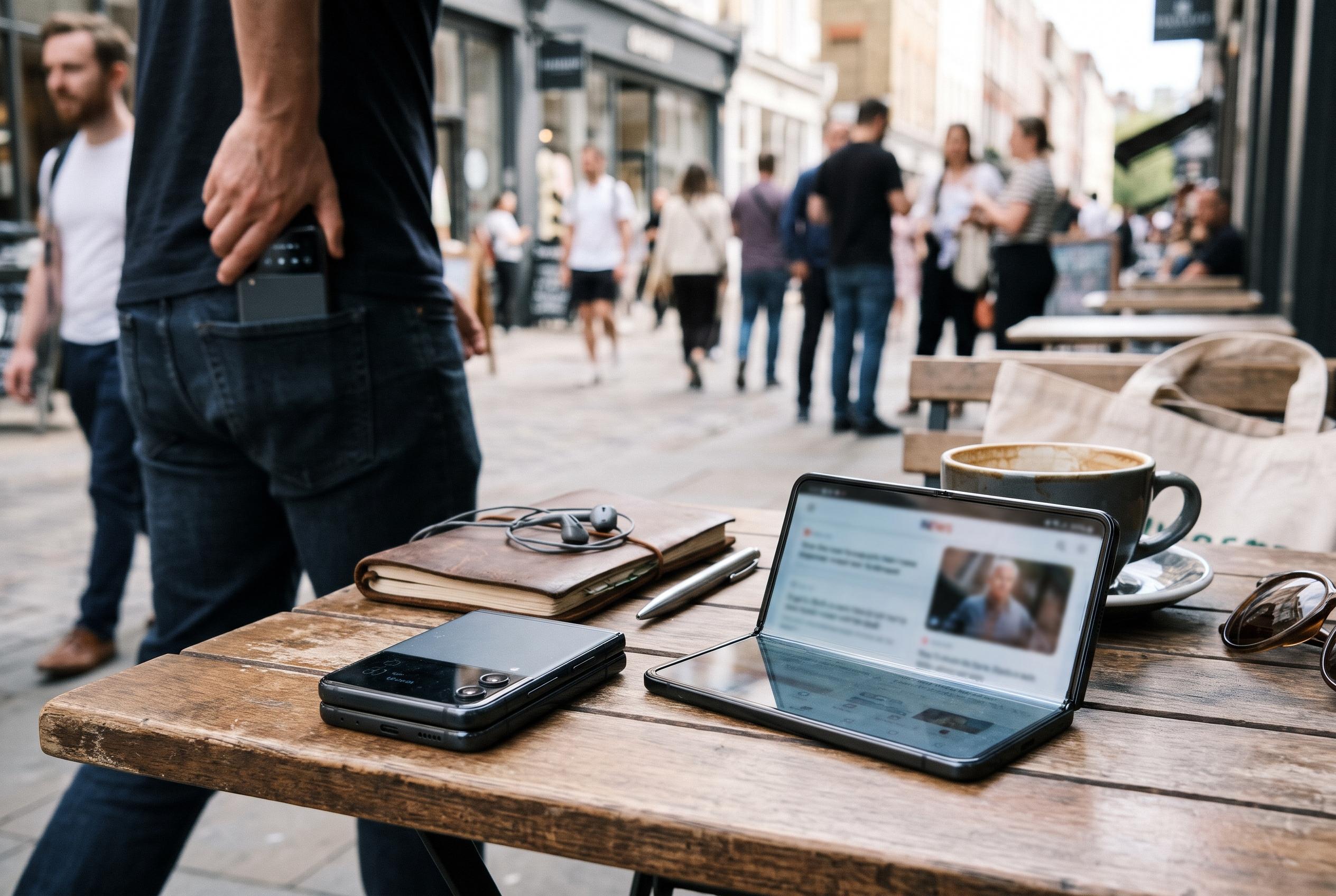

Samsung’s premium foldable is 24g lighter and lasts two hours longer in testing, while Google counters with a brighter display, IP68 protection and 5x optical zoom.
Samsung’s Galaxy Z Fold8 Ultra and Google’s Pixel 11 Pro Fold sit at the premium end of the foldable market, but they appeal to slightly different buyers. In the United States, Samsung is asking $2,099.99 for the base 256GB model, or $200.99 more than Google’s $1,899 asking price. That extra spend does not mainly buy a better camera system or a radically larger screen. It buys a handset that is 24g lighter, 1.2mm slimmer when folded, and better suited to people who carry their phone all day and want the least bulky book-style foldable available. That is the central reason the Samsung model comes out ahead for most shoppers.
The physical difference is easy to understand in hand. Samsung’s device weighs 215g and measures 8.9mm thick when shut, while Google’s weighs 239g and comes in at 10.1mm folded. Google has improved its own design compared with the previous generation, but Samsung still has the edge on portability. The distinction matters because foldables are judged less by their headline specifications than by how tolerable they are to carry, open and use every day. Samsung also makes clear that the Ultra is a distinct model from the standard Galaxy Z Fold8, which helps explain why the two phones should not be treated as identical variants.
Display performance is one of the few areas where Google takes a clear lead. Tom’s Guide measured the Pixel 11 Pro Fold’s inner panel at 2,982 nits, compared with 2,687 nits for Samsung’s foldable. In practical terms, that means the Pixel’s main screen should remain easier to read in bright outdoor conditions. Samsung counters with an LTPO panel, which can reduce its refresh rate when little is moving on screen and may help conserve power. Even so, brightness is the more visible advantage here, while the crease remains part of the foldable experience on both devices.
Battery life tilts the comparison back to Samsung. In Tom’s Guide’s custom test, the Galaxy Z Fold8 Ultra lasted 14 hours and 33 minutes, while the Pixel 11 Pro Fold ran for 12 hours and 31 minutes. That gap is notable because Samsung’s battery is only modestly larger at 5,000mAh, compared with Google’s 4,806mAh typical figure. The result suggests stronger efficiency from Samsung’s platform rather than simply a bigger cell. Charging also favours the Galaxy, with 45W wired support against Google’s 30W, although Google adds 25W Qi2.2 wireless charging for compatible magnetic chargers.
Durability and imaging are the areas where the Pixel can still justify itself. Google gives the Pixel 11 Pro Fold an IP68 rating, which means it is dust-tight as well as water-resistant, while Samsung’s IP48 rating offers less protection against fine particles. On a folding phone, that distinction matters because the hinge is a potential entry point for dust and grit. Camera choice is more nuanced. Samsung’s 200-megapixel main sensor sounds more impressive, but Google’s 5x telephoto lens offers greater reach than Samsung’s 3x unit, which will matter more to people who frequently photograph distant subjects. Samsung’s Snapdragon 8 Elite Gen 5 for Galaxy is also the stronger chip on paper and, alongside the battery results, supports the view that the Galaxy is the more efficient and better-rounded device overall.
Taken together, the trade-off is straightforward. Samsung’s premium over Google is, in effect, a charge for easier handling, lower weight and longer endurance, while Google’s strengths are more situational: dust protection, a brighter inner display and longer optical zoom. For most buyers, those everyday gains from the Galaxy Z Fold8 Ultra are likely to matter more than the Pixel’s narrower advantages. Only readers who regularly use a phone in dusty environments, depend on the brightest possible inner panel or value 5x zoom above all else are likely to find Google’s foldable the better fit.
Disclaimer: This content is intended for informational purposes only. Readers are advised to exercise their own judgement, conduct due diligence, or consult a qualified expert before acting on any information provided.