

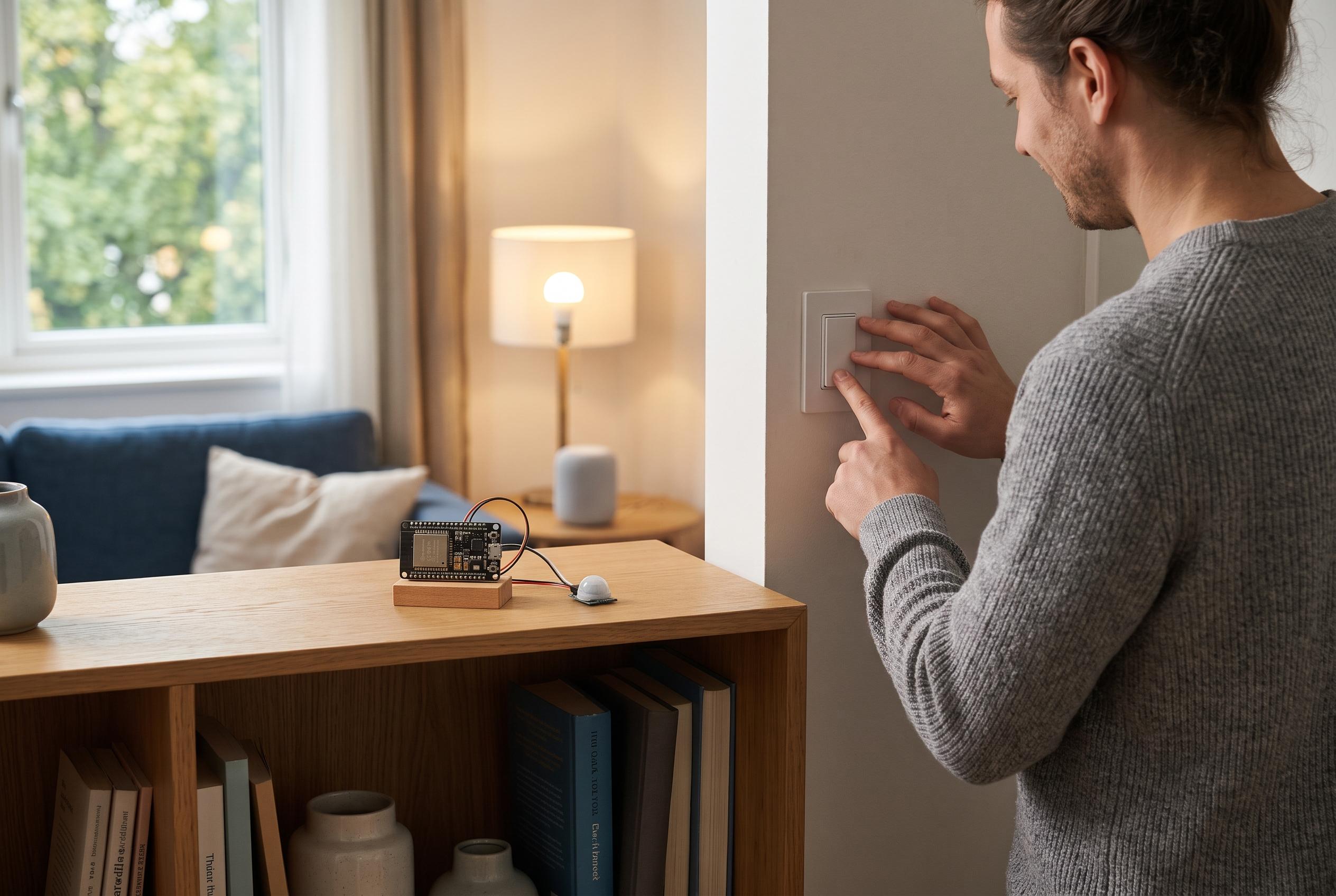

From room presence sensors to local voice control, inexpensive ESP32 boards can replace some subscription-based gadgets , though more demanding projects need careful setup and the right hardware.
ESP32 boards have become a favourite platform for home tinkerers because they are inexpensive, flexible and powerful enough to handle a surprising range of connected devices. For readers who want to avoid cloud subscriptions and the privacy trade-offs that often come with ready-made smart home products, they can also provide a practical route to building local alternatives. With a handful of sensors, a little wiring and software such as ESPHome or the Arduino IDE, it is possible to assemble useful household devices at a fraction of the cost of many premium commercial gadgets.
One of the clearest examples is room occupancy detection. A millimetre-wave radar module paired with an ESP32 can detect both movement and stationary presence, making it more capable than a basic motion sensor when someone is sitting still in a room. ESPHome documentation for the LD2410 module shows that these sensors can be integrated into a smart-home system through UART and configured for different setups, although placement and calibration still matter. In practice, that makes the approach well suited to lighting, heating and speaker automations where false triggers need to be kept to a minimum.
A weather station is another strong use case, especially for households that do not want to rely on external weather APIs or subscription services. Bosch Sensortec’s BME280 measures temperature, humidity and pressure, which makes it a popular choice for local environmental monitoring, while the company’s specifications underline its suitability for compact, low-power projects. For simpler builds, the DHT22 remains a budget option, though it is less capable than the BME280, and a peer-reviewed comparison of low-cost sensors found meaningful differences in performance between inexpensive parts. That distinction matters if the readings are going to drive automations rather than merely display rough conditions.
ESP32 hardware can also serve as the basis of a private voice assistant, but the project is more involved than many makers first expect. Home Assistant’s Assist platform supports local voice control through the companion app, dedicated hardware and ESPHome-based devices, while ESPHome’s own documentation makes clear that the voice assistant feature places real demands on memory and processing resources. In a typical DIY setup, a microphone such as the INMP441 and a speaker module such as the MAX98357A can provide audio input and output, with the Home Assistant system handling the heavier processing work. That arrangement keeps the device local, while still leaving room for custom wake words and tailored voice workflows.
For a wall-mounted smart home panel, the limitations of a basic ESP32 become more obvious. Rich dashboards, responsive touch input and live status views require more memory and better graphics handling than entry-level boards usually provide. Espressif’s documentation for the ESP32-P4 explains that the chip can use external PSRAM, which helps with larger display buffers and more demanding applications. That makes it a better fit for a control panel built around Home Assistant dashboards, especially if the goal is a polished interface rather than a simple status screen.
An ESP32-CAM module can fill a different niche as a low-cost camera for basic monitoring. Espressif maintains the camera driver and example resources for supported hardware, confirming that image capture and streaming experiments are technically straightforward on compatible boards. Even so, the module is not a replacement for a high-quality security system: resolution, frame rate and reliability will depend heavily on the board, sensor and software configuration. Used carefully, though, it can still be useful for low-risk tasks such as monitoring a pantry, attic or doorway, especially when the goal is local-only video rather than cloud surveillance.
Taken together, these projects show why the ESP32 continues to attract home automation enthusiasts. It is not the best choice for every job, and some builds require more tuning than a packaged product ever would, but the trade-off is control. A maker can keep data on the local network, avoid recurring fees and tailor the system to the house rather than to a vendor’s ecosystem. For many smart home tasks, that balance is more compelling than buying yet another appliance tied to an account, an app and a subscription.
Disclaimer: This content is intended for informational purposes only. Readers are advised to exercise their own judgement, conduct due diligence, or consult a qualified expert before acting on any information provided.



