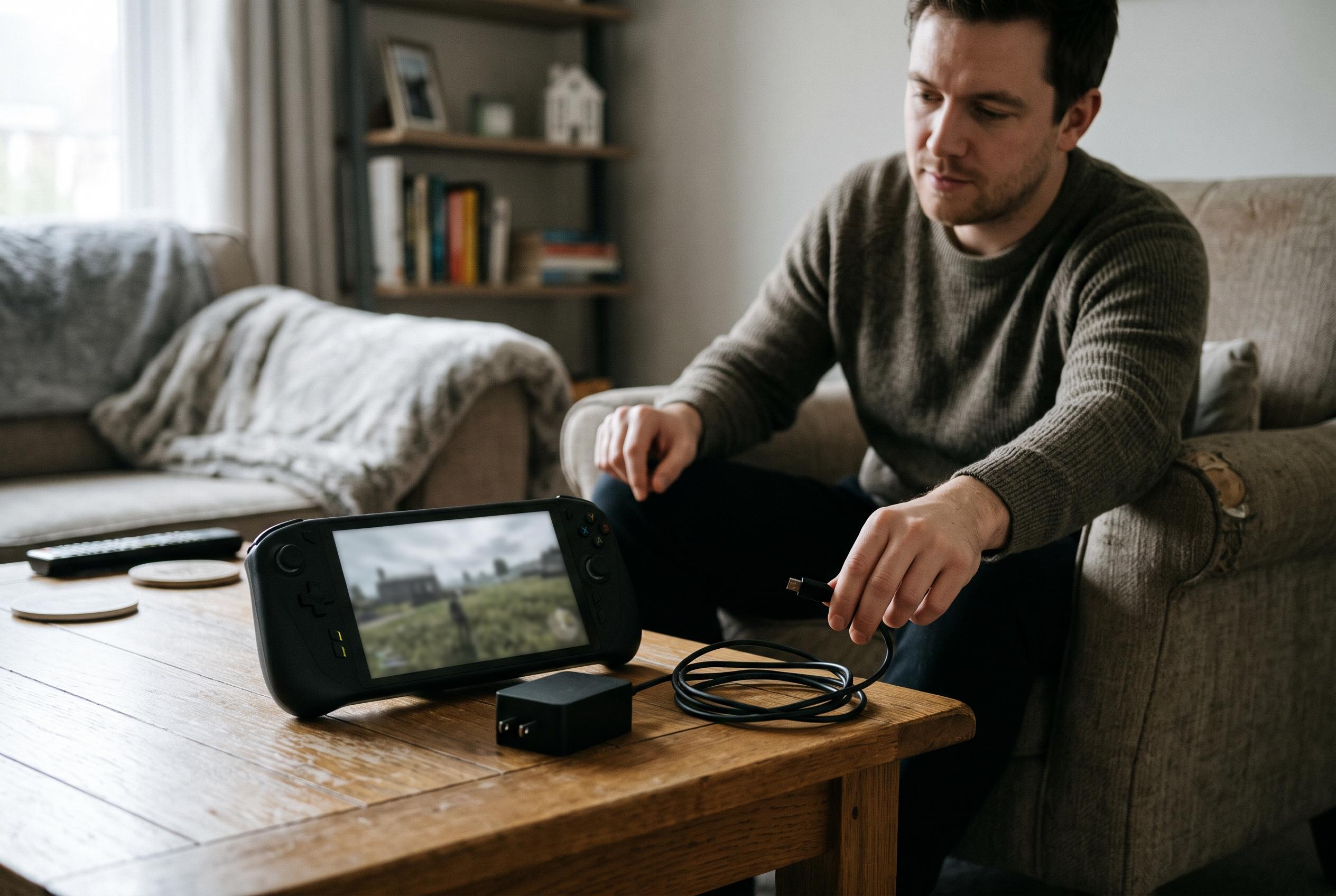

The eight-inch Windows handheld delivers convincing performance for its price tier, but its 840g bulk, noisy fans and short battery life make it a poor fit for gaming on the move.
Acer’s Predator Atlas 8 enters the handheld gaming PC market with a clear ambition: offer serious performance in a large-screen Windows device without pushing the price into the very top tier. In the configuration reviewed, it pairs an Intel Arc G3 chip with 16GB of memory and 512GB of storage, while Acer’s wider range also includes higher-end variants and larger batteries. The result is a machine that tries to balance power, features and cost in a segment where prices have climbed sharply.
Physically, though, the Atlas 8 is unapologetically large. Its eight-inch panel and broad grips make it feel more like a compact portable console than something built for a commuter bag, and at 840 grammes it is not a light device. The design is practical rather than elegant, with twin USB-C ports, a microSD card slot and a fingerprint reader built into the power button. According to Acer’s product information, the screen is a 1,920 by 1,200 panel with a 120Hz refresh rate, variable refresh rate support and up to 500 nits of brightness. The review also notes that Acer does not supply a carrying case, although it does include an extra screen protector.
On performance, the handheld appears to deliver what its specifications promise. The review says demanding games such as Gears of War: E-Day, Cyberpunk 2077 and Death Stranding 2 remained playable at around 40 frames per second with high settings and ray tracing enabled, rising to roughly 70 frames per second when Intel’s frame generation was switched on. Acer has positioned Intel XeSS and Arc graphics as central to the Atlas 8’s appeal, and the review suggests those technologies are doing a lot of the heavy lifting. The trade-off comes when the device is pushed into its highest-power mode: fan noise becomes pronounced, reaching about 50 decibels in the test, even if heat was handled competently.
Battery life is the handheld’s weakest point, which is hardly surprising for this class of product. The review found that the 60Wh model struggled to last long on demanding games, with roughly an hour of play in a heavy title and a little under two hours in a lower-power mode. Acer’s broader lineup includes batteries of up to 80Wh, but the tested unit still reflects the fundamental limits of Windows handhelds: excellent flexibility, but little endurance unless the charger is close at hand. The software experience is also mixed. Acer’s PredatorSense overlay is straightforward and useful for quick adjustments, yet Windows 11 still makes launching games from services such as Steam and Epic feel more complicated than it should on a handheld.
Taken together, the Predator Atlas 8 looks like a capable if imperfect entry in a fast-moving category. Acer’s own announcement frames it as a premium handheld with strong cooling, Xbox integration and Arc graphics, while launch reporting in the United States placed it at the upper end of the market, depending on configuration. The review’s verdict is that Acer has produced one of the more convincing value propositions in the segment, even if the price remains high and the software still feels like it was adapted from a desktop rather than designed for a portable gaming machine.
Disclaimer: This content is intended for informational purposes only. Readers are advised to exercise their own judgement, conduct due diligence, or consult a qualified expert before acting on any information provided.