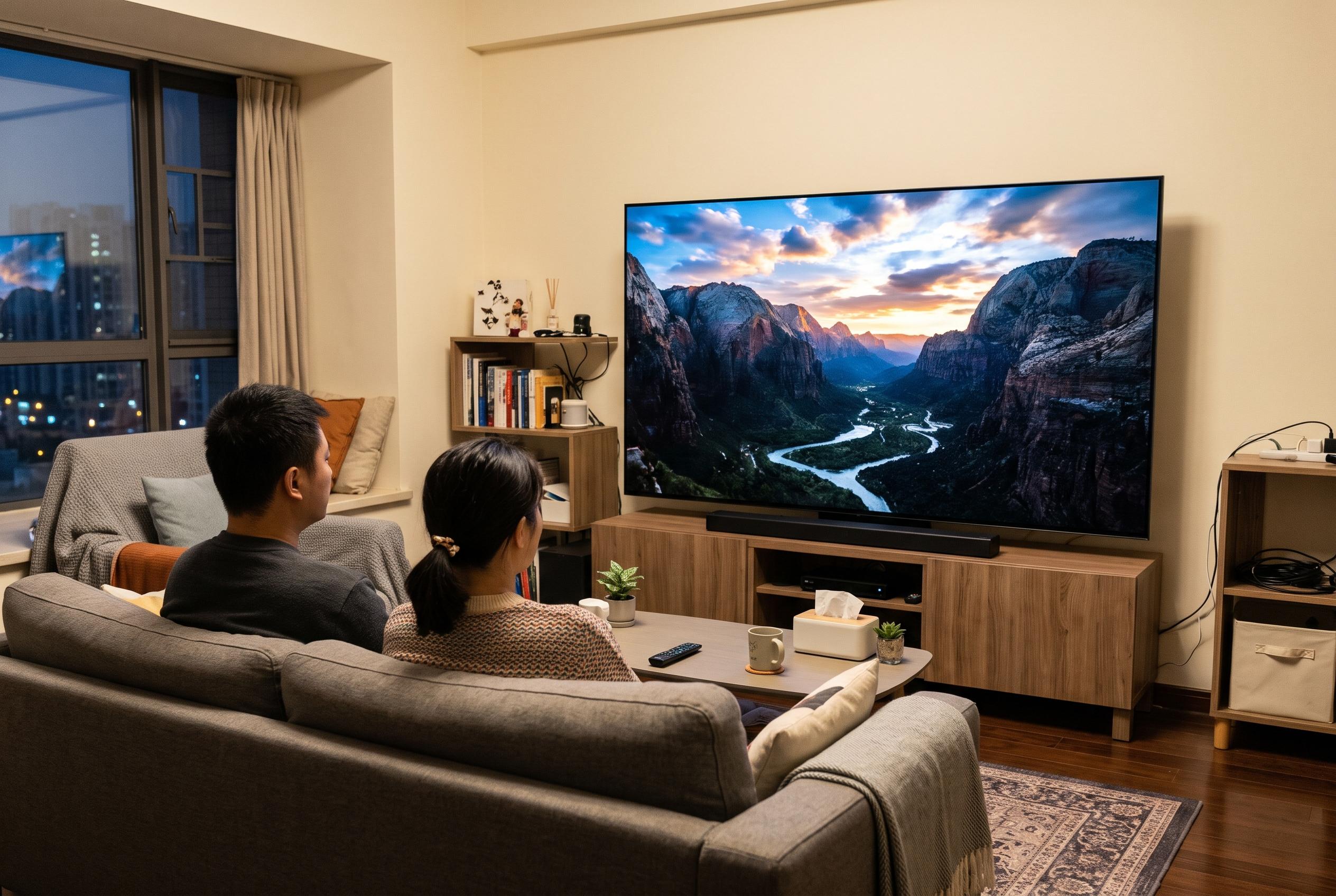

With similar headline specifications masking big differences in dimming zones, brightness and native refresh rates, the Redmi X85 2026 shows what buyers can expect at the budget end of China’s 85-inch Mini LED market.
This year’s 11.11 promotions have made the 85-inch Mini LED market look oddly uniform on paper. Several models now advertise 4K resolution, 144Hz or higher refresh rates, 4GB of memory, 64GB of storage and four-digit dimming-zone counts, yet prices still range from roughly 5,796 yuan to 9,220 yuan. The real differences are less about the headline numbers than the number of local-dimming zones, the generation of the chipset and whether a model is effectively being cleared from stock.
That is why the question is not simply whether 5,000 yuan is enough for an 85-inch Mini LED television, but what that budget can actually buy in late 2026. Xiaomi’s Redmi X85 2026 is one of the clearest examples of what sits in that bracket. IT Home reported that it uses 640 dimming zones, reaches a claimed peak brightness of 1,200 nits and supports native 4K at 144Hz, with a 288Hz gaming mode, 4GB of memory and 64GB of storage. Its launch price was 4,799 yuan, although market pricing has since moved lower on some channels. JD’s buying guide also places it in the 85-inch Mini LED category with two full-bandwidth HDMI 2.1 ports.
By contrast, Hisense’s Xiaomo E5S sits slightly higher in the market and pushes the specification sheet in a different direction. According to IT Home and Hisense’s official product listing, the 85-inch E5S offers 1,536 dimming zones, a claimed 4,200 nits of peak brightness, native 180Hz refresh, a 330Hz HSR mode, 3GB of memory and 64GB of storage. Hisense also lists four HDMI 2.1 inputs, with two supporting 4K at 180Hz. For buyers, the trade-off is straightforward: more aggressive backlight control and stronger brightness claims, but less memory than the Redmi model.
That distinction matters because dimming zones remain one of the most visible determinants of Mini LED performance, especially in dark scenes. RTINGS explains that the more precisely a backlight can be divided and controlled, the better it can limit blooming around bright objects such as subtitles against black backgrounds. But it also notes that zone count alone does not decide the final result; the television’s processing and local-dimming algorithm are equally important. In practice, the difference between a set with around 640 zones and one with more than 1,500 zones is most obvious in dark-room viewing, not in brightly lit showroom demonstrations.
The refresh-rate numbers also deserve caution. IT Home’s report on the Redmi X85 2026 makes clear that 288Hz is a separate mode, not the panel’s native 4K refresh rate. Hisense’s official listing does something similar with 330Hz HSR. For film, sports and console gaming, the native 144Hz or 180Hz mode is usually the more relevant figure, particularly when paired with HDMI 2.1 and low input lag. Higher advertised modes may appeal to competitive players, but they often involve a compromise in resolution or another aspect of image fidelity.
Room size matters just as much as panel specification. Hisense lists the 85-inch Xiaomo E5S as measuring 1,890mm by 1,088mm without the stand and weighing 35kg. RTINGS’ size-and-distance guidance suggests that viewing comfort depends on the field of view, room layout and personal preference, rather than on a single fixed rule. For a set this large, the practical question is not whether it can fit the wall, but whether the viewing distance is long enough for the screen to feel immersive rather than overwhelming. In many homes, 2.6 to 2.8 metres is the point at which 85 inches starts to make sense; below that, 75 inches is often the safer choice.
For most buyers, then, the 5,000-yuan class is enough if the viewing conditions are ordinary: moderate ambient light, mainly evening use and an interest in films, sport and occasional console gaming. In that scenario, a model such as the Redmi X85 2026 offers a balanced mix of 640 zones, 1,200 nits, native 144Hz and 4GB of memory. If the room is bright, the viewer is sensitive to haloing or dark-scene artefacts, and the budget can stretch further, the higher-brightness, higher-zone models make a stronger case. The most important mistake is to chase the biggest refresh-rate figure while ignoring the native panel rate, the memory configuration and the real viewing distance.
Disclaimer: This content is intended for informational purposes only. Readers are advised to exercise their own judgement, conduct due diligence, or consult a qualified expert before acting on any information provided.