

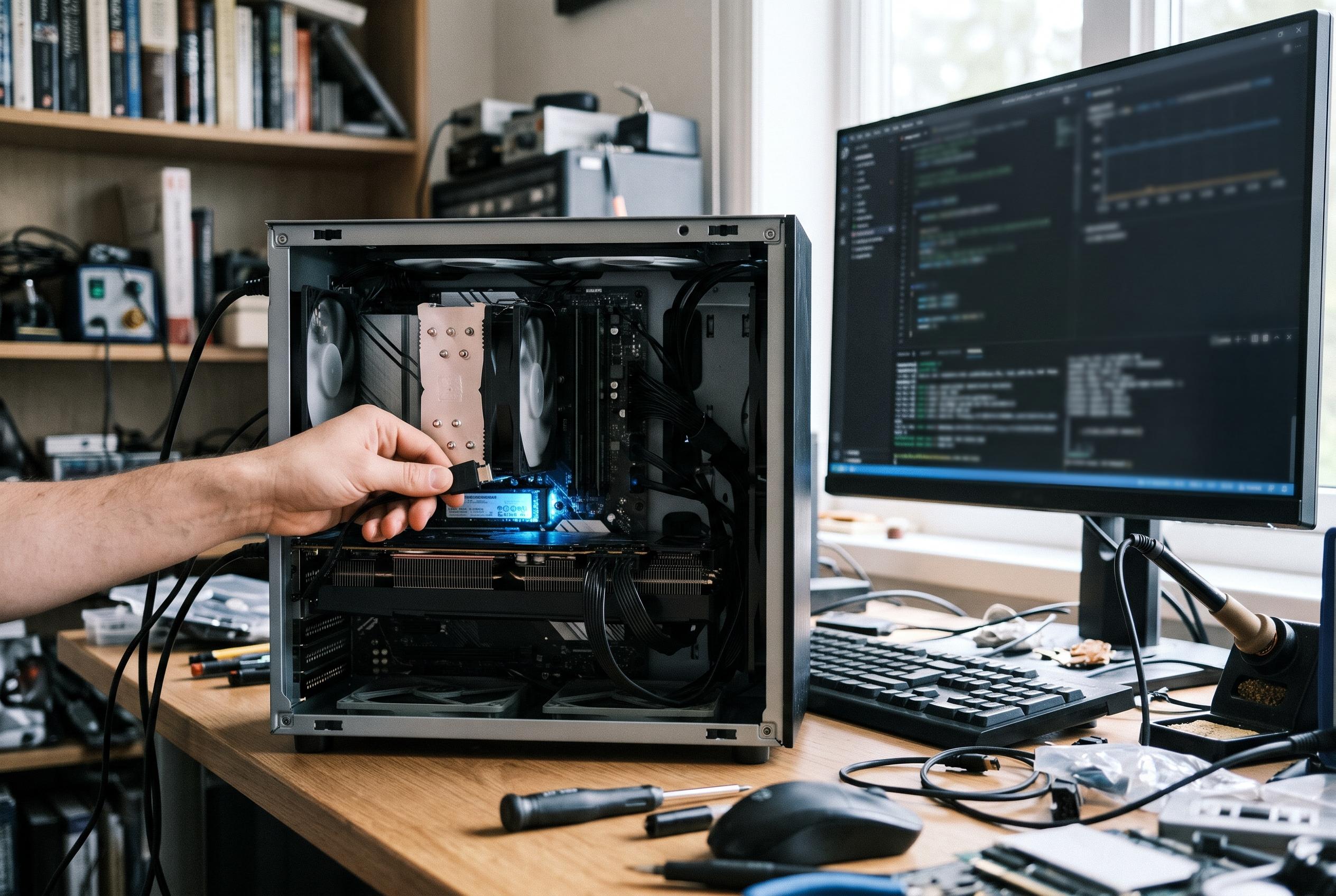

A fact-check found WiCi’s SSD-streaming demo technically plausible, but its speed claims are hard to compare with a high-memory Mac running a different model.
A recent sponsored YouTube demonstration claiming to run a very large DeepSeek model on a 32 GB graphics card withstands a detailed check, although the comparison with a high-memory Mac depends heavily on which model is being used. According to the analysis by Novel Cognition, NetworkChuck’s 30 October 2026 video, which was disclosed as sponsored by WiCi, showed a WiCi One unit using an RTX 5090 or RTX 5060 Ti inside a Wi-Fi 7 enclosure that can be shared across devices in a home as a remote graphics card. The video said the system was running DeepSeek V4.1 Flash at roughly eight tokens a second by streaming most of the model from a solid-state drive. DeepSeek’s own materials and WiCi’s documentation help explain why that is technically plausible: V4.1 Flash is a mixture-of-experts model, meaning only part of the full parameter set is active for each token, and WiCi’s open-source InferSSD software is designed to keep inactive weights on SSD rather than holding the entire model in memory.
Novel Cognition said it checked 21 claims from the video against DeepSeek’s model card, WiCi’s InferSSD code and Apple’s specification pages, then ran four tests on a Mac Studio of its own on 31 October 2026. Its conclusion was that 12 claims held as stated, six were broadly correct but needed qualification, and three could not be tested directly; none failed. The technical core of the WiCi system is that it streams selected experts from storage, keeps frequently used experts cached, and, on some systems, can also store part of the working set on the graphics card. WiCi’s repository reports a DeepSeek V4.1 Flash result of 7.27 tokens a second on an RTX 5090, while the company’s product page quotes about 8 tokens a second on one configuration and 20 on another, although the testing conditions are not identical.
There are, however, important caveats for buyers comparing the system with a Mac. Novel Cognition notes that the video’s “full quality” mode refers to the text-only build loaded by the engine, not the model’s image input or its built-in draft model. It also points out that the published speed figures are not directly comparable: WiCi’s repository cites one benchmark on an RTX 5090 with a prompt of about 4,000 tokens, the video shows another figure on early hardware, and the company’s own product page gives a higher number without detailing the same test conditions. On Macs, InferSSD follows a different path, computing each routed expert on the processor rather than the graphics chip; its repository says it reaches 2.874 tokens a second on a MacBook Pro.
The contrast with Apple’s latest desktop is equally important. Apple’s newsroom and support pages identify the 2026 Mac Studio with M5 Max and M5 Ultra chips, with the higher-end configuration available with up to 256 GB or 512 GB of unified memory. Novel Cognition uses a 256 GB Mac Studio in its office as a shared AI server, and when it asked the same two coffee-related questions posed in the video, it ran the older DeepSeek V4 Flash model fully in memory at a median 22.5 tokens a second over six runs. That is not the same model as DeepSeek V4.1 Flash, which DeepSeek says has a larger official release footprint and additional multimodal capability. In other words, a big-memory Mac can keep smaller or more memory-efficient models resident all the time, while WiCi’s approach is aimed at workloads too large to fit comfortably in RAM.
Novel Cognition’s tests also showed why the two systems behave differently. Its Mac Studio’s Thunderbolt storage could read large blocks at around 2.6 GB/s, but small 4 KB reads were far slower, at 34 MB/s, which helps explain why SSD streaming is useful only when the software is designed to minimise random access. Switching back to a chat model after loading a second, smaller model took less than a second when both remained in memory, but around 17 seconds without WiCi’s scheduler and about four seconds with it on the 32 GB card used in the video. The group says network traffic for a streamed answer used only about 18 kilobits a second on the office network, far below the roughly 400 megabits a second seen when the Wi-Fi system was used for gaming. Its broader reading is that the WiCi box and the Mac Studio solve different problems: one is designed to make very large models usable on shared consumer hardware, while the other is built to keep models that do fit in memory immediately available with no swapping.
Disclaimer: This content is intended for informational purposes only. Readers are advised to exercise their own judgement, conduct due diligence, or consult a qualified expert before acting on any information provided.



