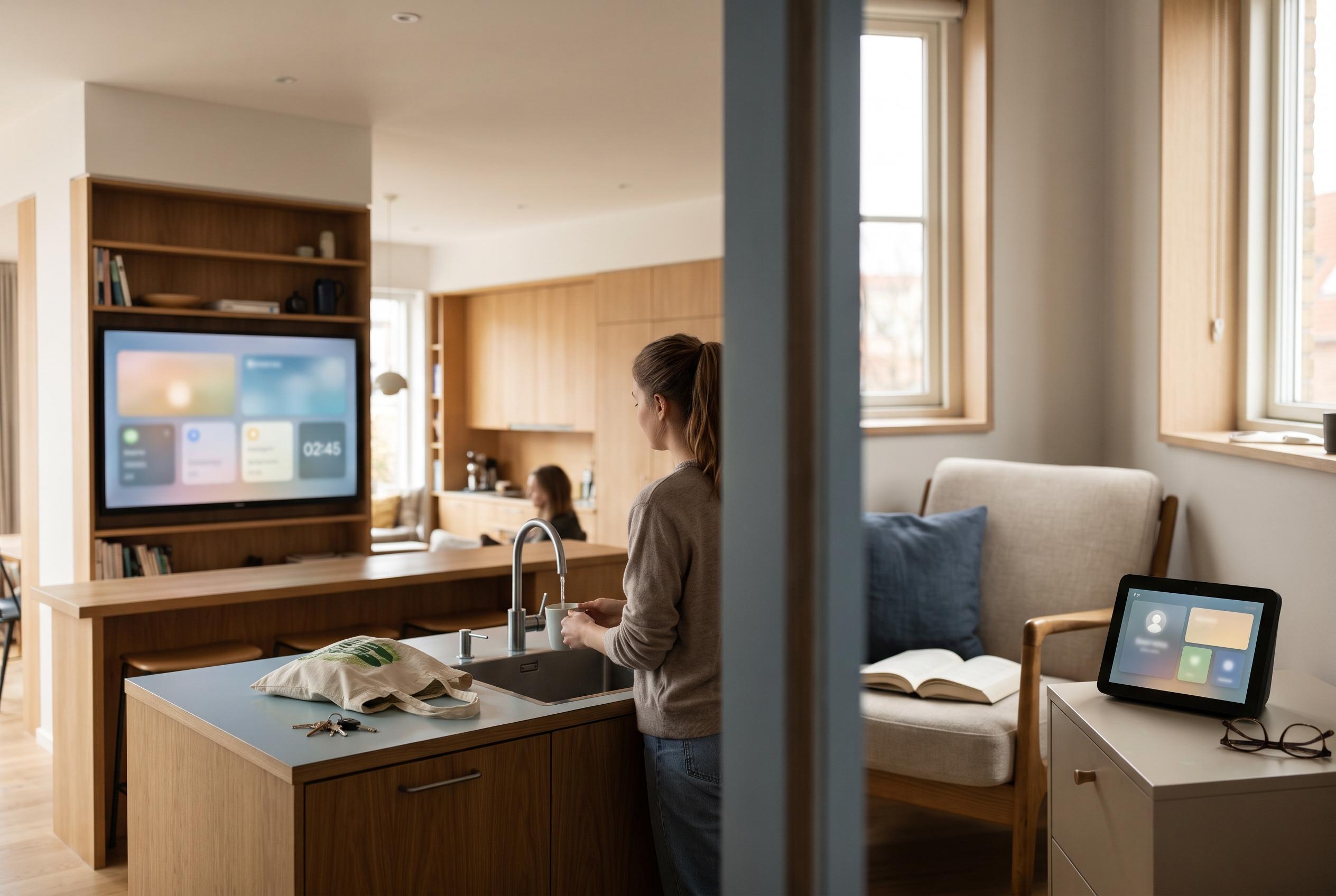

Amazon’s large, shared-screen hub is built for family routines, while Apple’s cheaper 7-inch HomeView centres on personal profiles and privacy. The choice may depend less on features than on which ecosystem, and kind of household, you already have.
Amazon and Apple have both moved the smart display category on, but they are aiming at different households. Amazon’s redesigned Echo Show 16 arrived as a large, kitchen-friendly hub with a 16-inch Full HD screen, a 13-megapixel camera, night vision and Fire TV built in. Apple’s HomeView, by contrast, is a far smaller 7-inch display built around personalisation, privacy and tighter integration with the Apple ecosystem. For buyers weighing the two, the first question is no longer which one is more capable, but which kind of home it is meant to serve.
Price is where the contrast becomes impossible to ignore. Amazon has set US preorder pricing at $499.99 for the standard Echo Show 16 and $569.99 for the Nanomatte version, while Apple has opened HomeView preorders at $299, with availability due from 13 November. That leaves a gap of roughly $200 between the base models, even before Amazon’s optional anti-glare panel is considered. In practical terms, the Echo Show 16 buys a much larger display and a more commanding wall presence, while HomeView is designed to sit unobtrusively on a countertop or desk.
Amazon is leaning heavily on scale and shared use. The company says the Echo Show 16 can act as a family organiser, a smart-home dashboard and a digital photo frame, while Omnisense sensors combine temperature sensing with presence detection to trigger actions such as adjusting the thermostat or switching on lights. Amazon also says certain functions depend on Alexa+, which is included with Prime membership. That gives the device a clear advantage for households that already rely on Alexa for routines, connected cameras and family scheduling.
Apple is taking a more personal route. HomeView is built to recognise up to six people and present each of them with a tailored home screen. Apple says it can show up to nine camera feeds, handle FaceTime and music, and support hands-free control of compatible accessories. The company is also pitching the device as a home hub for Apple users, with Siri AI, personal content and the ability to surface information only when the recognised user’s paired device meets Apple’s conditions. For households already centred on iPhone, iPad and Apple Home, that may feel more seamless than Amazon’s broader, more communal approach.
Privacy remains one of the sharpest dividing lines. Apple says HomeView uses Secure Exclaves to process camera and microphone data in a protected environment, and its system is designed so personal content appears only under specific conditions. Amazon, meanwhile, offers physical mute controls and says its devices detect the wake word locally before sending audio to the cloud. But the company has also faced regulatory scrutiny over Alexa recordings in the past, after the Federal Trade Commission said Amazon retained certain voice data and, in some cases, did not fully remove transcripts when parents asked for deletion. That history does not determine how the new Echo Show 16 behaves, but it does shape how some buyers will judge Amazon’s privacy assurances.
The broader choice, then, is not simply between two smart displays. It is between a larger, more household-oriented Amazon device that doubles as a shared screen for calendars, cameras and entertainment, and a smaller Apple display that prioritises individual profiles, tighter ecosystem control and stronger privacy framing. Amazon’s model is the more ambitious family centre, particularly for homes already invested in Ring and Alexa. Apple’s is the more restrained and cheaper option, and for many households that will be enough.
Disclaimer: This content is intended for informational purposes only. Readers are advised to exercise their own judgement, conduct due diligence, or consult a qualified expert before acting on any information provided.