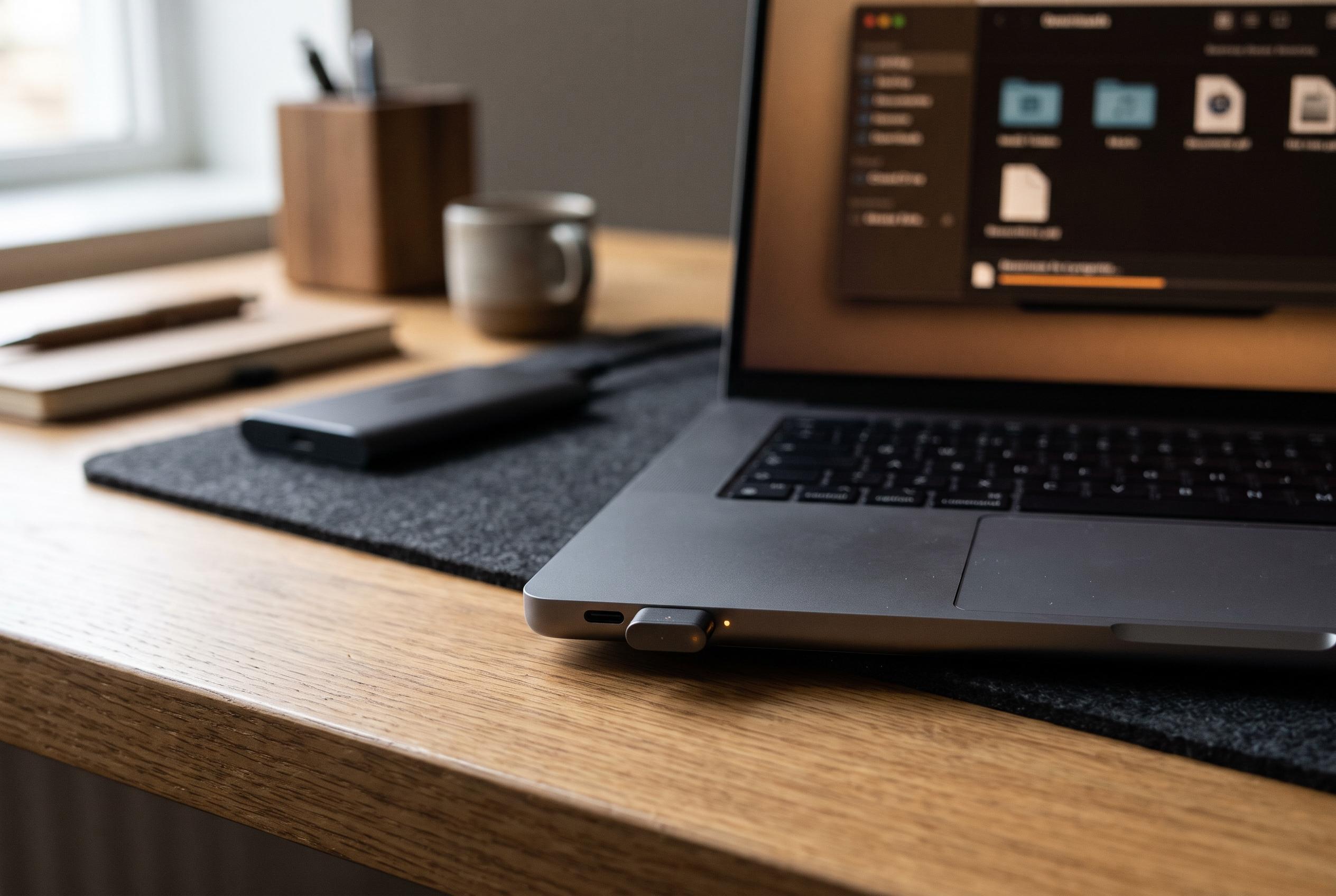

The Extreme Fit’s low-profile design makes extra storage easy to leave plugged in, but heat-related slowdowns and FAT32’s file-size limit may frustrate users with heavier workloads.
SanDisk’s Extreme Fit USB-C flash drive is not trying to win on raw speed alone. Its appeal lies in a very different promise: storage that is so small it can stay attached to a laptop, tablet or phone without becoming an inconvenience. In a market where many users are balancing slimmer devices against ever-growing files, that makes it a practical accessory rather than just another portable drive.
The model line spans five capacities, from 64GB to 1TB. According to SanDisk, the 64GB version is rated at read speeds of up to 300MB/s, while the 128GB, 256GB, 512GB and 1TB versions are rated at up to 400MB/s. The company also says the drive uses a USB 3.2 Gen 1 interface and weighs just three grams, which helps explain why it is designed to sit almost flush with a device rather than hang off it awkwardly. Business Standard’s review tested the 512GB version and found that it fitted naturally into day-to-day use across work, travel and personal storage.
That tiny footprint is the drive’s greatest strength and its main weakness. It is easy to leave plugged in, which is exactly the point, but it is also easy to forget it is there or misplace it once removed. SanDisk offers a separate protective case, which is not essential for operation but does make the drive easier to keep track of when it is not attached. StorageReview reached a similar conclusion in its independent review, describing the product as best suited to light, everyday storage rather than heavier professional workloads.
Out of the box, the drive comes formatted as FAT32, which gives it broad compatibility across major platforms. Apple’s support documentation for iPhone external storage confirms that exFAT and FAT32 are among the supported formats, while Microsoft’s file-system guidance notes that FAT32 cannot handle individual files larger than 4GB. That matters in practice, because users who work with large video files or other sizeable media may need to reformat the drive to exFAT. Business Standard found that this trade-off preserved cross-platform use while removing the single-file limit, though it also reduced the simplicity of the default setup.
Heat is the other limitation worth noting. Because the device is so small, it warms up noticeably during transfers, and the reviewer found that sustained performance dropped as temperatures rose. That makes it less suitable for long, continuous write sessions, even if it remains perfectly serviceable for moving documents, photos and smaller batches of files. SanDisk positions the drive for phones, tablets and laptops that need extra space without the bulk of an external SSD, and that is the use case where it makes most sense. It is not a substitute for a fast portable SSD, but for users who want storage always within reach, it is a neat and unusually unobtrusive option.
Disclaimer: This content is intended for informational purposes only. Readers are advised to exercise their own judgement, conduct due diligence, or consult a qualified expert before acting on any information provided.