

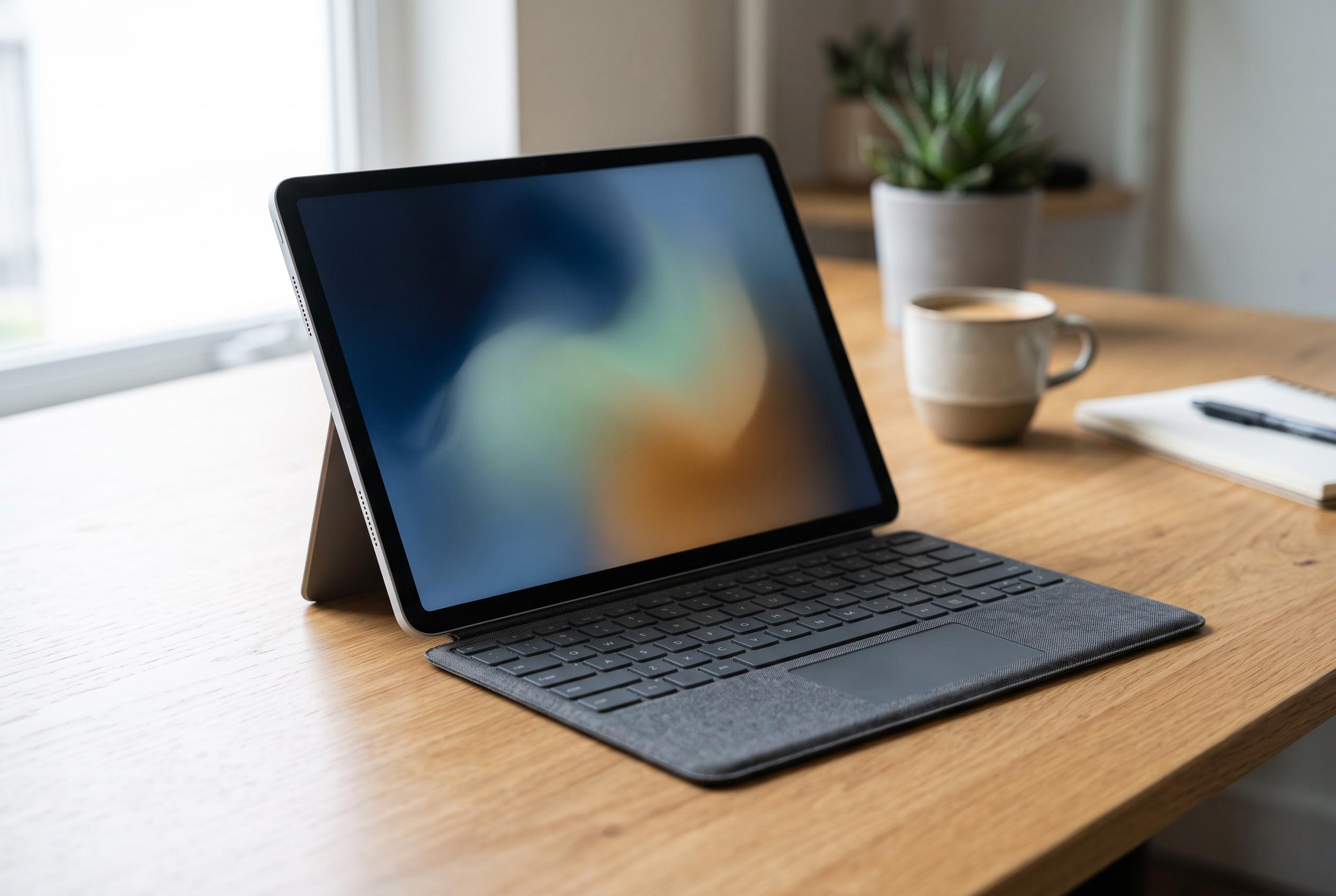

Notebookcheck found that a new Sharp panel in one retail unit is brighter than the previous model’s screen, but has lower contrast and slower pixel response. The reviewer cautions that other units may use a different panel.
Microsoft’s latest Surface Pro 12-inch may look familiar on paper, but Notebookcheck’s lab review suggests the screen inside at least one retail unit is not the same panel Microsoft used before. The device keeps the same 12-inch, 3:2 IPS touchscreen format at 2,196 x 1,464 pixels and 90Hz, yet the review found that the new Sharp panel is measurably brighter but also less capable in contrast and motion handling than the earlier BOE version. Microsoft launched the second-edition Surface Pro 12-inch and Surface Laptop 13-inch on 23 September 2026, with the Pro going on sale in select markets from 13 October. In the US, Microsoft’s store lists the entry model at $1,149.99 with a six-core Snapdragon X2 Plus, 16GB of RAM and 256GB of UFS storage.
That change matters because display quality is one of the few areas where a tablet-first Windows device can still stand out or fall short. Notebookcheck’s measurements put the newer panel at about 512 nits of average brightness, up from roughly 484 nits on the earlier model, but black levels worsened from 0.24 cd/m² to 0.44 cd/m². As a result, measured contrast fell to 1,220:1 from 2,021:1. The same review also recorded slower pixel transitions, with grey-to-grey response at 41.8 milliseconds and black-to-white at 20 milliseconds, and said ghosting was visible even with the display set to 90Hz.
The panel is not a poor one in every respect. Notebookcheck reported accurate grayscale and colour reproduction, 97.7 per cent sRGB coverage and no PWM flicker, which should make the screen comfortable for general productivity work. The problem is that refresh rate alone does not determine motion clarity. A display can redraw quickly while liquid crystals still take too long to settle, and that is what appears to be happening here. For web browsing, office tasks, note-taking and casual photo review, the issue may be minor. For anyone sensitive to smearing, or for users who want to play fast-moving games on the device, it is more likely to be noticeable.
Notebookcheck also said the revised screen may have a small effect on battery life. In its Wi-Fi test at 150 nits, the Surface Pro 12-inch lasted up to around 14 hours, and it reached about eight hours at maximum brightness. That was roughly 40 minutes less than the earlier model, although the review treated the difference as modest and still considered endurance strong. Microsoft’s own battery claims are not directly comparable, as the company says its figures came from pre-production testing in August 2026 under its own conditions.
The processor story is more mixed. Qualcomm’s Snapdragon X2 Plus platform is aimed at thin, efficient PCs, and in the Surface Pro 12-inch it gives the new model a clear lift in single-core performance and graphics work. Notebookcheck’s Geekbench 6.7 result showed 3,231 points in single-core testing, ahead of the earlier model’s 2,442. Yet multi-core performance dropped against the older eight-core Snapdragon X1 Plus, with Cinebench 2024 recording 427 points versus 554. Even so, Notebookcheck said the chip remains fast enough for everyday use, and the passive cooling still makes the Surface unusual in a market where many rivals depend on fans.
There are also a few practical hardware limits worth noting. The review unit weighed 688g, carried a 38Wh battery and ran Windows 11 Home. It has two USB-C ports with power delivery and DisplayPort support, though not USB4, and Notebookcheck said it had no trouble driving an external 4K display at 144Hz. The device includes Wi-Fi 7, but no 5G on the tested consumer model, while Microsoft’s business listings show an optional 5G version. RAM and storage are not user-upgradeable, there is no card reader or 3.5mm headphone jack, and Microsoft does not include a power adapter in the box.
For buyers, the main lesson is that a matching specification sheet does not guarantee the same viewing experience. Microsoft may be selling the same resolution, refresh rate and chassis across units, but Notebookcheck’s measurements suggest the panel supplier can still affect contrast, response time and perceived smoothness. That is why the older model may be the safer pick for anyone who values display quality above newer silicon, while the new version makes more sense for users who want the faster single-core behaviour, stronger graphics and newer NPU, and who are unlikely to notice the screen changes. Notebookcheck also cautioned that it tested just one unit, so other 2026 examples could use a different panel.
Disclaimer: This content is intended for informational purposes only. Readers are advised to exercise their own judgement, conduct due diligence, or consult a qualified expert before acting on any information provided.



