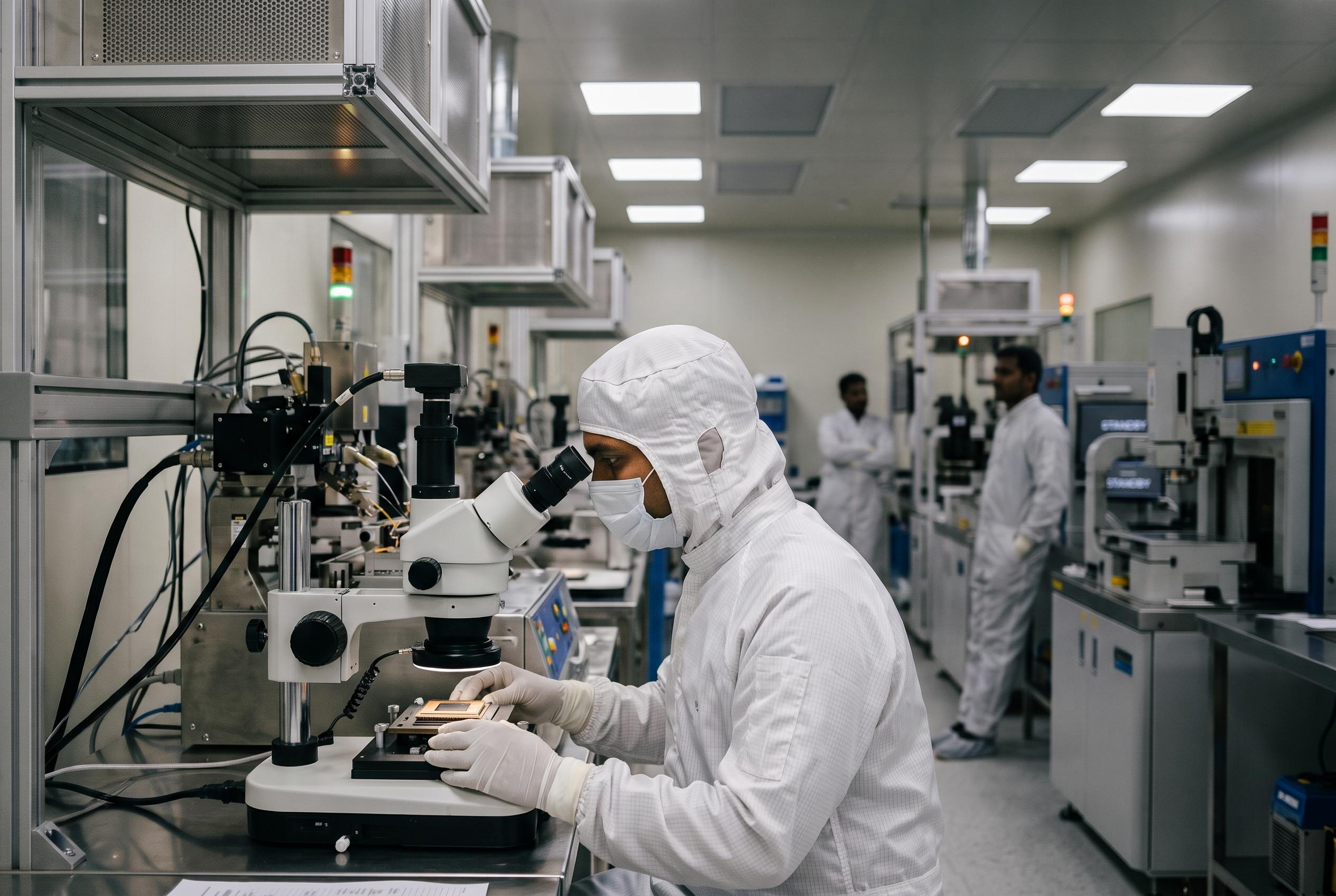

Smaller outsourced assembly and test plants could serve legacy packages and lower-volume customers, but they must secure anchor buyers, skilled staff and years of product qualification to keep costly equipment busy.
India’s semiconductor packaging build-out is creating room for a second tier of outsourced assembly and test providers, not just the large plants drawing most of the public attention. The question is no longer whether the country can attract major OSAT investments, but whether smaller, more specialised facilities can survive by concentrating on mature package types, narrow product lines and customers that value flexibility over scale.
According to EE Times, semiconductor consultant Nitin Dodia argues that a facility focused on established packaging processes could be launched with roughly ₹1.5 billion to ₹2 billion, depending on the products, equipment and operating costs involved. He said simpler formats such as wire bonding and leadframe-based packaging require less capital than more complex technologies. But he also stressed that the real test is not how much money is spent upfront; it is whether the plant can keep its equipment busy, qualify products and secure enough demand to support the business over time.
Sahasra Semiconductors offers a useful example of what a smaller Indian packaging site can look like in practice. The Press Information Bureau said the company inaugurated its semiconductor assembly, testing, marking and packaging facility in Bhiwadi, Rajasthan, on 15 May 2026. Built under the government’s Scheme for Promotion of Manufacturing of Electronic Components and Semiconductors, the plant occupies 57,000 square feet, cost more than ₹150 crore and is designed to package memory chips for microSD cards and flash storage, LED driver integrated circuits, eSIMs and RFID products. The government said it is India’s first small and medium enterprise facility to begin commercial semiconductor-chip production.
The scale gap with India’s larger OSAT projects remains wide. A government briefing on approved semiconductor projects puts Tata Electronics’ Assam facility at 48 million chips a day, CG Power’s Sanand project at 15 million chips a day and Kaynes Semicon’s Sanand plant at 6.33 million chips a day. By contrast, Sahasra’s stated annual capacity of 60 million units works out to only about 164,000 units a day on average. That difference underlines why small plants must compete on target markets, turnaround time and customer service rather than volume alone.
Dodia said that makes anchor customers essential. In his view, a new OSAT should ideally have at least one buyer committed for three to five years before production begins, particularly when the initial investment is modest. He pointed to companies such as Sahasra and RRP Electronics as examples of early entrants that already have customers in place. RRP says on its website that its Mahape, Navi Mumbai facility is Maharashtra’s first dedicated OSAT site and that it serves consumer, industrial and defence applications. Larger Indian OSAT ventures, by contrast, are following a model in which technology partners and anchor customers are built into the project from the outset. The government briefing says CG Semi, for example, is working with Renesas and Stars Microelectronics.
Experience, not just machinery, is another limiting factor. Dodia said trained personnel are scarce and that much of the knowledge needed to run semiconductor-grade production is not written down anywhere. He argued that two identical tools from the same supplier can drift in behaviour over time and that an experienced engineer is often needed to spot the cause through process data and statistical control charts. In an earlier interview cited by EE Times, Kaynes Semicon’s Wasi Uddin made a similar point, saying the immediate shortage is not in materials or equipment but in the expertise required to operate such facilities. He noted that India is drawing on engineers with overseas experience as well as specialists from countries such as the Philippines and Malaysia, while also competing with the domestic information technology sector for talent.
Qualification is another slow and expensive hurdle. Dodia said it can take 12 to 24 months before a new OSAT is fully approved by customers, who may demand six or more consistent production batches before signing off on a supplier. Even then, a plant may only become a secondary source. That lag matters because idle equipment still carries financing costs, and Dodia warned that investors should not expect meaningful returns in the first one or two years. A low entry cost does not guarantee a viable business if the line is underused.
He also argued that India’s OSAT map should evolve into a cluster model rather than a scattered one. States are competing to host projects, but a dispersed build-out makes it harder for suppliers to establish efficient logistics. Some materials, including leadframes for certain packages, may need to travel only short distances to avoid quality issues. Dodia said the alternative is a more concentrated ecosystem such as Sanand in Gujarat, where several packaging projects are already close enough to support shared suppliers. Even then, he said, the supply chain will take longer to mature if the industry is spread across multiple states.
The opportunity for smaller OSATs may lie in the parts of the market that larger operators are moving away from. Dodia pointed to legacy packages, automotive components and other mature products that continue to generate demand for many years. Amkor’s 2025 annual filing shows advanced products generating about $5.556 billion in sales, compared with $1.152 billion from mainstream products, illustrating how the global industry is shifting towards higher-value packaging. At the same time, the retirement of ASE’s punch quad flat no-lead line in Chung-Li in 2022 forced NXP to change or discontinue some parts, showing how line closures can ripple through supply chains. Dodia said that creates openings for smaller Indian firms willing to serve established products, defence customers, start-ups and research teams that need secure capacity, fast turnaround and lower volumes. In his view, India does not need one kind of OSAT alone, but a tiered system in which large plants handle scale and smaller facilities fill the gaps that bigger factories are less suited to cover.
Disclaimer: This content is intended for informational purposes only. Readers are advised to exercise their own judgement, conduct due diligence, or consult a qualified expert before acting on any information provided.