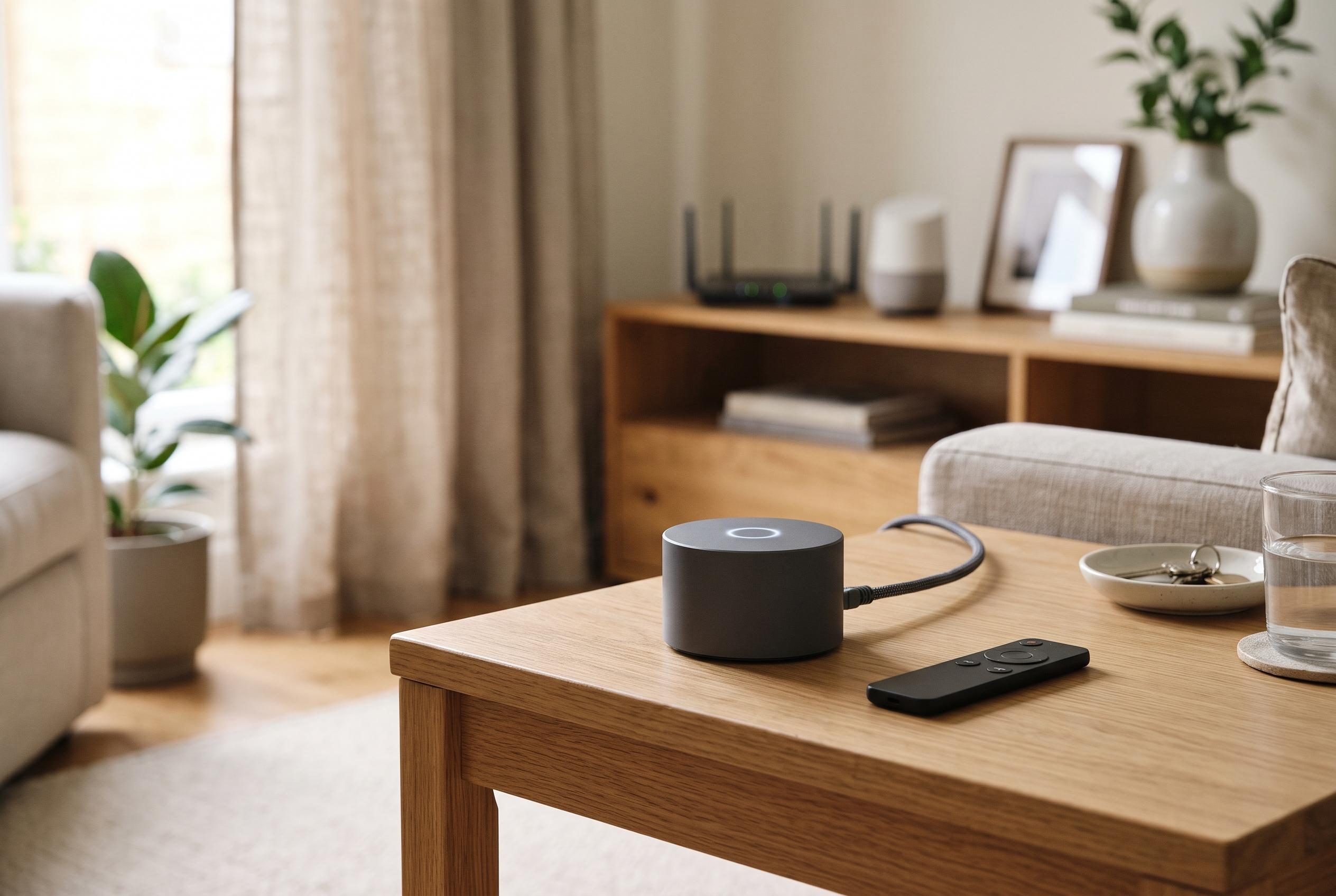

The M200 offers dual-band Wi-Fi, PoE, infrared control and a built-in speaker, while the M3’s higher device capacity is aimed at larger systems. Its offline recovery features, however, may not work reliably in practice.
The Aqara M200 and Hub M3 cover similar smart-home basics, but their differences matter most as a system grows. Both can connect Aqara Zigbee devices and Thread products, act as Matter controllers and bridges, and run local automations. The M200 is a lower-cost option for a more modest setup; the M3 is designed for larger installations, with greater device capacity and more advanced local processing.
One correction is important: Aqara’s current M200 specifications list features absent from some earlier comparisons. The hub has a built-in 90-decibel speaker, supports both 2.4GHz and 5GHz Wi-Fi, and offers Power over Ethernet as well as USB-C power. It also includes infrared control for compatible appliances. Aqara’s product page describes it as a Thread border router and mesh extender, and says it can bridge Aqara Zigbee devices to platforms including Apple Home, Google Home, Alexa, SmartThings and Home Assistant.(aqara.com)
The M3’s principal advantage is capacity. Aqara lists support for up to 127 Zigbee devices and 127 Thread devices, compared with 40 of each for the M200. It also has more substantial onboard storage for edge computing: processing automations on the hub rather than relying on cloud services. Aqara says this can help routines continue during internet or cloud outages, and describes ways selected Aqara devices can act as proxies if the M3 is unavailable.(aqara.com)
That resilience should not be treated as guaranteed in every installation. PCWorld’s hands-on review found that offline device support did not work reliably in its testing, despite the M3’s failover ambitions. The M3 may therefore suit a larger system that needs more capacity, but its advanced recovery features are worth assessing against real-world performance rather than relying solely on the manufacturer’s claims.(pcworld.com)
Both hubs also support migrations from older Aqara systems, though the M3’s migration tools are a selling point for users moving an established network. The broader Matter picture has changed since the M3’s launch, when third-party compatibility was limited. Aqara announced in April 2025 that its platform would support more than 50 types of Matter devices and that Advanced Matter Bridging, first introduced with the M3, was expanding across its Matter controllers and bridges. This gives the M3’s early compatibility constraints useful context, but does not guarantee that every device or feature will work across every ecosystem.(aqara.com)
For many buyers, the M200 is the more practical choice. It already combines local automations, Matter bridging, Thread support, infrared control, dual-band Wi-Fi, PoE and a speaker. Its 40-device limits may be ample for a smaller home, while the M3’s higher capacity and edge-computing features are more relevant when a system is extensive or expected to expand. Aqara’s current product information confirms several M200 capabilities that earlier comparisons overlooked, so buyers should check the specifications of the model and region they intend to purchase before deciding.(aqara.com)
Disclaimer: This content is intended for informational purposes only. Readers are advised to exercise their own judgement, conduct due diligence, or consult a qualified expert before acting on any information provided.