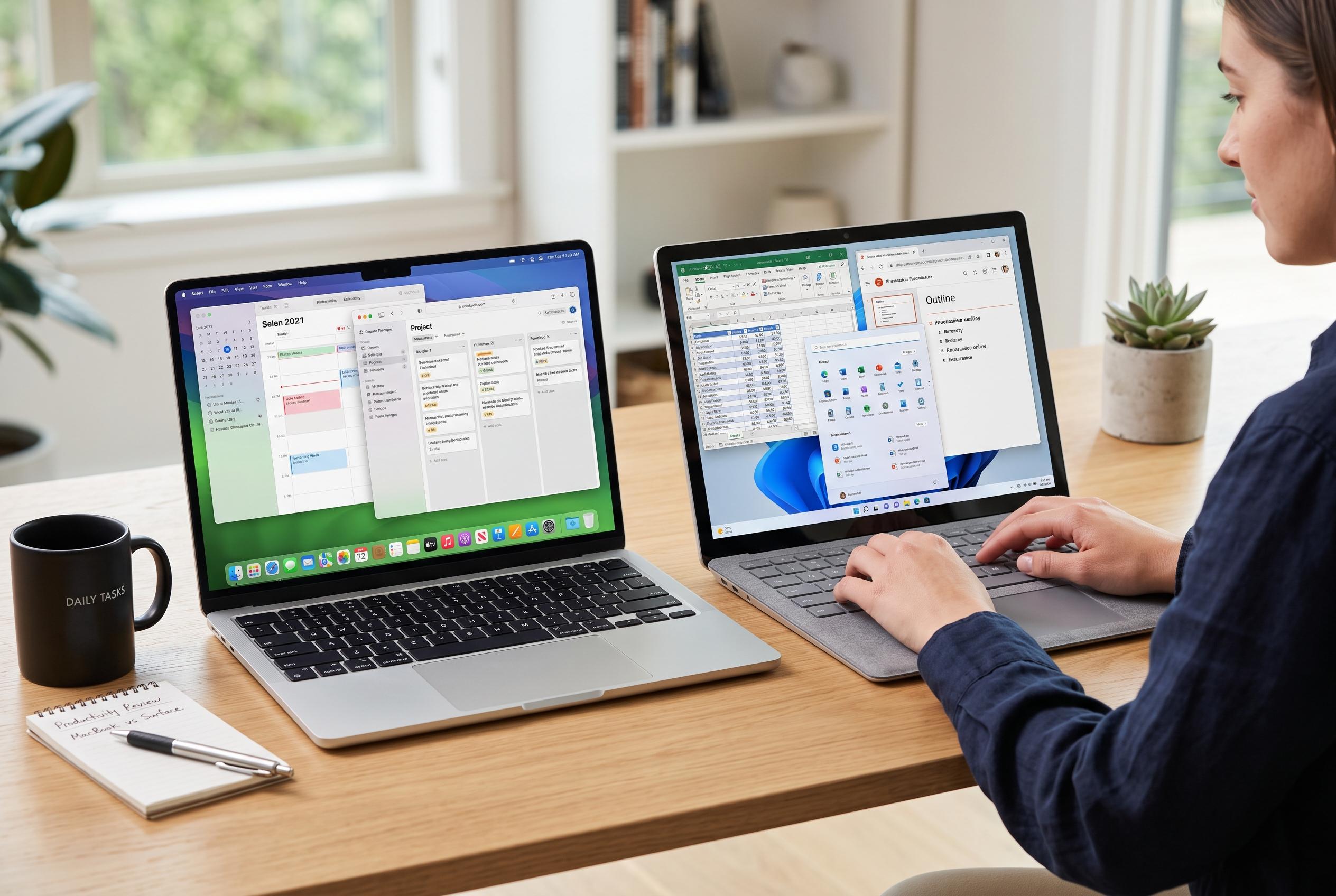

Recent tests reveal the MacBook Air’s superior speed in handling everyday Office tasks compared to the Microsoft Surface Laptop, raising questions about value and hardware choices for productivity users.
If you want a laptop mainly for Microsoft Word and Outlook, the latest evidence suggests Apple’s MacBook Air may be the better buy than Microsoft’s own Surface Laptop. A PhoneBuff test using a robotic arm to remove human variation found that Apple’s machine opened a 500-page Word document in 7 seconds, compared with 12 seconds on the Surface Laptop, despite the latter being built by Microsoft and equipped with 16GB of RAM.
The price gap makes the result even more awkward for Microsoft. In the UK, Apple’s MacBook Air starts at £1,299, while the Surface Laptop begins at £1,449. TechRadar has reported that Microsoft has been trying to reposition its Surface line with Qualcomm’s Snapdragon X Elite chips, promising faster graphics and longer battery life, but those gains do not appear to translate into a clear advantage in everyday Microsoft Office use.
PhoneBuff’s wider testing pointed to a similar pattern across heavier workloads. Unzipping a 6GB file took the MacBook Air just under 10 seconds, while the Surface Laptop needed 42 seconds. In Adobe Premiere Pro, Apple’s laptop completed a full editing-and-export workflow in 1 minute 46 seconds, versus 3 minutes 19 seconds for Microsoft’s machine. The gap was smaller in Photoshop, where the difference was about 6 seconds, and web browsing was a dead heat.
Battery life, however, swung back in Microsoft’s favour. Over a two-hour productivity run involving Word, Excel and Spotify, the Surface Laptop used 16% of its battery, while the MacBook Air used 24%. That fits with other reviews showing Surface models can be strong on endurance, even if Apple often wins on storage speed and, in some comparisons, overall responsiveness. PhoneBuff argued the broader slowdown on Windows machines is tied less to the hardware than to Windows 11 itself, pointing to WebView2, Microsoft’s browser-based framework that can consume memory and processor resources in the background. Microsoft executive Pavan Davuluri said on July 31 that improving Windows performance is a priority, with changes to memory management and a shift away from WebView2 among the planned fixes.
Disclaimer: This content is intended for informational purposes only. Readers are advised to exercise their own judgement, conduct due diligence, or consult a qualified expert before acting on any information provided.