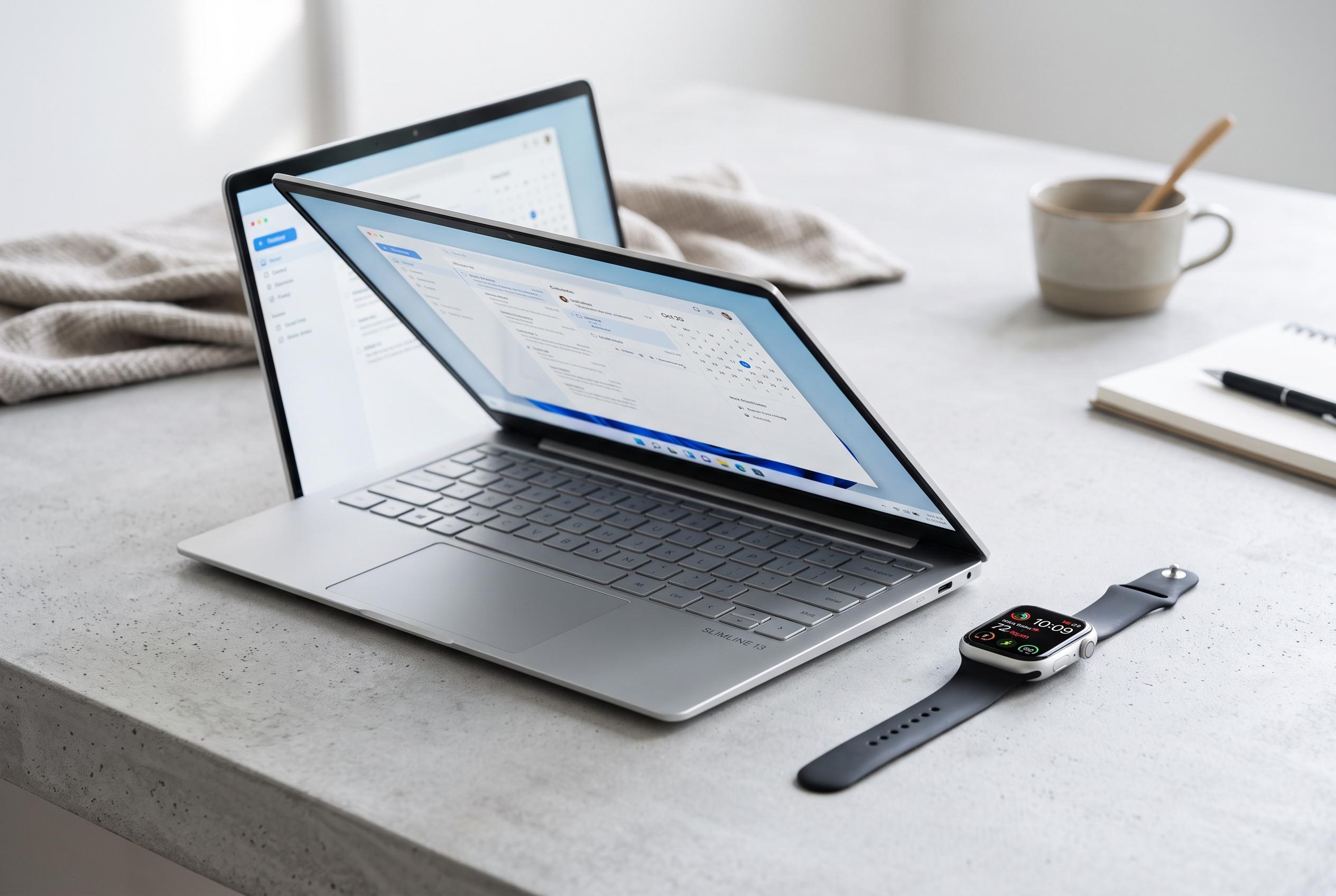

Huawei launches a featherweight laptop challenging the MacBook Air, while Google reveals a smarter, thinner Pixel Watch 5 as it prepares to retire its long-standing voice assistant in favour of the AI-powered Gemini, signalling a new era in portable devices.
Competition in smart devices is intensifying as major technology groups push lighter hardware, stronger performance and more artificial intelligence features into the same products. Huawei and Google are both leaning into that trend, with one focusing on a featherweight laptop and the other on a new smartwatch, while Google is also preparing to retire its long-running voice assistant in favour of Gemini.
Huawei’s latest device, the MateBook Pro S, is being positioned as a direct challenge to ultra-light notebooks such as Apple’s MacBook Air. Leaked specifications suggest a 14-inch machine weighing just 798 grams and measuring 11.9mm thick, with a metal body, a large trackpad and a black keyboard. PhoneArena’s hardware listing says the laptop is expected to use Huawei’s Kirin XE90 chip, run HarmonyOS 5 and ship with 16GB or 32GB of RAM plus 512GB or 1TB of SSD storage. Huawei’s own product page for the MateBook Pro shows a similar design language, though with a slightly heavier 970-gram chassis, underscoring how aggressively the company is trying to compete in the premium portability segment.
Google’s Pixel Watch 5, meanwhile, is emerging as another example of the industry’s shift towards more capable wearable devices. Reports from PhoneArena and 9to5Google suggest the watch is still unannounced, but leaked details point to a 1.4-inch LTPO AMOLED display, 2GB or possibly 3GB of RAM, and Qualcomm’s Snapdragon W5 Gen 2 or related silicon. Android Central says the watch may also bring health tracking improvements, including possible blood pressure and arterial stiffness monitoring, though those features remain speculative. The same leaks point to a stronger battery focus, a thinner profile and new design touches aimed at answering long-standing user complaints about wearables.
Google is also making a broader software shift that could reshape how Android users interact with its devices. The company has started telling users that Google Assistant will be phased out and replaced by Gemini, its AI-powered successor, with the transition beginning on September 4 and continuing over several weeks. Gemini is expected to take over familiar voice commands, including activation through the power button or the phrase “Hey Google”, while extending the same functionality to devices such as smartwatches and earbuds. The move marks the end of a tool that helped define Google’s consumer AI strategy for a decade, and signals a sharper focus on conversational AI across the company’s hardware ecosystem.
Disclaimer: This content is intended for informational purposes only. Readers are advised to exercise their own judgement, conduct due diligence, or consult a qualified expert before acting on any information provided.