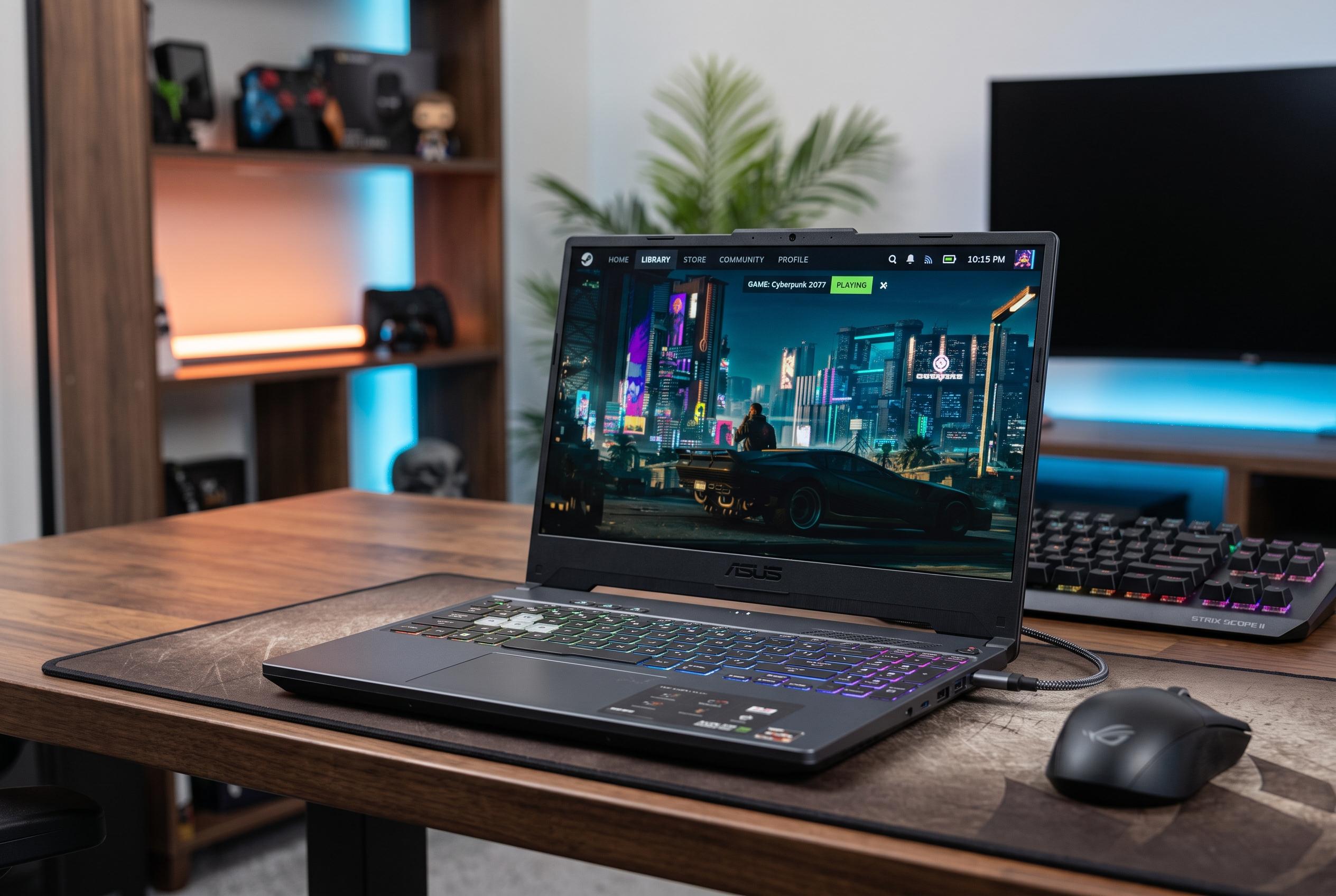

A YouTuber demonstrates Valve’s SteamOS running on an Asus TUF Gaming A14 with AMD’s high-performance Strix Halo APU, signalling a potential shift in Linux gaming beyond handheld consoles to full-fledged gaming laptops.
A YouTuber has shown Valve’s SteamOS running on an Asus TUF Gaming A14, suggesting the company’s Linux-based gaming software may be ready for a much wider class of PCs than the Steam Deck. ETA Prime installed SteamOS 3.9 on the laptop using Valve’s official Steam Deck recovery image, and the machine booted into both the familiar gaming-friendly interface and a standard desktop mode. According to the video, core hardware support was in place too, including Wi‑Fi, Bluetooth, USB ports and peripherals.
The laptop used in the experiment is no ordinary thin-and-light. It is built around AMD’s Ryzen AI Max+ 392 Strix Halo APU, a 12-core chip paired with a Radeon 8060S integrated graphics unit, 32GB of LPDDR5X-8000 memory, a 14-inch 2,560 x 1,600 display with a 165Hz refresh rate and a 73Wh battery. That matters because Strix Halo is being pitched as a high-end all-in-one platform for gaming and AI workloads, with early benchmarks from Tom’s Hardware suggesting the chip can get close to a Ryzen 7 9800X3D in multi-core tests.
On gaming performance, the results were better than many would expect from a Linux desktop installed on a Windows laptop. ETA Prime said Halo: Campaign Evolved ran at around 70fps at 1440p on High settings with FSR set to Medium. Spider-Man 2 reportedly averaged more than 80fps at the same resolution and quality level, while Crimson Desert also held up well. Doom: The Dark Ages proved heavier, needing FSR set to Balanced on High settings to stay above 60fps. Cyberpunk 2077 delivered a steady 60fps at 1440p on the High preset with FSR 2.1, and the tester switched off frame generation to measure native performance.
Battery life varied sharply by game and resolution. In Cyberpunk 2077, the laptop lasted about two hours and 25 minutes at 800p, but only around one hour and 40 minutes at 1200p. By contrast, Hollow Knight: Silksong ran at a locked 60fps at 1200p while drawing less than 16W, with ETA Prime estimating between four and seven hours of battery life for lighter indie games depending on settings and screen resolution. The broader takeaway is that SteamOS appears to be stretching well beyond handhelds: other recent tests on Strix Halo hardware have shown the same AMD platform putting up serious numbers in gaming, including claims that it can go toe-to-toe with some RTX 4070 laptop systems in the right scenarios.
Disclaimer: This content is intended for informational purposes only. Readers are advised to exercise their own judgement, conduct due diligence, or consult a qualified expert before acting on any information provided.