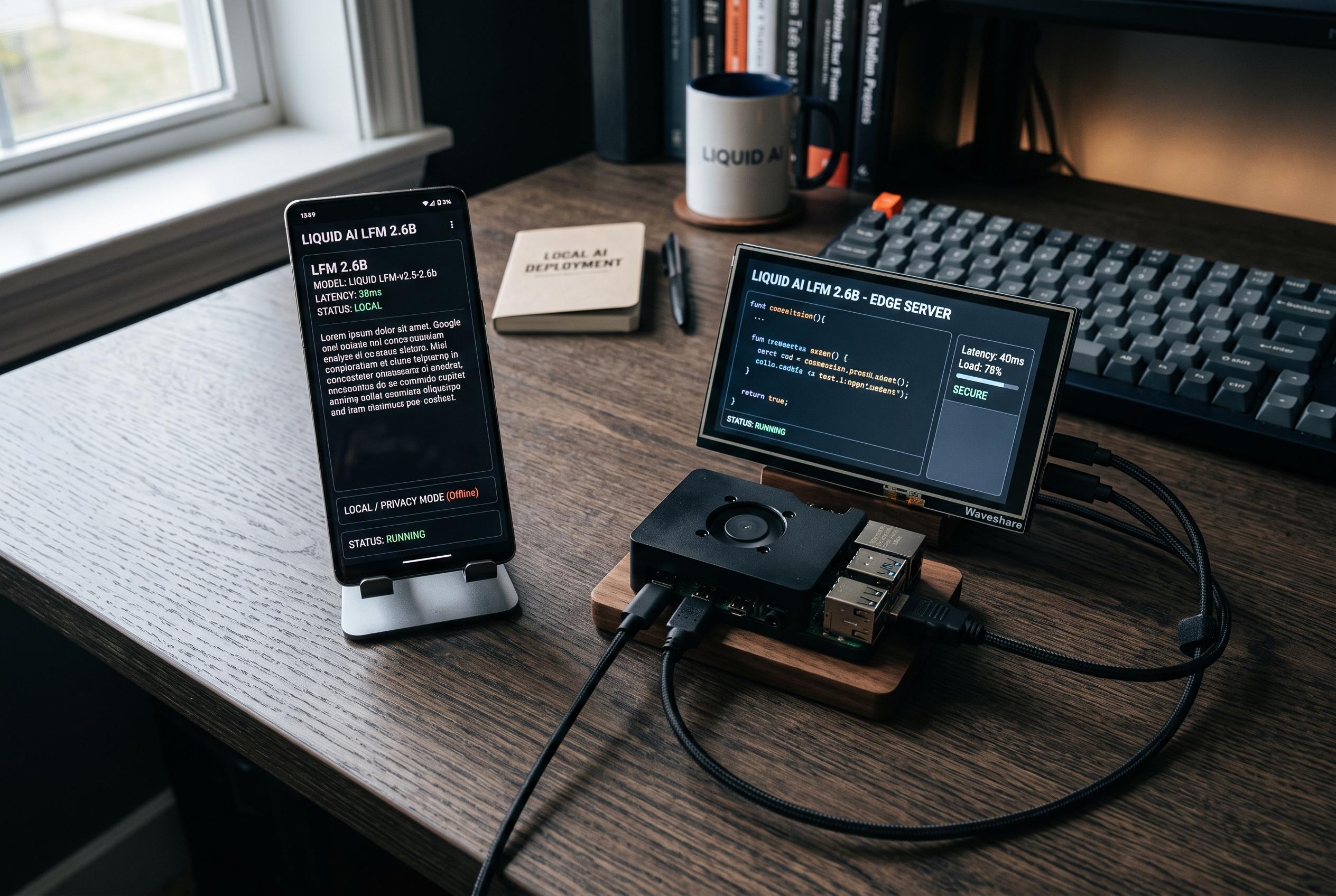

Liquid AI introduces LFM2.5-2.6B, a small, open-weight model designed for agentic tasks on devices like smartphones and Raspberry Pi, emphasising privacy and low latency through local inference.
Liquid AI has unveiled LFM2.5-2.6B, a compact open-weight model it says is built for agentic work rather than general chat, with the company arguing that many enterprise tasks can now be handled locally on devices ranging from smartphones and laptops to a Raspberry Pi. In materials tied to the launch, researchers said the model is designed to keep data on-device, reduce reliance on cloud inference and fit use cases where privacy, latency or connectivity are limiting factors. That framing puts it squarely in the broader push towards device-native artificial intelligence, a market Liquid AI says is increasingly shaped by workloads that run continuously in the background rather than in short user conversations.
The model has 2.6 billion parameters, a 128,000-token context window and native tool calling. Liquid AI has released both the post-trained version and a base checkpoint on Hugging Face, while saying the model works with common inference stacks including llama.cpp, MLX, vLLM, SGLang and ONNX. The company also promotes its LEAP fine-tuning framework as part of a broader developer toolkit. According to Liquid AI’s own website and documentation, the firm has been building a family of device-native foundation models for text, vision and audio, with an emphasis on deployment outside data centres.
Maxime Labonne, Liquid AI’s head of post-training, told VentureBeat that the company sees the model as best suited to high-volume, well-defined tasks such as tool calling, document handling, calendar management and workflow automation. He said the architecture was tuned for CPU performance rather than GPU benchmarks and pointed to the Raspberry Pi as a proof point for the company’s on-device ambitions. Liquid AI also said the model can be run on smartphones through its Apollo app, while company-reported benchmarks showed a wide spread in throughput depending on hardware. Those figures have not been independently verified.
The training approach is aimed at agent systems rather than plain conversational interfaces. Liquid AI said the model was pre-trained on about 34 trillion tokens and then refined through a four-stage post-training pipeline that included supervised fine-tuning, specialist teacher models, multi-domain distillation and agentic reinforcement learning. The company said it trained the model inside real agent harnesses such as Hermes Agent and OpenClaw, using productivity tasks involving research, coding, document management and tool use. Labonne said that design helped lift performance beyond the model’s original target areas, including instruction following, maths and even coding.
Liquid AI is also making a commercial bet on local inference. Its open licence allows use by organisations with annual revenue below $10 million, while larger companies need a separate arrangement, a structure Labonne described as necessary to fund future model development. That licensing approach contrasts with the permissive terms used by rivals such as Google’s Gemma and Alibaba’s Qwen lines, even as Liquid AI argues its smaller footprint and tool-use focus make it attractive for enterprise deployments. The timing of the launch also underlines that pitch: MacPaw announced a partnership with Liquid AI to build an on-device AI stack for its Mac assistant Eney, with the model expected to run locally on Apple silicon.
Disclaimer: This content is intended for informational purposes only. Readers are advised to exercise their own judgement, conduct due diligence, or consult a qualified expert before acting on any information provided.