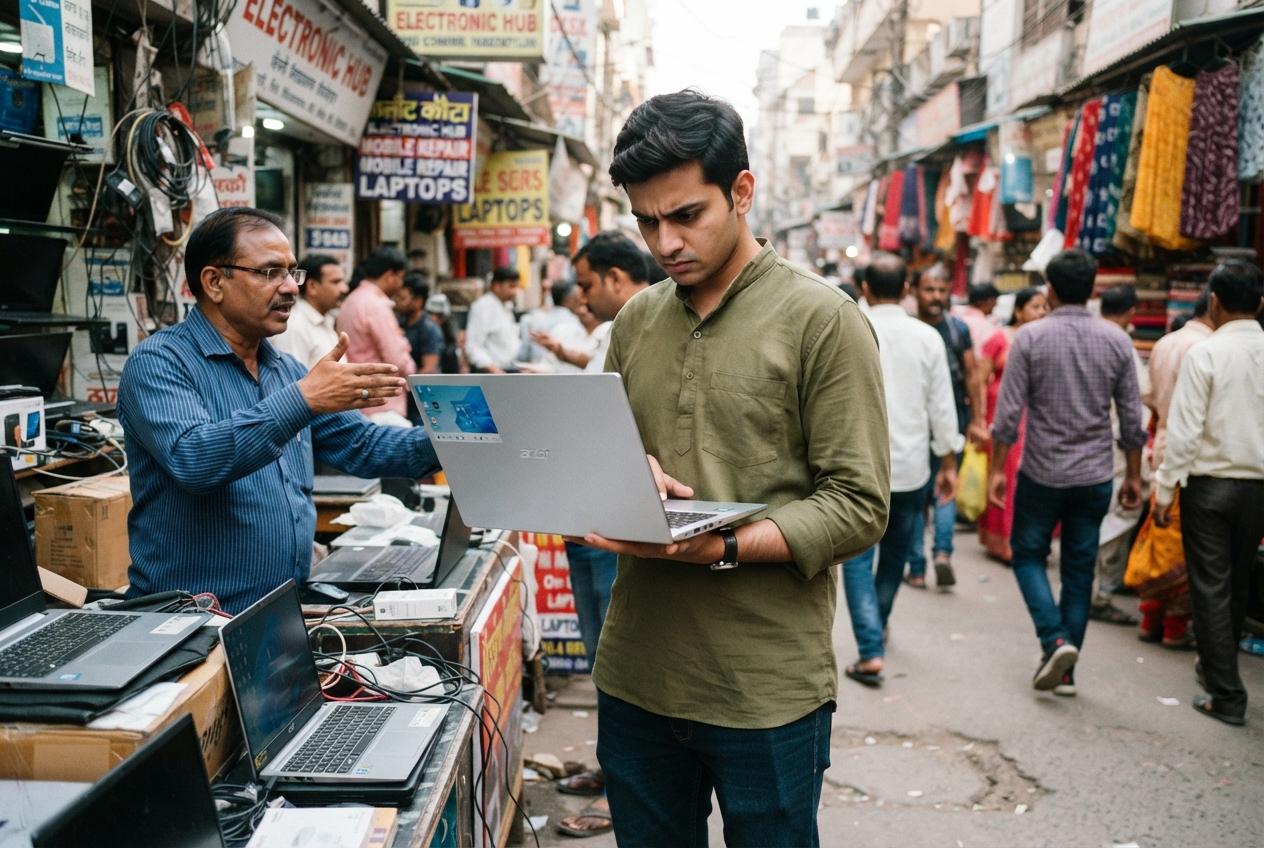

Acer launches its lightweight TravelLite series in India, but early reviews highlight concerns over build quality, AI capabilities, and reliability, potentially limiting its appeal amid stiff competition.
Acer has widened its Indian business-laptop line-up with the TravelLite series, a family of machines pitched at professionals who value portability, security and modern connectivity over headline-grabbing design. In the Indian market, the range starts at Rs 1 lakh, and the review configuration examined by Business Standard is priced at Rs 1.2 lakh, placing it in a crowded segment where buyers increasingly compare Windows machines not just with one another but with high-end Macs as well.
On paper, the TravelLite looks well prepared for office life. Acer is offering configurable processor, memory and storage options, while the reviewed model pairs AMD’s Ryzen AI 5 PRO 340 with integrated Radeon graphics, 16GB of DDR5 memory and a 512GB NVMe SSD. The notebook also comes with a 14-inch Full HD+ IPS panel in a 16:10 format, a 5MP webcam with infrared support for Windows Hello, a physical camera shutter and a generous spread of ports that includes HDMI 2.1, USB-C and a microSD reader.
The appeal begins with portability. Business Standard says the laptop weighs 1.38kg and measures 17.6mm thick, making it easy to carry through commutes and airport lounges. That fits Acer’s wider positioning for the TravelLite line, which earlier launch material from India described as a lightweight business machine with MIL-STD 810H certification, a spill-resistant backlit keyboard and Wi-Fi 7. Yet the review finds the chassis less reassuring than the specification sheet suggests, with noticeable flex in both the body and lid and a hinge that feels uncomfortably stiff.
The display and sound system are more serviceable than impressive. The 14-inch panel gives users extra vertical space for documents and spreadsheets, but Business Standard says brightness is modest, white balance can shift towards either blue or orange, and colour reproduction is only average. The speakers are loud enough for meetings and standard video playback, though they lack the richness expected for music or films.
Where the TravelLite fares better is in connectivity and everyday productivity. Business Standard praises the Wi-Fi 7 implementation and Bluetooth 5.4 support, while the port selection is broad enough to reduce reliance on dongles and docks. In routine office use, the machine handles browsing, documents, video calls and multitasking without trouble, and the review also suggests it can cope with light editing when plugged in. Acer’s AI branding, however, does not translate into convincing local inference performance: according to the review, attempts to run open-weight models were unstable, with crashes and loading failures pointing to limits in both the chip and memory bandwidth.
Battery life is described as adequate for a standard workday, but the deeper issue is reliability. Business Standard says the laptop repeatedly failed to wake from sleep and had to be restarted, while also losing around 10% to 15% charge overnight even when switched off. That undermines the sense of an always-ready mobile device, and it is the clearest reason the TravelLite does not fully match its business-laptop ambitions. For buyers who want a light, well-connected Windows machine for office work, it remains credible value; for those expecting a sturdier build, a better screen or dependable AI capability, stronger rivals may be easier to recommend.
Disclaimer: This content is intended for informational purposes only. Readers are advised to exercise their own judgement, conduct due diligence, or consult a qualified expert before acting on any information provided.