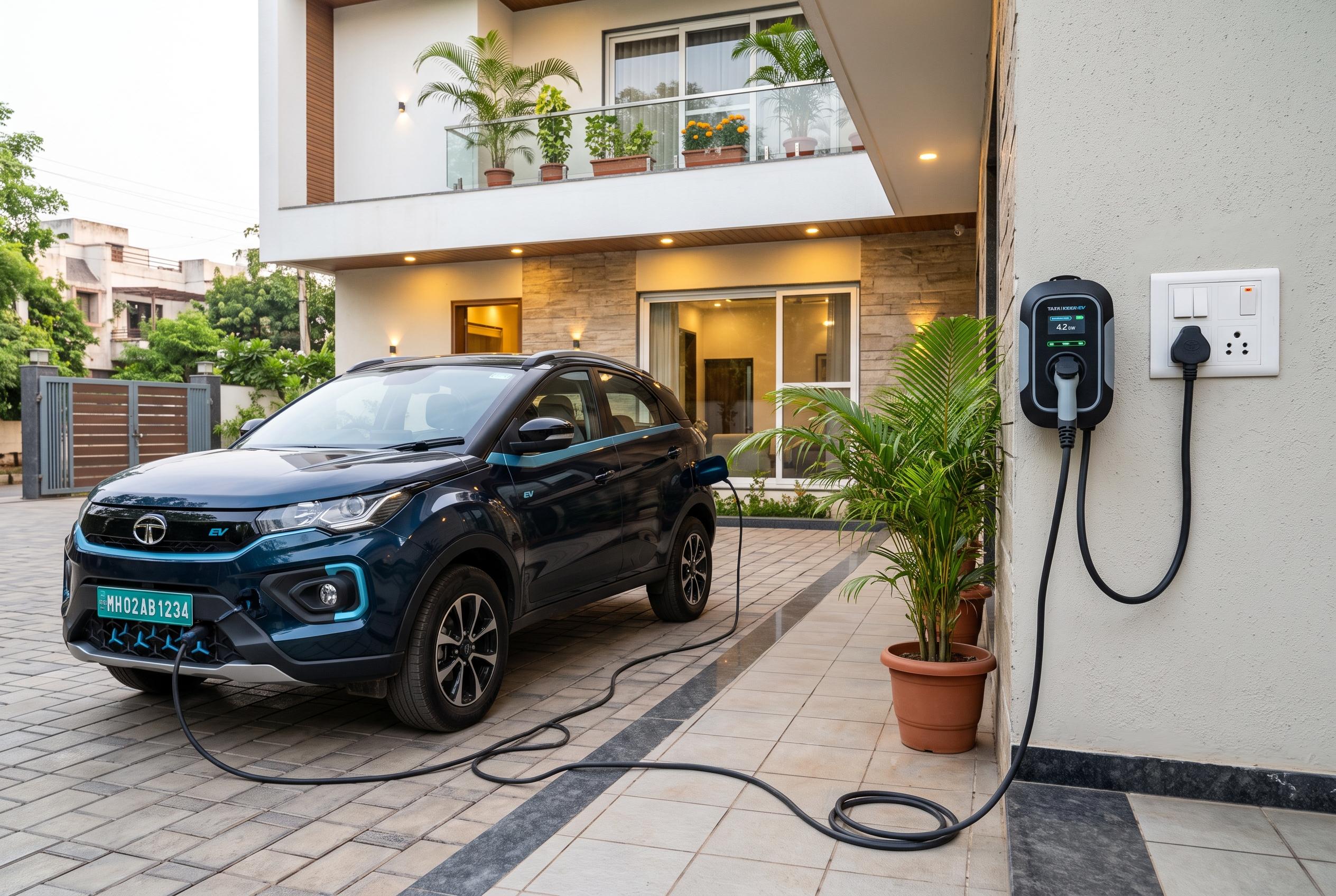

As EV adoption rises in India, portable AC chargers offer flexible, cost-effective options for drivers lacking fixed home charging infrastructure, transforming the EV charging landscape.
As electric vehicles gain wider acceptance in India, charging remains one of the biggest practical barriers for owners. Home charging is still the most convenient option, but many drivers do not have access to a fixed wallbox. In that gap, aftermarket portable AC chargers have become a useful alternative, offering a way to charge from industrial sockets or standard domestic outlets without a permanent installation. Industry guides and product listings show that the appeal lies not only in convenience but also in the ability to avoid the higher cost of automaker-supplied fast chargers.
The basic distinction is between DC and AC charging. DC chargers deliver power directly to the battery and can be far faster, but they are costly and tied to dedicated infrastructure. AC charging is slower because the car’s onboard charger converts the incoming power into DC before it reaches the battery pack. In practical terms, most home-based AC systems in India deliver about 3.3kW, while portable aftermarket units can reach 7.2kW, 7.5kW, 11kW and, in some cases, 22kW when paired with the right supply. Zevpoint’s guide to portable chargers in India also notes that plug type, weather resistance and safety systems are central to choosing the right unit.
The market now includes a broad spread of products aimed at different use cases. Cartoq’s roundup highlights options such as the Zevpoint Aveo Pro and ZapConnect Smart EV Charger for single-phase 7.5kW charging, the PME Ultrafast EV Charger and PME 11kW Portable EV Charger for higher-output use, and more modest household-plug models such as the Exicom 3.3kW Spin-Free Portable EV Charger and Statiq 3.3kW Portable EV Charger. Other listings, including the StromPuls Portable Charger, Calion 7.5kW Portable EV Charger and Strompuls Prime, underline how manufacturers are mixing features such as app controls, display screens, travel cases and fault protection into products aimed at owners who need flexibility rather than a fixed home installation.
Safety and compatibility are the main technical issues. Portable chargers are effectively smart, heavy-duty cables with control boxes that instruct the vehicle how much current to draw. That makes build quality, certification and protection features essential. Guidance from EV specialist sites stresses the importance of matching the charger to the outlet type, whether a standard 15A household socket or a 32A industrial connection, and checking for protections such as leakage detection, earthing safeguards and weather sealing. These details matter more in India’s climate, where monsoon use and outdoor parking are common concerns.
For the right buyer, a portable charger can be a practical investment. Apartment residents, renters and drivers who travel regularly to places without public fast-charging infrastructure stand to benefit most. Fleet operators may also find them useful for quick top-ups. The main advantage is flexibility: a portable unit can travel with the vehicle, avoid the cost of fixed installation and provide faster charging than a basic domestic charger when a suitable power source is available. For many owners, that combination makes it a sensible middle ground between convenience and infrastructure constraints.
Disclaimer: This content is intended for informational purposes only. Readers are advised to exercise their own judgement, conduct due diligence, or consult a qualified expert before acting on any information provided.