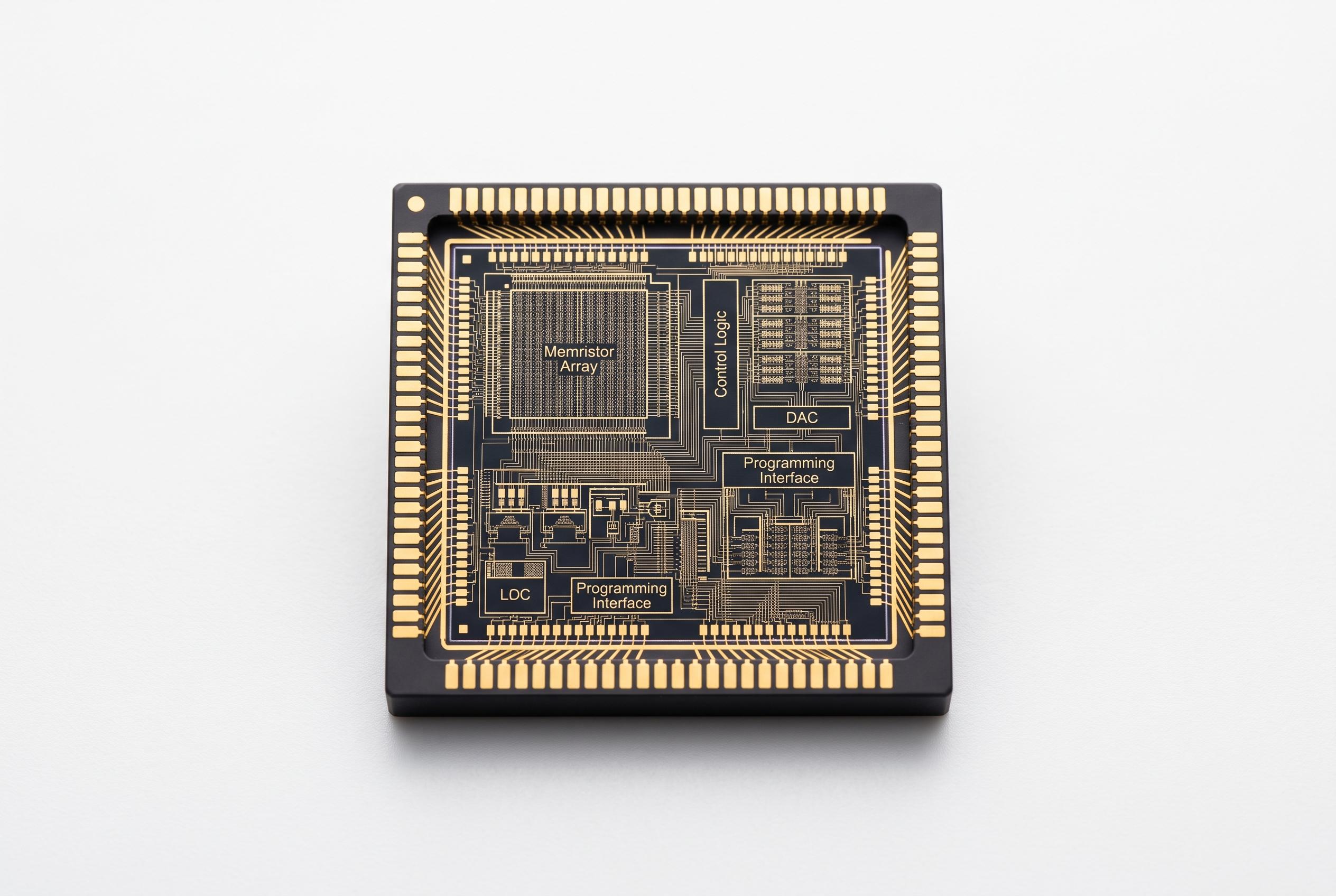

A new programmable dynamic memtransistor developed in South Korea allows AI hardware to adjust its processing speed post-manufacture, enhancing adaptability to fluctuating data streams and accelerating progress towards flexible, energy-efficient AI chips.
Researchers in South Korea have developed a semiconductor chip that can have its response speed programmed after manufacture, a feature that could make hardware more adaptable to artificial intelligence systems handling data that changes at different rates. The device, called a programmable dynamic memtransistor, combines memory and computation in a single component and is designed to adjust how quickly it processes incoming signals according to the pace of the data stream.
The key difference from conventional chips is that its timing behaviour is not fixed at fabrication. According to the description of the work, the device can store and preserve response settings without continuous external power, using a two-layer structure inside the transistor. One layer handles information storage and processing, while the other governs how quickly the device returns to its baseline state.
In laboratory tests, the researchers said they were able to change the recovery time of current by a factor of five and alter signal-processing frequency by more than 10 times. On forecasting tasks involving rapidly changing data, the chip reduced errors by a factor of 40 compared with devices that had fixed timing characteristics. That level of adaptability is notable because many hardware accelerators for AI are optimised for speed, but not for shifting workloads.
The design also appears closer to production than many experimental AI chips. The researchers said it is compatible with materials already used in commercial semiconductor manufacturing, which could reduce the need for major changes to existing fabrication lines. That matters because hardware aimed at in-memory or neuromorphic computing often faces a long path from laboratory demonstration to mass production.
The broader field has been moving in a similar direction. IBM researchers have recently shown ferroelectric and phase-change memory based systems that support reconfiguration and in-memory inference while reducing area or power use. Other neuromorphic chips, such as the ROLLS processor developed by INI, use reconfigurable architectures to mimic adaptive neural behaviour with very low power consumption. The South Korean work fits into that wider effort to build AI hardware that is not only faster, but also more flexible and energy-efficient.
Disclaimer: This content is intended for informational purposes only. Readers are advised to exercise their own judgement, conduct due diligence, or consult a qualified expert before acting on any information provided.