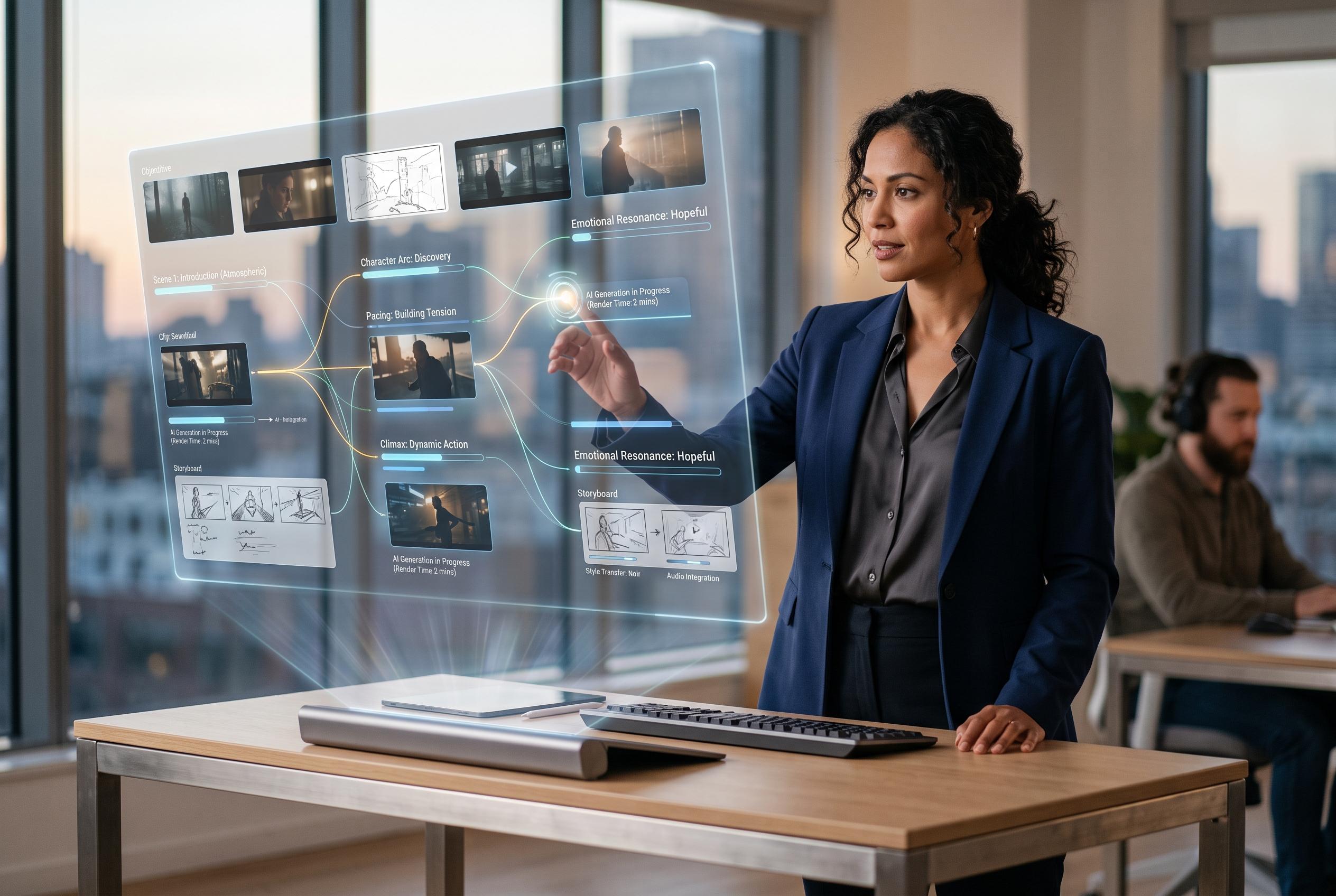

As AI tools become more advanced and accessible, creators are now focusing on guiding narrative flow and visual coherence rather than just prompt precision, marking a shift in the art of AI-assisted video production.
The conversation around AI video creation has changed quickly. When the first generation of tools appeared in 2023, creators competed to see who could write the most precise prompt and squeeze the best result from limited systems. That skill mattered because early models were narrow, short-form and highly sensitive to wording. By 2026, however, the underlying tools have become far more capable and far more common, which means prompt writing is no longer the only way to stand out.
The shift is moving the creator’s value away from command writing and towards direction. In practical terms, that means defining tone, pacing, character behaviour, visual language and emotional intent across a sequence, rather than asking for a single impressive shot. CapCut’s Web Video Studio – Director Mode reflects that change by giving users scene-by-scene control, the ability to edit individual shots without rebuilding the whole sequence and a structured workspace for organising characters, environments, props and references.
That approach also mirrors a broader split in the market. Kompozy’s 2026 map of AI video tools breaks the field into distinct categories, from text-to-video and avatar generation to editing and end-to-end orchestration, showing that the landscape is becoming more specialised. At the same time, Google’s Gemini Omni, announced at Google I/O 2026, pushes video creation further into multimodal editing, letting users work from text, audio, images or video and make changes through conversational commands while preserving continuity.
Other platforms are following the same direction. TechRadar’s review of InVideo’s 2026 release highlighted Agent One, a conversational assistant aimed at scene continuity and cinematic storytelling, while also noting support for multiple AI models, 4K output and a wide range of creative controls. Microsoft has also folded OpenAI’s Sora 2 into Microsoft 365 Copilot for commercial users, adding video generation to its broader productivity suite and signalling that AI video is moving from novelty territory into routine workplace software.
For filmmakers, the practical lesson is becoming clearer. Creative control now depends less on producing one perfect prompt and more on managing a coherent workflow. That means keeping scripts, shots, props and world-building aligned across a project, and correcting individual scenes without breaking the whole. The result is a more traditional model of authorship, even when the tools are generative: the technology can assist, but the strongest work still comes from the person making the decisions.
That is also why directors and independent creators are beginning to treat AI as a production environment rather than a one-off generator. Creative Bloq reported that filmmaker Kévin Mendiboure used tools including ChatGPT, Midjourney and video generators to turn a long-dormant sci-fi horror idea into the short film CATACOMBS, but only after doing the same kind of pre-production work expected in conventional filmmaking. His experience reflects the direction of the industry: as AI becomes easier to use, the differentiator is not technical prompting alone, but the ability to shape an entire visual story.
Disclaimer: This content is intended for informational purposes only. Readers are advised to exercise their own judgement, conduct due diligence, or consult a qualified expert before acting on any information provided.