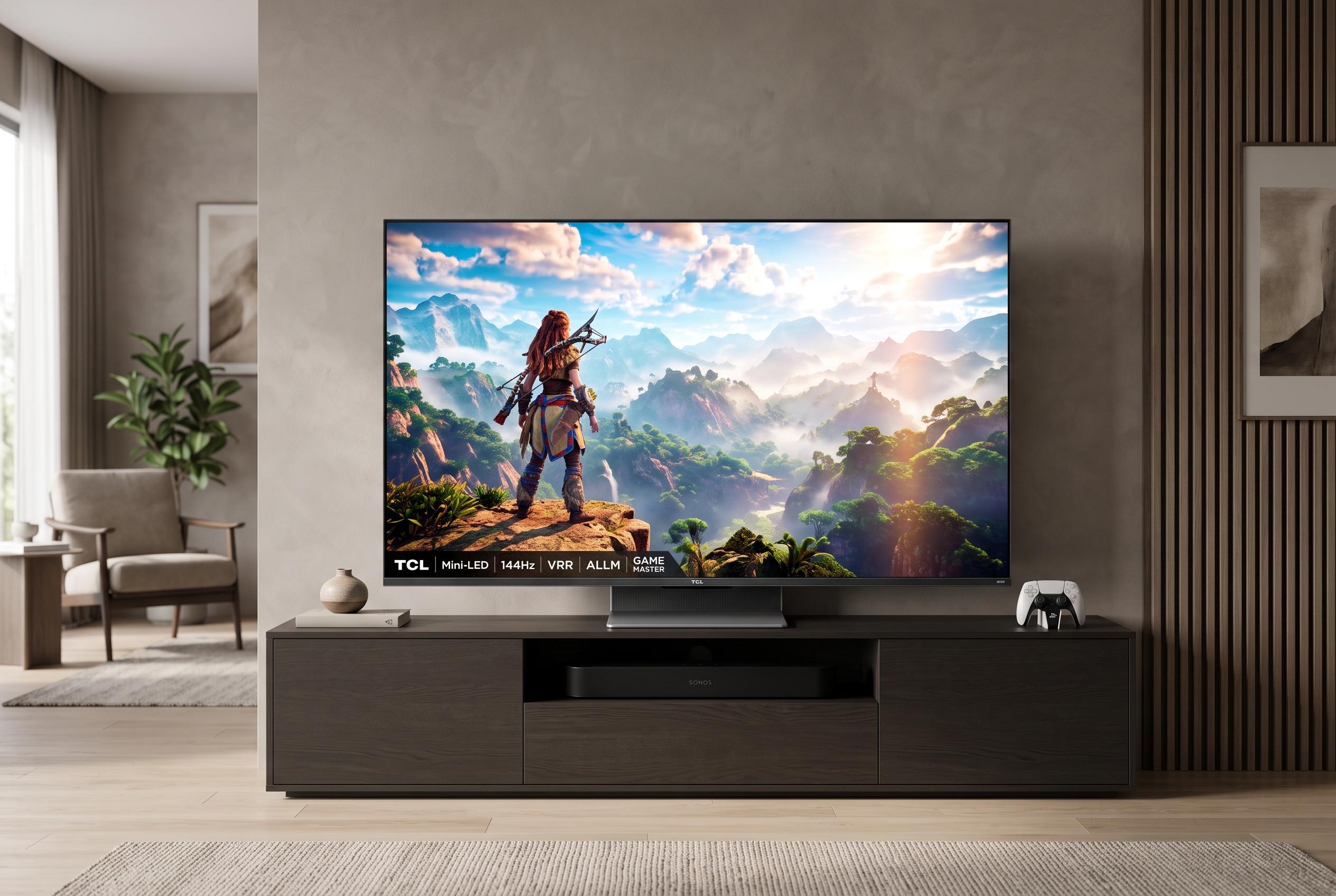

TCL aims to redefine its market position with the launch of the X11L, a flagship Mini-LED TV designed to compete with high-end OLEDs through improved brightness, design, and gaming features, marking a shift in its branding from value to premium.
TCL is making a clearer push into the premium television market with the X11L, a set designed to challenge high-end OLED and Mini-LED rivals rather than simply compete on price. The French review published by Frandroid says the company has broadened the range beyond the older X11 format, which had been harder to find in shops, and positioned the new model above the C89L in its line-up. The timing matters: in 2026, TCL is no longer selling itself only as a value brand but as a serious contender in the flagship class.
On paper, the X11L is built to impress. TCL pairs SQD-Mini LED backlighting with a very large number of dimming zones, claims peak brightness above 10,000 cd/m² on some sizes and adds a 144 Hz panel, four HDMI 2.1 inputs, Google TV and Bang & Olufsen audio. Tom’s Guide and RTINGS both describe the set as a flagship model, with the latter noting up to 20,736 dimming zones and a WHVA 2.0 panel, while TCL’s own launch materials emphasise deep colour management and support for Dolby Vision IQ and HDR10+.
Frandroid’s hands-on review suggests TCL has also paid close attention to physical design. The bronze grille that hides the integrated speaker system gives the X11L a more distinctive look than most Mini-LED televisions, and the chassis remains relatively slim at about 2.5 cm despite the dense backlight structure. The set uses two side feet rather than a central stand, which improves stability but demands a wide cabinet, especially on the larger 85-inch and 98-inch versions. The glossy screen finish helps contrast in bright rooms, though it also increases reflections.
The picture performance is strong, if not flawless. Frandroid found the X11L’s colours vivid and natural in Filmmaker mode, with fine detail well preserved in both bright and dark scenes. RTINGS and Tom’s Guide similarly report high colour accuracy and strong HDR performance. In Frandroid’s measurements, the 75-inch model reached a peak HDR brightness of 2,526 cd/m² in standard testing and briefly exceeded 4,000 cd/m² with a boost setting, but could not sustain that figure. Computer Bild also notes that the set does not fully match OLED for precision, even if its brightness and contrast make it highly convincing in normal viewing.
For gamers, the X11L looks particularly well equipped. Frandroid measured input lag at 11.5 ms and praised the TV’s 144 Hz native panel, VRR support and ALLM compatibility. RTINGS also highlights the gaming credentials, including low latency and the full complement of HDMI 2.1 ports. That gives the set unusual flexibility for a living-room display: it can handle a PlayStation 5, Xbox Series console, gaming PC and sound system at the same time without compromise.
Audio and software are solid rather than class-leading. The Bang & Olufsen-tuned system gives the X11L more weight than most built-in TV speakers, but Frandroid found the soundstage less immersive than the best rivals and recommended an external sound system for serious home cinema use. Google TV remains one of the most complete smart-TV platforms, and TCL’s interface additions make navigation simpler, but the review notes that some artificial intelligence features were still absent at the time of testing. At launch, the 75-inch model was priced at about €4,300 in France, with the 85-inch version near €6,500 and the 98-inch model around €9,000, placing the X11L firmly in premium territory.
Disclaimer: This content is intended for informational purposes only. Readers are advised to exercise their own judgement, conduct due diligence, or consult a qualified expert before acting on any information provided.