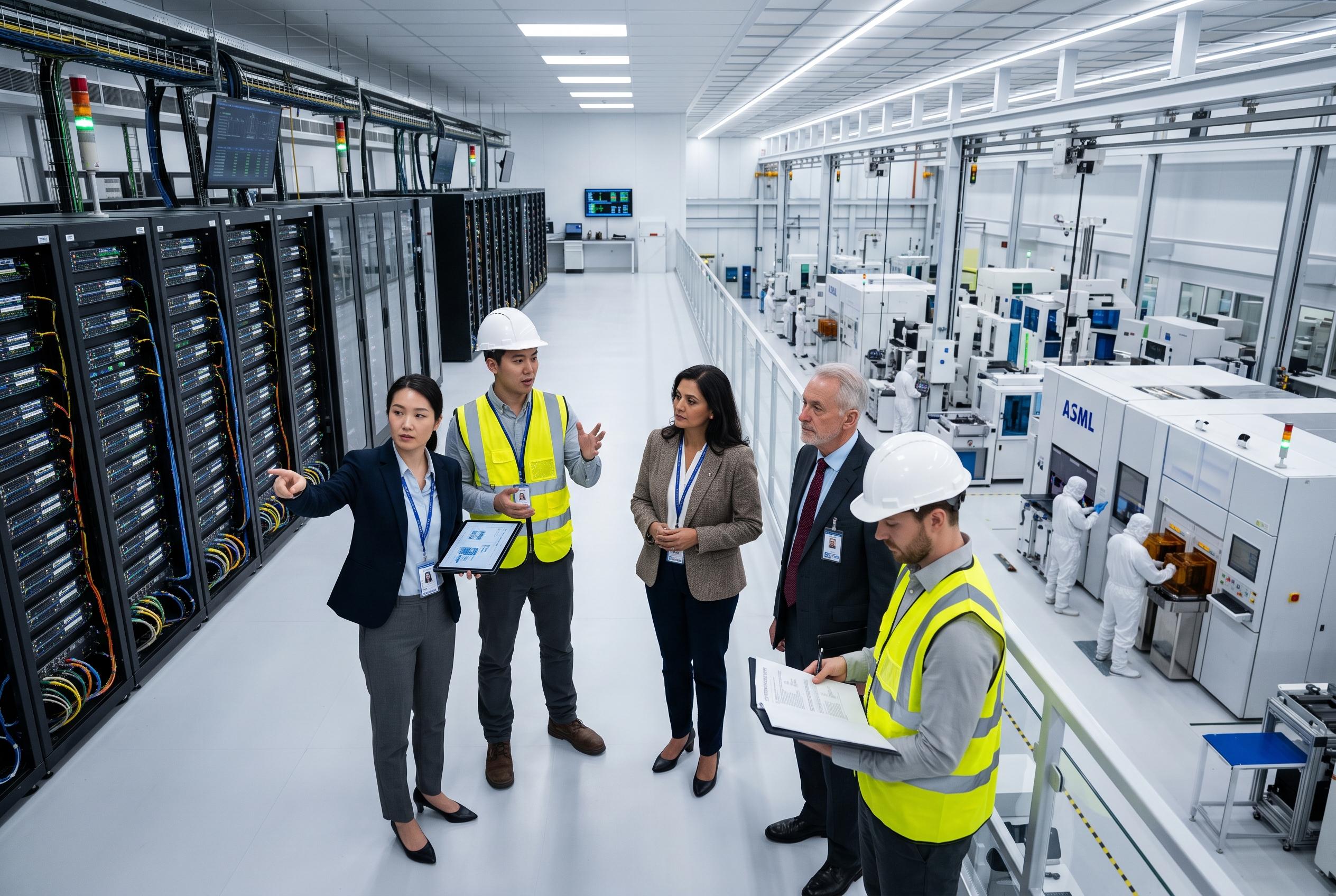

Washington’s strategic stake in Intel, alongside South Korea’s billion-dollar investments in memory chip capacity, underscores a new era where government backing and industrial scale are shaping the future of AI semiconductor dominance.
Washington’s move to take a direct stake in Intel has sharpened a broader shift in the semiconductor industry: AI chips are no longer just a race between companies, but a contest shaped by government policy, national security and access to capital. In South Korea, Samsung Electronics and SK hynix are responding with investment on a vast scale, extending the competition into manufacturing capacity, advanced packaging and the industrial base behind it all.
According to GovCon Wire, the U.S. government agreed in August 2025 to buy a 9.9% stake in Intel through an $8.9 billion investment in the company’s common stock. The package combined remaining CHIPS and Science Act grants with funding from the Secure Enclave programme. Intel chief executive Lip-Bu Tan has since framed the partnership as part of an effort to ensure advanced technologies are made in the United States, a sign that Washington now sees chipmaking not only as an industrial priority but as a strategic asset.
That support comes after a difficult period for Intel. The company reported a net loss of $18.8 billion in 2024 and moved to cut around 20,000 jobs while selling stakes in businesses such as Altera and Mobileye. Its recovery now hinges on whether its turnaround can be tied to commercial demand, not just public backing. Intel has said its 18A process entered production in 2025 and that 18A-P moved into risk production this year, with the company claiming 18A offers higher performance, lower power use and greater density than Intel 3. Lip-Bu Tan has also warned there will be “no more blank checks” for the next-generation 14A node, underscoring the pressure to secure customers and improve yields.
Samsung is taking a different path, building capacity at home and in the United States rather than relying on direct state equity. Reuters has reported that the company plans to spend more than $37 billion around Taylor and Austin, Texas, supported by up to $4.745 billion in U.S. CHIPS Act funding. At the same time, a South Korean public-private plan announced in June 2026 by President Lee Jae Myung and the two memory chipmakers points to an 800 trillion won investment programme designed to expand national chipmaking capacity, including four new fabrication plants.
Samsung’s longer-term strategy appears to rest on combining memory and foundry strengths. The company began shipping samples of 12-layer HBM4E in May, using 1c DRAM with a logic base die made on a 4-nanometre process. That matters because high-bandwidth memory, or HBM, has become one of the most important components in AI systems, where data movement can be as critical as raw processing power. In January, Korea JoongAng Daily reported that Samsung expected to raise HBM production capacity by 50% and was preparing major investment for its P5 plant in Pyeongtaek.
SK hynix, meanwhile, is pressing its advantage in HBM and trying to convert market leadership into even larger scale. The company was estimated to hold about 58% of the global HBM market in the first quarter, and chairman Chey Tae-won said in June that SK hynix plans to double overall wafer production capacity over the next five years. In August, the board approved 54.3 trillion won for the Yongin Y2 fab and the Cheongju M17 fab, with Y2 intended for advanced DRAM including HBM and M17 scheduled to support NAND production. SK hynix is also investing about $4 billion in an HBM packaging and R&D facility in West Lafayette, Indiana, due to open in the second half of 2028.
The common thread is that manufacturing scale has become as important as design. AI customers now need HBM, logic chips and advanced packaging delivered reliably and in enormous volumes, which means the winners will be those able to convert technology into repeatable production. Yet even that may not be enough. TSMC founder Morris Chang has warned that rebuilding semiconductor manufacturing in the United States could become “a very expensive exercise in futility”, a reminder that factories depend on engineers, suppliers, power, water and decades of accumulated know-how. For Korea, the challenge is similar: world-class chipmakers are no longer sufficient on their own. The next phase of the AI semiconductor race will reward the countries that can align capital, infrastructure, talent and industrial policy with the pace of technological change.
Disclaimer: This content is intended for informational purposes only. Readers are advised to exercise their own judgement, conduct due diligence, or consult a qualified expert before acting on any information provided.