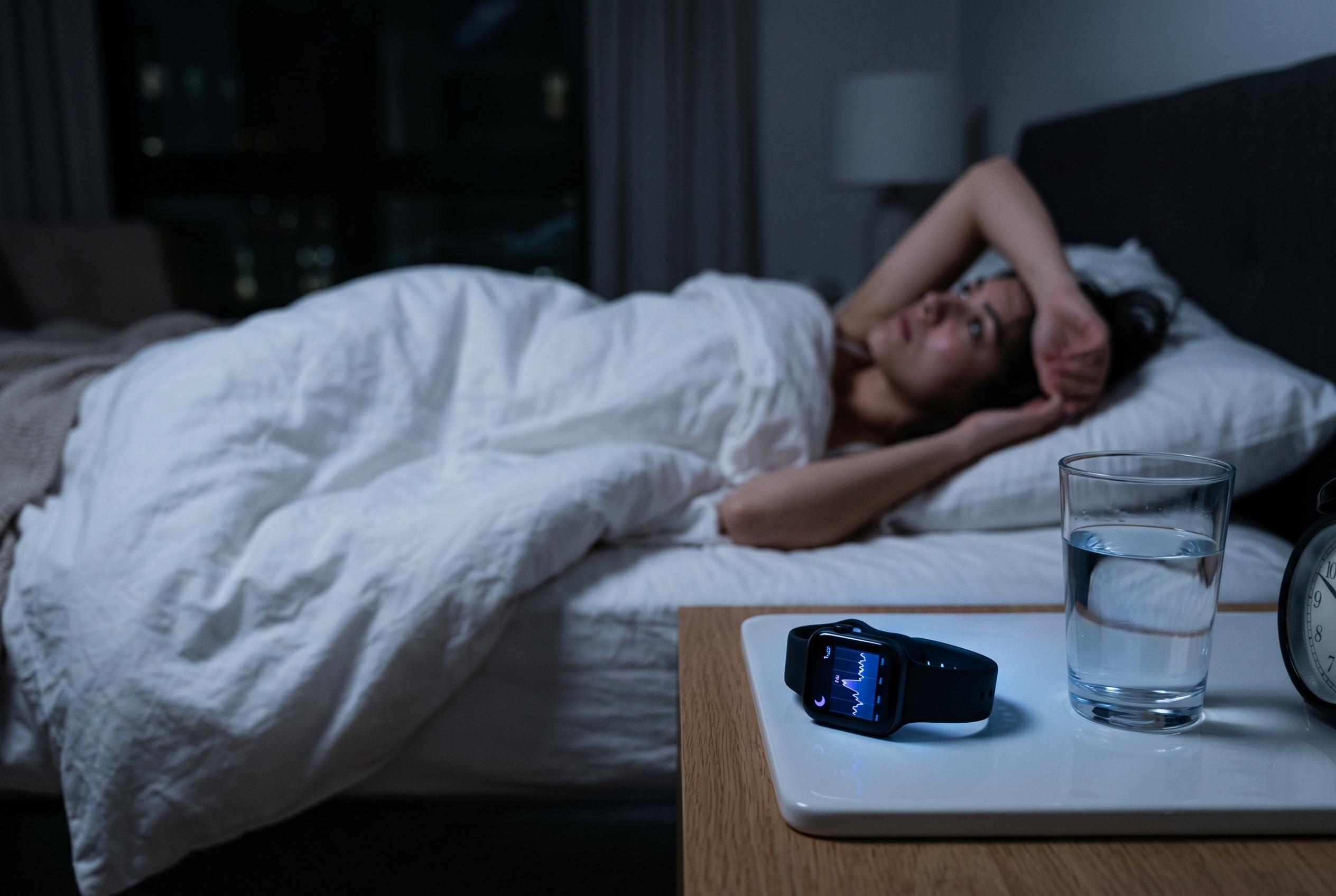

A systematic review highlights significant discrepancies between consumer sleep wearables and validated sleep assessments, raising questions about their reliability for diagnosing sleep disorders.
The latest evidence suggests that consumer sleep wearables are weakest precisely where insomnia medicine places the most weight: the sleeper’s own account. In a systematic review published in Sleep Medicine in August 2026, Narat Srivali of Duke University and Wisit Cheungpasitporn of Mayo Clinic found that wrist-worn devices had only poor to moderate agreement with validated patient-reported sleep measures, and said tracker data should complement, not replace, those assessments. (scholars.duke.edu)
Their review used PRISMA methods and searched PubMed/MEDLINE, Embase and the Cochrane Library through October 2025. Across five observational studies covering 2,006 adults, wearable metrics explained just 2.5 to 16.2 per cent of the variation in subjective sleep ratings. Total sleep time showed only a moderate same-day relationship with sleep diaries, at r = 0.367, while the devices did not capture Pittsburgh Sleep Quality Index scores. The authors rated the certainty of the evidence from low to moderate. (scholars.duke.edu)
The mismatch was most pronounced in the groups most likely to seek help. Good sleepers showed 82.4 per cent concordance between tracker output and reference measures, against 39.4 per cent in patients with insomnia. Even when compared with polysomnography, the clinical gold standard, the devices showed only fair agreement for sleep efficiency, which they overestimated by 1.75 to 7.9 per cent. Sleep-onset latency barely correlated at all, with r = 0.033, and wake after sleep onset was underestimated by 7 to 30 minutes. Older adults and other clinical populations also showed poor agreement. (scholars.duke.edu)
That pattern is consistent with how sleep specialists describe the technology itself. AP reported in January 2026 that watches, rings and similar consumer devices generally infer sleep from heart rate and motion signals rather than measuring sleep directly. Daniel Forger, a University of Michigan mathematician who studies sleep wearables, said the algorithms are highly accurate at determining when someone is asleep, but that laboratory studies remain more precise for separating stages. Mayo Clinic has long given similar advice, saying trackers are not reliable for distinguishing light from deep sleep and are especially weak at spotting periods of wakefulness during the night. Samuel Gurevich of Cleveland Clinic said many devices rely on a basic accelerometer, making them reasonably useful for estimating total sleep but far less dependable for “really granular data” about REM or deep sleep. (apnews.com)
Why this matters extends beyond research methods. AP said the US market for sleep-tracking devices generated about $5 billion in 2023 and, according to Grand View Research, could double by 2030. The Pittsburgh Post-Gazette reported in February 2025 that Ryan Soose, a UPMC sleep physician, was routinely seeing patients arrive with data from phones and wearables. Morehouse School of Medicine neurologist Chantale Branson told AP that these scores can show trends over time, but should not be mistaken for definitive judgements on a single night’s sleep. (apnews.com)
Used narrowly, the gadgets can still influence behaviour. AP profiled Kate Stoye, a middle-school teacher in Hiram, Georgia, who said her Oura Ring helped her notice that alcohol and late eating coincided with worse nights, leading her to stop drinking. Branson said people would often get more value from basic sleep hygiene – a calming bedtime routine, fewer screens and a comfortable sleep environment – than from dissecting each morning’s score. (apnews.com)
The same feedback loop can also backfire. AP described a New York user, Mai Barreneche, who became “obsessed” with nightly numbers, a pattern often referred to as orthosomnia. Branson said she sees similar anxiety in patients who compare REM totals with friends or chase arbitrary targets, even though sleep needs differ by age, genetics and other factors. Gurevich’s advice was blunt: if a tracker makes someone overly focused on the daily read-out, the numbers have stopped being helpful. (apnews.com)
The practical lesson from the new review is not that wearables are useless, but that they answer a narrower question than many buyers assume. They can be serviceable for tracking duration, regularity and the effect of habits over time. They are much less capable of explaining why someone wakes unrefreshed, or whether a sleep disorder is present. Mayo Clinic advises medical assessment when people struggle to fall or stay asleep, snore loudly, wake gasping, feel unrefreshed after a full night, develop morning headaches or are persistently sleepy by day. For those patients, a sleep diary and a clinician’s assessment remain more informative than a reassuring app score. (scholars.duke.edu)
Disclaimer: This content is intended for informational purposes only. Readers are advised to exercise their own judgement, conduct due diligence, or consult a qualified expert before acting on any information provided.