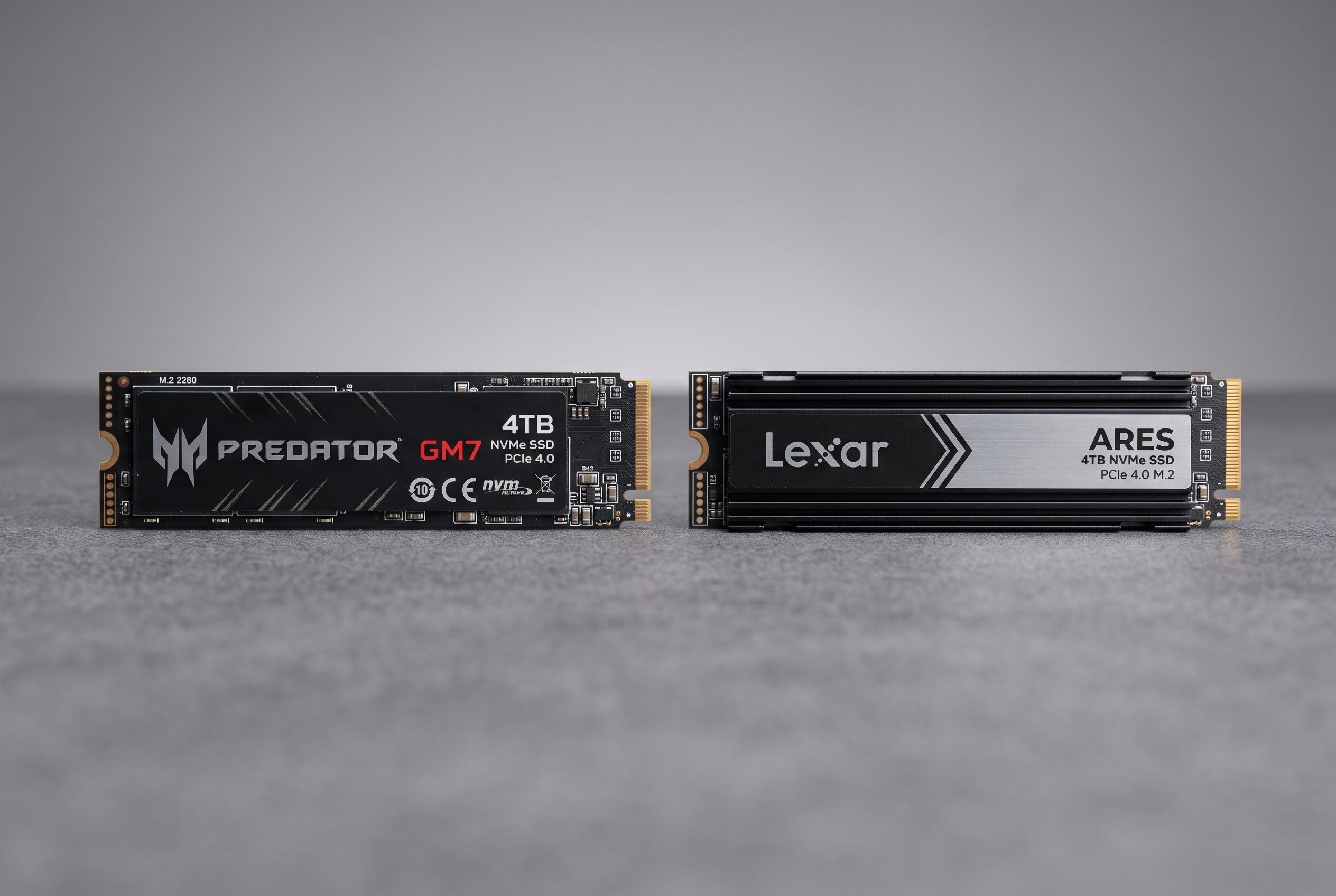

Acer’s Predator GM7 and Lexar’s ARES debut as high-capacity 4TB M.2 NVMe drives, offering peak speeds without requiring PCIe 5.0, catering to gamers, media creators, and power users seeking robust performance and endurance.
Acer’s Predator GM7 and Lexar’s ARES are two 4TB M.2 NVMe drives aimed at users who want high-capacity storage for gaming, media work and backups without moving to PCIe 5.0 hardware. Hardware Upgrade reported that both models are on offer in Italy, with the Lexar drive priced at €399.98 and the Acer model at €446.49. Both are positioned for desktops, laptops and PlayStation 5 use, provided the console installation includes suitable cooling.
The two drives are closely matched on paper. Acer says the Predator GM7 reaches up to 7,400 MB/s in sequential reads and 6,500 MB/s in writes, while its technical sheet also lists HMB, which allows the drive to use system memory instead of dedicated DRAM, and SLC cache support for sustained burst performance. Tom’s Hardware identified the Maxio MAP1602A controller in the GM7 and said the drive is compatible with PCs, laptops and PS5, though it noted that peak performance characteristics are typically associated with the smaller capacities.
Lexar’s ARES follows the same general design philosophy. According to Hardware Upgrade, it also uses PCIe 4.0 x4 and NVMe 2.0, with the same headline transfer speeds of 7,400 MB/s read and 6,500 MB/s write. The drive uses HMB 3.0 and dynamic SLC caching, and Lexar quotes up to 900,000 random read IOPS, 3,000 TBW of endurance and a mean time between failures of 1.5 million hours. Like the Acer model, it is intended for systems that can physically accept an M.2 2280 drive and manage heat properly.
The main difference is less about raw speed than about the small details that matter in practice: endurance, firmware tuning, flash configuration and price. Acer’s official materials list the GM7 with a 5-year warranty, while Tom’s Hardware reported 1,300 TBW for the 4TB model it reviewed. Acer’s product page and specification sheet also describe the drive as a general-purpose option for gaming and content creation, with thermal-management features that make it suitable for heavier workloads. For buyers choosing between the two, the decision may come down to whether the lower price of the Lexar drive outweighs Acer’s broader ecosystem and slightly different published specifications.
Disclaimer: This content is intended for informational purposes only. Readers are advised to exercise their own judgement, conduct due diligence, or consult a qualified expert before acting on any information provided.