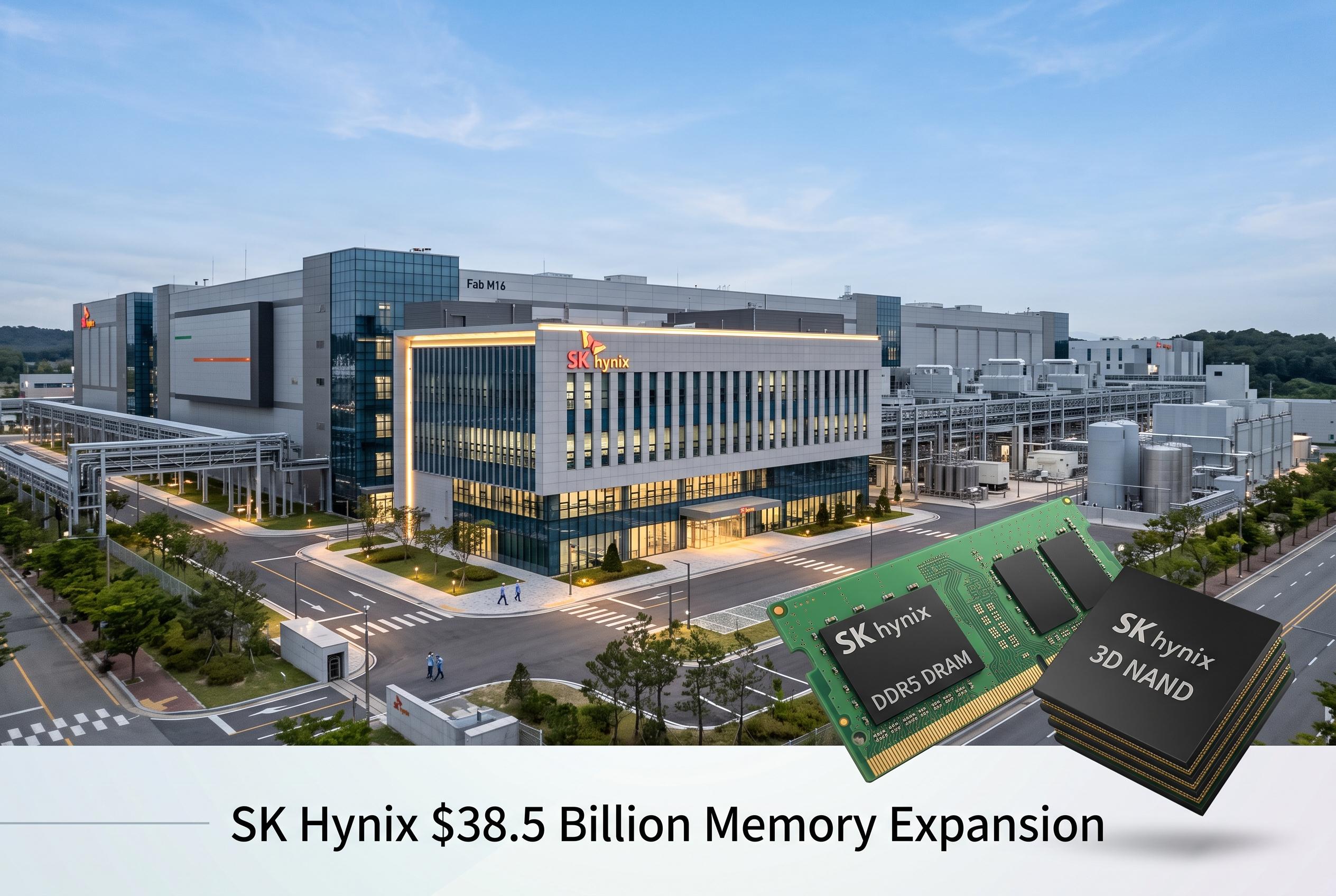

South Korean chipmaker SK Hynix plans a $38.5 billion expansion in DRAM and NAND manufacturing capacity, aiming to meet surging memory demand driven by AI growth, though new plants will not alleviate current shortages until 2028 or 2029.
SK Hynix is moving to expand its memory-chip manufacturing base with roughly $38.5 billion in new investment, a sign that the company expects demand for DRAM and NAND to stay elevated well into the decade. The South Korean chipmaker said it plans to build a new DRAM fabrication plant and a separate NAND facility, but the timetable means neither is likely to offer relief to the current supply squeeze before 2028 or 2029.
According to the company’s announcement, the DRAM plant will require KRW 35.2 trillion, or about $25 billion, and is expected to begin operations in June 2029. The NAND factory will cost KRW 19.1 trillion, or about $13.5 billion, and is scheduled to open in December 2028. SK Hynix said the additional capacity is meant to position it for a market it sees growing rapidly, especially as artificial intelligence drives heavier use of memory in data centres and other infrastructure.
The investment comes as memory makers face a broader shift in demand. SK Hynix cited Omdia research indicating that DRAM and NAND demand will grow at a compound annual rate of 19% from last year through 2030. The company said the ability to deliver chips in the right volume at the right time has become a competitive advantage, suggesting that supply discipline now matters as much as raw capacity. Even so, the long build-out means the new plants will not address near-term shortages.
Tom’s Hardware reported earlier this year that SK Hynix was also preparing major spending in other parts of its South Korean operations, including expansion at Cheongju and the Yongin Semiconductor Cluster, with the first DRAM fab there expected to start production in May 2027. The same report said the company was targeting more output for high-bandwidth memory, or HBM, the stacked memory used in AI servers. Separately, the company has approved a new advanced packaging and test plant dedicated to HBM, underlining how central AI has become to its strategy.
Other industry reports have pointed to further investment in next-generation manufacturing equipment and NAND capacity, reflecting a wider race among chipmakers to secure future supply. But the basic problem remains unchanged: these projects are designed for longer-term demand, not the immediate shortage that is already affecting buyers of servers and consumer electronics. If AI-related memory demand continues to outpace supply, SK Hynix’s latest spending may look less like an expansion and more like a necessary bid to stay ahead of a structural shift.
Disclaimer: This content is intended for informational purposes only. Readers are advised to exercise their own judgement, conduct due diligence, or consult a qualified expert before acting on any information provided.