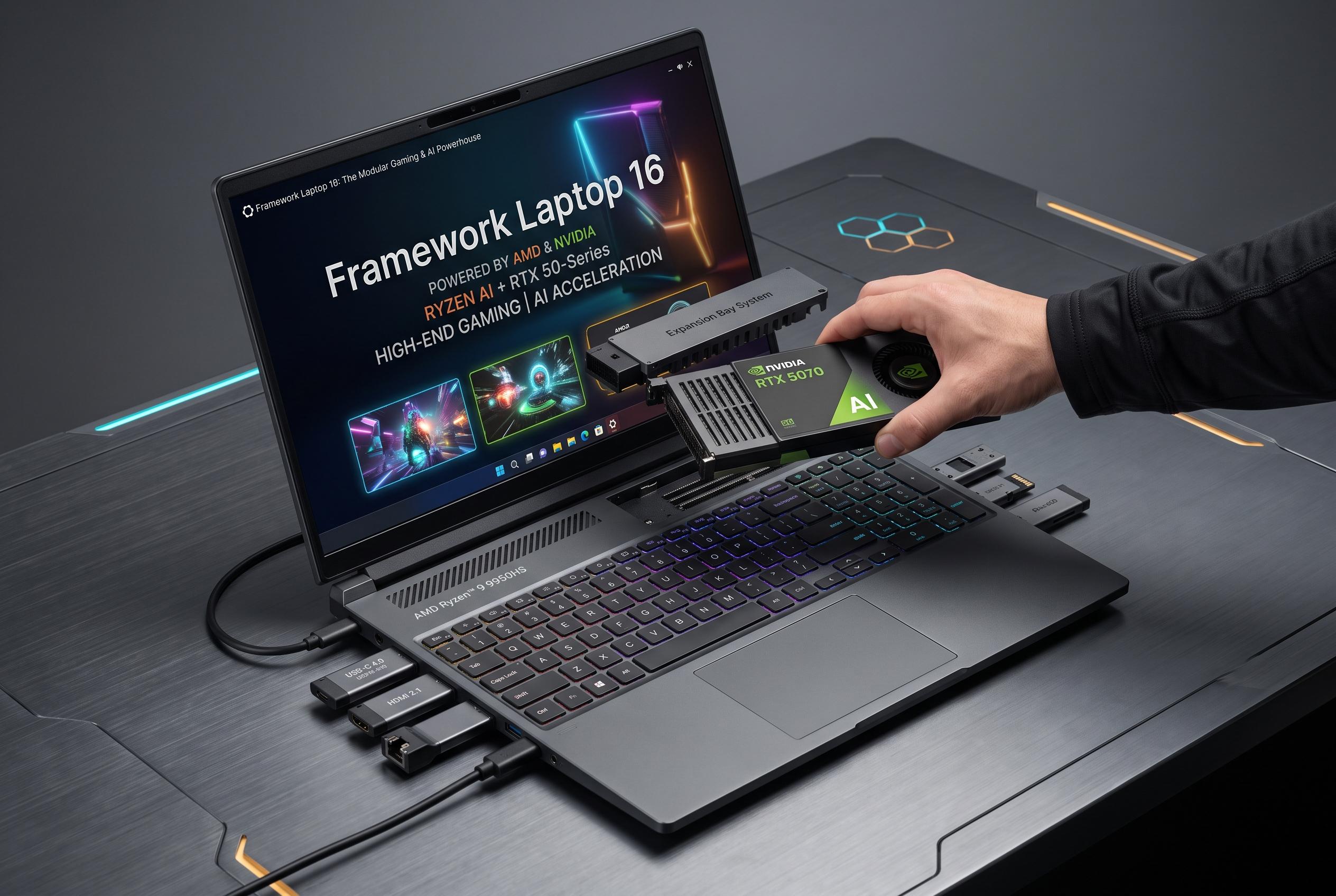

The Framework Laptop 16 of 2026 redefines the gaming and AI laptop market with its repairable, upgradeable design featuring powerful AMD and Nvidia components, though at a premium price.
Framework’s Laptop 16 remains one of the most unusual gaming notebooks on sale because it is built around replacement rather than disposal. In its 2026 form, the machine combines AMD’s Ryzen AI 9 HX 370 with Nvidia’s GeForce RTX 5070 Laptop GPU, a configuration that pushes the platform further into serious gaming, local AI work and creator tasks while keeping the core promise intact: nearly everything can be opened, swapped or upgraded by the owner.
That modularity is not a marketing flourish. The chassis is designed around separate systems for ports, input devices and graphics, so users can change the layout and the hardware without replacing the whole computer. Framework supplies the tools, publishes repair guides and sells individual parts, which puts it in a small category of its own at a time when most laptops are sealed, glued and soldered shut. The approach is expensive, but it is also the point.
The 2026 configuration tested by Frandroid pairs 32GB of DDR5 memory with a 2TB WD_Black SN7100 SSD and, crucially, a version of the RTX 5070 Laptop GPU fitted with 12GB of GDDR7 memory. That extra video memory matters. Compared with earlier 8GB versions of the same GPU, it gives the machine more room for demanding games, larger language models and generative AI workloads that quickly run into memory limits.
In use, the laptop keeps the Framework formula recognisable. The six Expansion Card slots let buyers choose their own mix of USB-C, USB-A, HDMI, DisplayPort, Ethernet, audio and storage options, while the magnetic input modules allow the keyboard, touchpad and spacers to be rearranged in seconds. Frandroid notes that the system feels more like assembling a configurable workstation than buying a fixed laptop. The trade-off is visible: the seams are obvious, and the design is not as visually seamless as premium unibody rivals. But that is the cost of making the machine genuinely serviceable.
Performance is strong across the board. Frandroid’s benchmarks put the Ryzen AI 9 HX 370 among the best mobile CPUs currently available, with especially impressive single-core results and steady sustained performance under load. The test unit held roughly 3.9GHz all-core clocks with very little throttling, while temperatures stayed controlled. Tom’s Hardware similarly found the RTX 5070 version capable of handling demanding workloads well, and PCWorld reported that the new GPU and CPU combination improves gaming performance by a meaningful margin over earlier models.
Gaming performance is where the 2026 machine becomes more interesting than a conventional mid-to-high-end laptop. Frandroid’s testing showed Cyberpunk 2077 running comfortably at the panel’s 2560 x 1600 native resolution in standard ultra settings, while ray tracing remained practical with DLSS enabled. With path tracing and Nvidia’s latest frame generation features, the laptop could push fluid frame rates in a mode that used to be confined to large desktop systems. That does not erase the usual caveat: frame generation can improve apparent smoothness, but input latency still follows the underlying rendered frames. For single-player play, the compromise is acceptable; for fast competitive gaming, less so.
The RTX 5070’s 12GB frame buffer also changes the machine’s appeal for local AI. Frandroid found that smaller and mid-sized language models run quickly on CUDA, while image, audio and short video generation are now realistic on a laptop that stays reasonably quiet under GPU-only load. The limitation is memory capacity, not raw speed. Once models grow beyond what fits into 12GB, performance drops sharply as the system spills into main memory. That is still useful, but it shows why 12GB is a pragmatic step rather than a cure-all.
Thermals and acoustics are well judged for the class. Under mixed CPU and GPU load, the fan noise becomes clearly audible, but not harsh, while lighter GPU work stays comparatively quiet. The keyboard area warms up, though it remains usable, and the machine’s rear extension for the graphics module is part of the cooling design rather than a flaw. Tom’s Hardware reported similarly that the laptop remains comfortable in sustained use, and Frandroid’s tests suggest Framework has learned how to give its hardware enough headroom without turning the chassis into a small turbine.
The real obstacle is price. Frandroid’s fully loaded test configuration cost €4,442, well above most laptops with similar graphics performance. PCWorld said the new model starts at $2,200 in the United States, while Tom’s Guide cited lower entry prices for other configurations, showing how much the final bill depends on how many modules and upgrades are chosen. That is the unavoidable tension with Framework’s idea: buyers pay a steep premium up front in exchange for repairability, long-term upgrade paths and the possibility of extending the machine’s useful life well beyond the normal laptop cycle.
For users who value those things, the Laptop 16 makes a stronger case in 2026 than ever. It is a gaming laptop, but it is also a repairable platform, a development machine and, increasingly, a local AI workstation. For everyone else, the cost will be hard to justify. Framework has built a product that solves real problems. It has not, however, made those problems cheap.
Disclaimer: This content is intended for informational purposes only. Readers are advised to exercise their own judgement, conduct due diligence, or consult a qualified expert before acting on any information provided.